
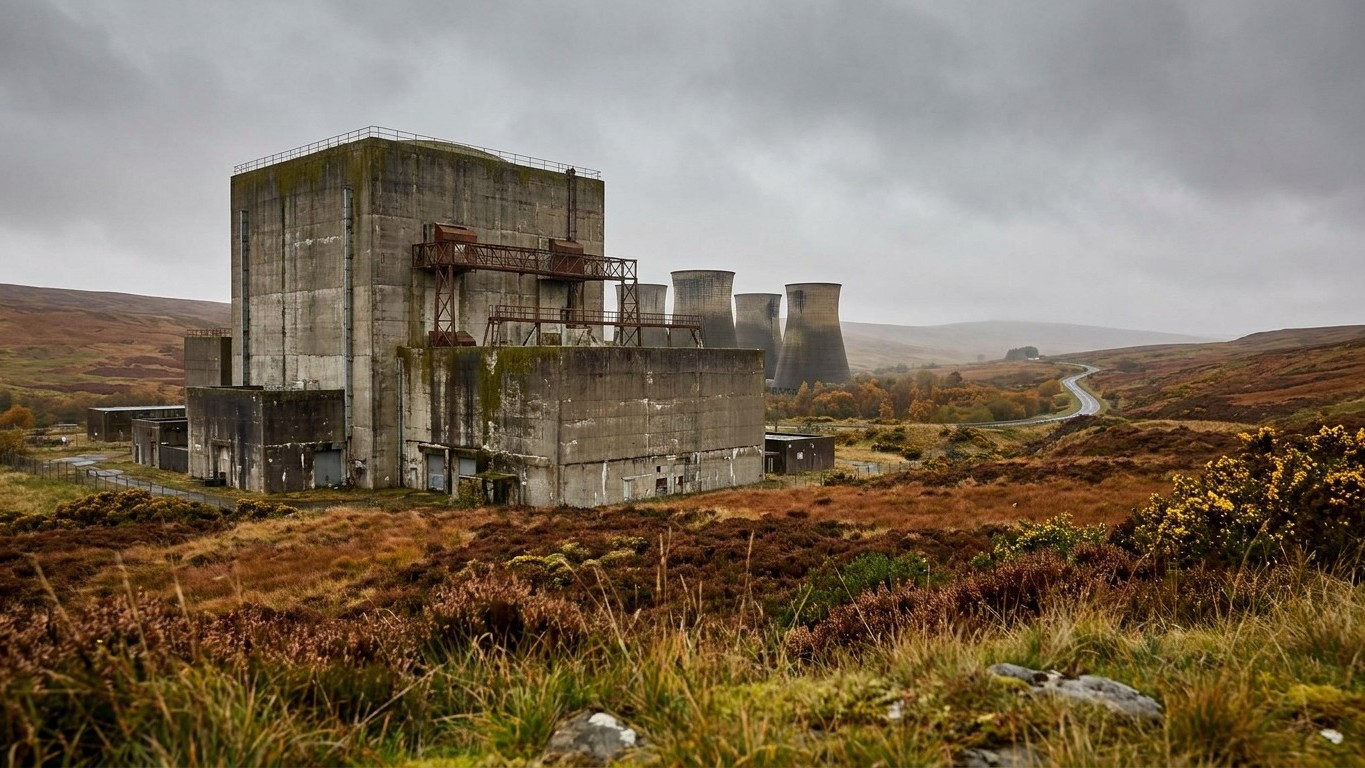
Fifty-five years. That is the time it has taken, at the very least, to erase a reactor that produced electricity for only one generation. The Brennilis nuclear plant, located in the Monts d’Arrée of Finistère, was shut down on July 31, 1985. It remains in the dismantling phase today, and the deadline that once seemed to be drawing nearer has once again shifted back, with completion now envisaged around 2040.
Key takeaways
- Why a nuclear prototype halted 55 years ago is still under construction?
- How have dismantling costs been multiplied by twenty over four decades?
- What lessons for the future dismantling of France’s 56 reactors?
A prototype that actually operated for twelve years
Brennilis was never a plant like any other. Built by the Commissariat à l’énergie atomique from 1962, the experimental EL4 reactor was an industrial electricity-production prototype that ran on lightly enriched uranium, moderated with heavy water and cooled by carbon dioxide, with a thermal power of 250 megawatts. On the production side, the alternator, rated at 75 megawatts electric, was connected to the grid in July 1967.
The operation lasted eighteen years, from 1967 to 1985, but the reactor’s actual run time was much more modest: the plant produced 6.235 TWh over 106,000 hours of operation, roughly twelve years. A modest record on the scale of France’s nuclear fleet, especially since the reactor was definitively shut down on July 31, 1985, after France chose another technological path. It is, in fact, the country’s very first power plant to have entered a dismantling process, which partly explains why almost everything had to be invented along the way.
A bill that exploded, again and again
The initial estimate produced in 1985 by the commission charged with evaluating the costs of France’s nascent nuclear fleet proved completely unrealistic. Twenty years later, the Court of Auditors estimated in 2005 the dismantling cost at 482 million euros, twenty times the commission PEON’s initial projection. An already dizzying drift for a reactor producing barely 75 MW of electric power.
The project did not stop there. In 2021, the total dismantling cost was revaluated to 850 million euros, of which 40% accounted for the reactor block alone, far more than initially planned. EDF justified this renewed surge by repeated stoppages: excluding inflation, the increase reaches 30%, explained by operating costs during work interruptions, between 2008 and 2012 following the annulment of the decree for complete dismantling, and between 2019 and 2023. Each year of administrative blockage carried a real cost, ultimately borne by taxpayers and users through EDF’s provisions.
A three-act project, full of obstacles
The Brennilis dismantling unfolded in stages, rarely in a straight line. The first two phases, corresponding to partial dismantling, were completed relatively quickly: the initial two phases of partial dismantling were finished by 2005, twenty years after the reactor’s shutdown. The real puzzle began thereafter, with the legal annulment of the decree authorizing full dismantling, which froze the project for several years.
It took until 2018 for EDF to file a new, colossal dossier: the operator submitted to the Nuclear Safety Authority a complete dismantling file in July 2018, whose 3,000 pages were reviewed over several years. The green light arrived only five years later. On September 26, 2023, the site obtained the decree for complete dismantling, signed by the Minister of Energy Transition, which allows the dismantling of the reactor block, the decontamination of the civil engineering, the demolition of the reactor containment, and the site’s final rehabilitation. This final stretch is no sprint: it opens a fifteen-year phase for this project, a unique case in France. A deadline that, added to the delays accumulated, now pushes the overall completion to 2040, whereas earlier schedules still spoke of 2035.
Why heavy water changes the entire equation
It is impossible to compare Brennilis with the 56 pressurized-water reactors that make up today’s EDF fleet. The site hosts a heavy-water reactor, the only model of its kind in France, the oldest in EDF’s fleet and the first to be dismantled. France turned away from this technology in the 1970s in favor of light-water reactors, so this prototype found itself isolated in national industrial history, a peculiarity that limits its transferability and complicates the use of procedures already proven elsewhere. Each operation had to be designed on a case-by-case basis, with no usable experience to draw on.
The physical layout of the reactor block doesn’t help either. This unique French prototype sits inside a concrete cube measuring 20 meters on each side and 1.5 meters thick, inside which the dismantling equipment is tightly nested in a very confined space. Cutting, extracting, and conditioning tons of irradiated materials in such a tight volume is more like precision surgery than a conventional demolition project. The Court of Auditors, tracking the file for two decades, highlighted as early as 2005 the scale of the financial overshoot, and subsequent decades have not managed to curb it.
The Breton case is not incidental for the future of French nuclear power. EDF now estimates the deconstruction cost of standard reactors in the current fleet at between 350 and 400 million euros per unit, installations that are far more powerful than Brennilis’s small prototype. Yet these reactors, built in series, will benefit from shared procedures that Brennilis had to invent one by one. The question raised by this Breton project goes far beyond the Monts d’Arrée: it concerns the dozens of reactors that will need to be dismantled in the coming decades.
Sources: contreinfo.info | dailygeekshow.com
