
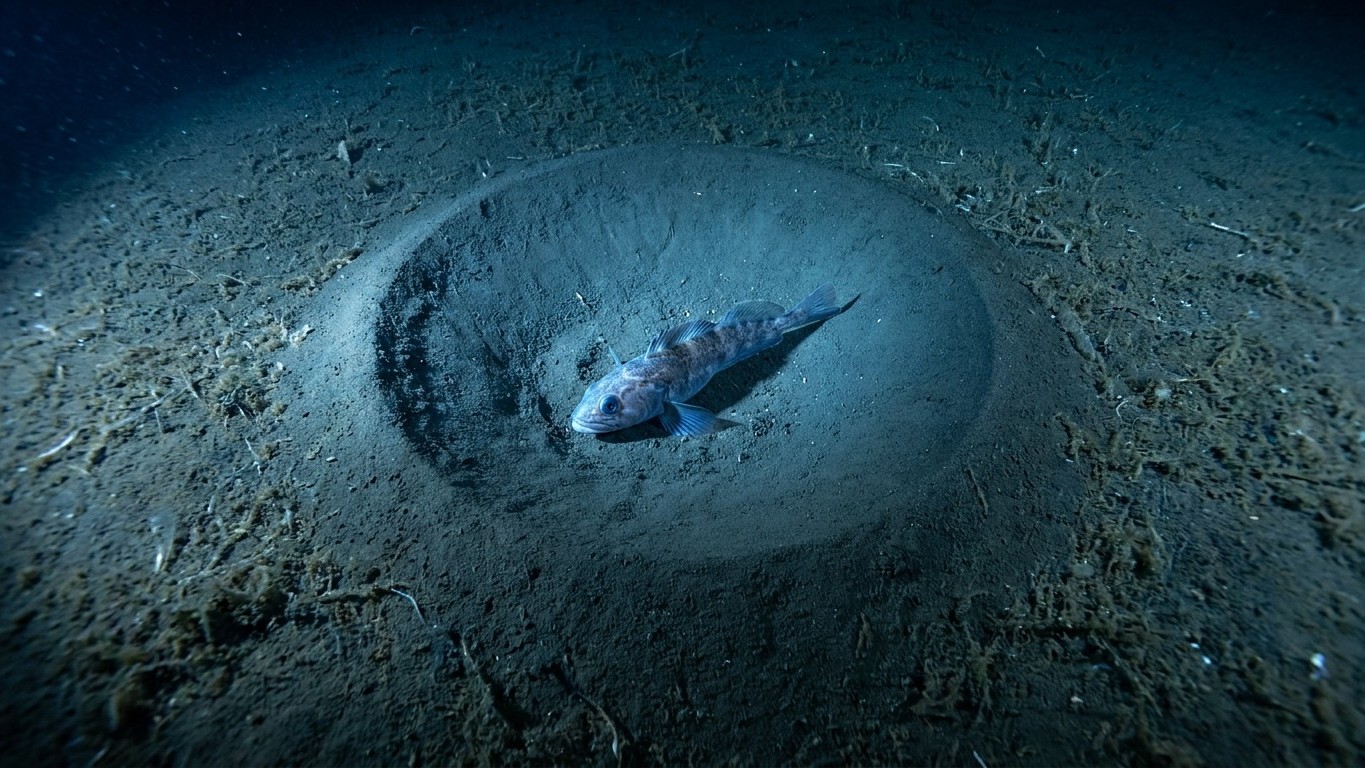
A colony of more than a thousand nests perfectly aligned along the seabed, each watched by a motionless fish. This is what underwater cameras deployed to locate the Endurance wreck — Sir Ernest Shackleton’s ship lost in the ice of the Weddell Sea in 1915 — captured. Nobody was looking for fish that day. And yet, it might be the most fascinating discovery of the entire expedition.
Key takeaways
- A giant colony of nests discovered by accident at the bottom of the Weddell Sea
- Polar fish display a social organization never documented before
- Thousands of individuals deploy a sophisticated group strategy in a hostile environment
A Wreck Found After a Century of Waiting
The story begins in November 1915. The Endurance became trapped in the pack ice and eventually sank in the Weddell Sea, off Antarctica. For more than a century, the wooden vessel remained invisible, buried under 3,000 meters of icy water in one of the planet’s most hostile seas. Several attempts failed, hindered by an ice floe so dense that it had already swallowed an autonomous underwater vehicle during a previous expedition.
On March 5, 2022, the Endurance22 expedition team finally located the wreck. The shipwreck of the Endurance was discovered on March 5, 2022, about 107 years after it sank, at a depth of 3,008 meters, in a state of preservation described as remarkable. The footage captured that day shows a vessel standing upright, lifted off the seabed, with its name still perfectly legible on the stern. The most striking feature remains its name, ENDURANCE, arched on the stern with pristine clarity, crowned by the five-point Polaris star. A shot almost identical to those taken by the expedition photographer more than a century earlier.
But finding this ship was not a matter of luck alone. The search stretched over several years and multiple campaigns, with the same support vessel, the South African icebreaker SA Agulhas II, sent to scour these waters on two occasions. And it was precisely during one of these preparatory campaigns, when the ice had already dashed hopes of locating the wreck that year, that the real unexpected catch occurred, at the seabed, far from any trace of wood or metal.
A Nursery No One Expected
Heading west of the Weddell Sea, an area long covered by a 200-meter-thick ice shelf. The calving of iceberg A68, which measured 5,800 square kilometers, from the Larsen C ice shelf in 2017, opened unprecedented access to this portion of the seabed. It was here that the remotely operated vehicle nicknamed Lassie, deployed to scan the sediment for clues about the wreck, filmed something abnormal: hundreds of circular depressions, clearly outlined in the sand, devoid of the layer of plankton debris that covers the rest of the seabed.
As the craft scanned the seabed, wide hollows appeared in the sand, noticeably cleaner than their surroundings, free of the decomposing plankton layer observed elsewhere. Reviewing the footage afterwards, researchers noticed something else: fish and larvae living in each of these depressions. A closer look revealed it to be a species of rockcod named Lindbergichthys nudifrons, known as the yellow-fin notie.
The figure is dizzying for an environment long considered nearly sterile: a remotely operated vehicle exploring the seabed revealed more than 1,000 circular nests, each cleared of the plankton layer covering the surrounding areas. According to precise data reported by the scientific team, the colony totals exactly 1,036 nests, each watched by a motionless adult guarding its clutch. A polar fish nursery, hidden under the ice for generations, revealed by robots that had come to look for a sunken stack of timber.
The Mystery of the ‘Selfish Pack’
What intrigues biologists most is not only the number of nests, but their arrangement. Some nests are isolated, others arranged in curves, others still clustered in dense aggregates. Nothing random in this geometry. The dense clusters illustrate the theory of the “selfish herd” in action: individuals at the center of the group benefit from enhanced protection, sheltered by their neighbors. The solitary nests on the periphery would be occupied by larger and stronger individuals, better able to defend their territory.
Each fish chooses its place according to its standing in relation to the environment, a social behavior once associated more with seabirds or gregarious mammals, not with a solitary little rockcod living at temperatures at minus two degrees. This behavior marks the first documented nest-guarding society for Lindbergichthys nudifrons, an endemic species thriving at -1.9°C. A discovery published in October 2025 that somewhat challenges the image of a frozen Southern Ocean, sterile and poor in organized life.
The species is found from the Antarctic Peninsula to South Georgia, in the Atlantic portion of the Southern Ocean. This suggests that other similar colonies, just as vast, may still lie under the ice, never filmed, never counted. The next wreck a robot will search for in these waters may intersect with a city of fish that expected no one.
Sources: laughingsquid.com | phys.org
