
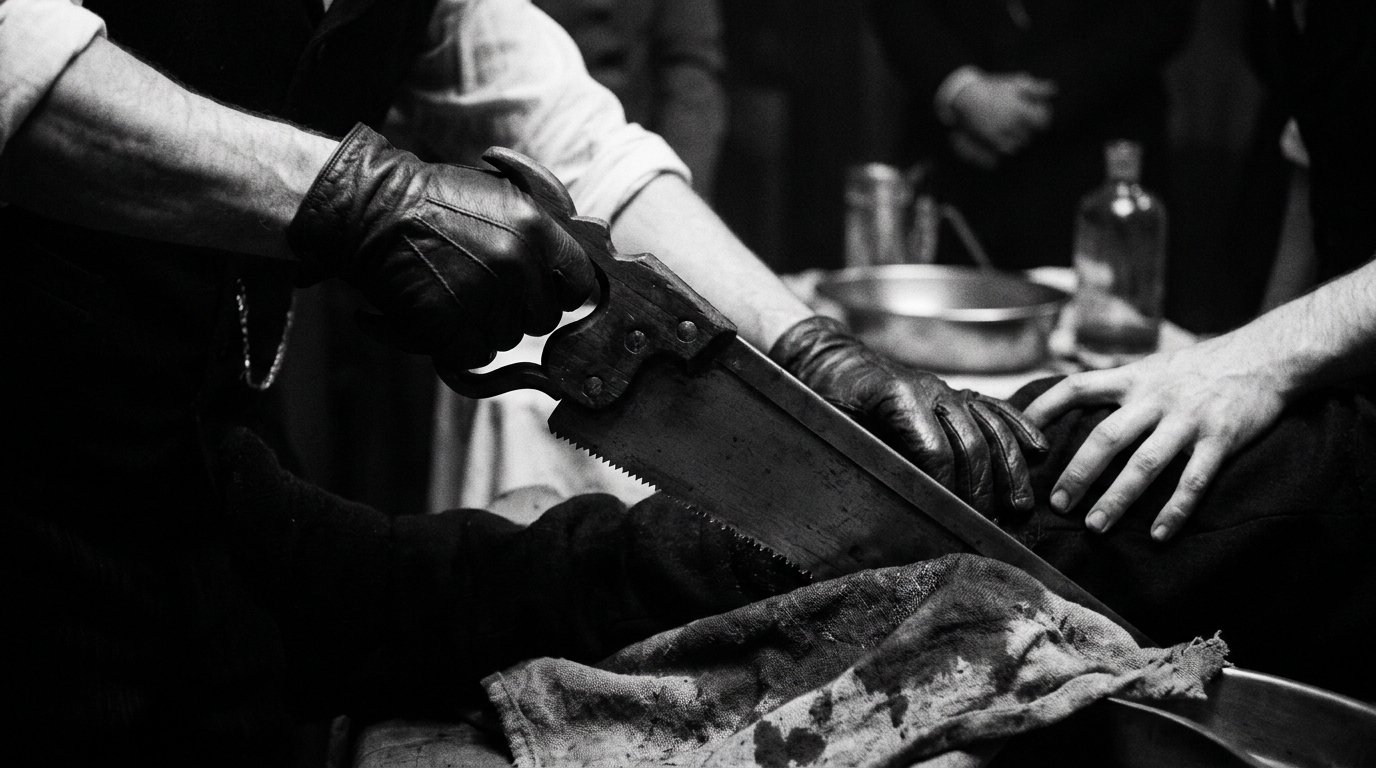
In the early 19th century, stepping into an operating theater was less about soothing care and more about a physical ordeal. The patient remained conscious, pain could trigger a violent shock, and assistants sometimes had to restrain them by force. In this medical world where every second counted, a Scottish surgeon based in London distinguished himself by a quality that became almost terrifying: his speed.
Robert Liston could remove a leg in under half a minute during his swiftest procedures. This feat, spectacular even for his era, earned him considerable renown. But it is also linked to a macabre anecdote, often summarized by a striking formula: the only operation with a 300 percent mortality rate. Behind this tale, of which some details remain uncertain, lies above all the brutal reality of surgery before modern anesthesia.
28 seconds to save a life, sometimes at the price of a tragedy
Before the widespread adoption of anesthesia, an amputation was not merely a technical act. It was a race against pain, bleeding, and the patient’s exhaustion. A surgeon who was too slow risked seeing his patient slip into shock, lose too much blood, or thrash with such violence that the procedure became impossible. Speed therefore was not simply a virtuoso display: it could spell the difference between a chance of survival and an immediate catastrophe.
In London hospitals, Liston was known for lightning-fast amputations. A leg could be removed in roughly two and a half minutes, with a record commonly cited at 28 seconds. In front of a gallery of spectators, he would allegedly cry out: “Time me, gentlemen!” This theatrics matched his energetic temperament, but also reflected a medical conviction: moving quickly helped reduce part of the immediate risks.
Robert Liston, the surgeon who made speed into a weapon
Robert Liston was no ordinary practitioner. Trained in Scotland and then a major figure in London surgery, he was regarded as one of the most skilled operators of his time. His nickname, the “fastest knife in the West End”, sums up the image he left: a man with a direct, confident, and fearfully efficient gesture.
Calling Liston the “best surgeon in Europe” should be understood as reflecting an exceptional reputation, not as a scientific ranking in today’s sense. His edge did not rest solely on speed. He boasted a mortality rate markedly lower than many peers, around one death in ten according to figures often associated with his practice, compared with about one in four elsewhere. Notably, he already emphasized cleanliness: washing hands and instruments, clean aprons, shaving the operative area. Basic gestures today, but far from universal in his era.
Before anesthesia, the operating room looked more like a test of strength
It would be misleading to picture a nineteenth-century operating theater as the direct ancestor of today’s hospital rooms. Operations were often conducted before an audience of students and curious onlookers. Instruments were metallic, reused, and knowledge about microbes remained very limited. Surgeons knew wounds could become infected, but they largely did not understand the role of bacteria or effective ways to combat them.
The dangers were manifold: bleeding, gangrene, postoperative infection, and shock caused by pain. In this context, speed followed a terrible yet rational logic. The longer a patient remained conscious under the knife, the more their body endured extreme suffering. The emergence of ether as a surgical anesthetic, in the mid-19th century, upended this relationship with time. The surgeon could finally operate on a patient asleep, without turning the intervention into a desperate struggle.
Three deaths for one amputation: the legend of the 300% mortality rate
The episode most associated with Liston tells of an amputation performed with extreme haste, during which he allegedly severed his assistant’s fingers. The patient and the assistant would then have died from an infection, in a time before antibiotics. A third man, present among the spectators, allegedly believed the knife had struck him after the blade pierced his clothing. Panicked, he is said to have collapsed from shock.
It is from this tale that the expression “the 300% mortality rate” was born: three deaths for a single operation. But this figure should be handled with caution. The assistant’s injury is usually considered the most plausible part of the story; the spectator’s death belongs more to medical legend, lacking solid historical proof. It is therefore not a real medical statistic, but a striking image of the potential violence of surgeries of the era.
Liston’s lightning gesture and what anesthesia truly changed
The Liston paradox is fascinating. A man revered for his ability to save patients rapidly, he is also remembered for a tale where speed seems to have led to disaster. Yet reducing his career to this anecdote would be unfair. He also contributed to ushering surgery into a new era by early adopting ether as an anesthetic in Europe.
Anesthesia did not eliminate all dangers: infections continued to kill many operated on until advances in antisepsis, then asepsis, reduced their impact. But it changed the essential: the patient no longer had to endure the agony of the procedure while fully conscious, and the surgeon could prioritize precision over speed alone. Liston’s story thus reminds us how modern medicine rests on often quiet advances, such as hygiene, pain control, and infection prevention. His blazing scalpel belongs to the past; the question it raises remains relevant: how fast should technique go to heal better?
