
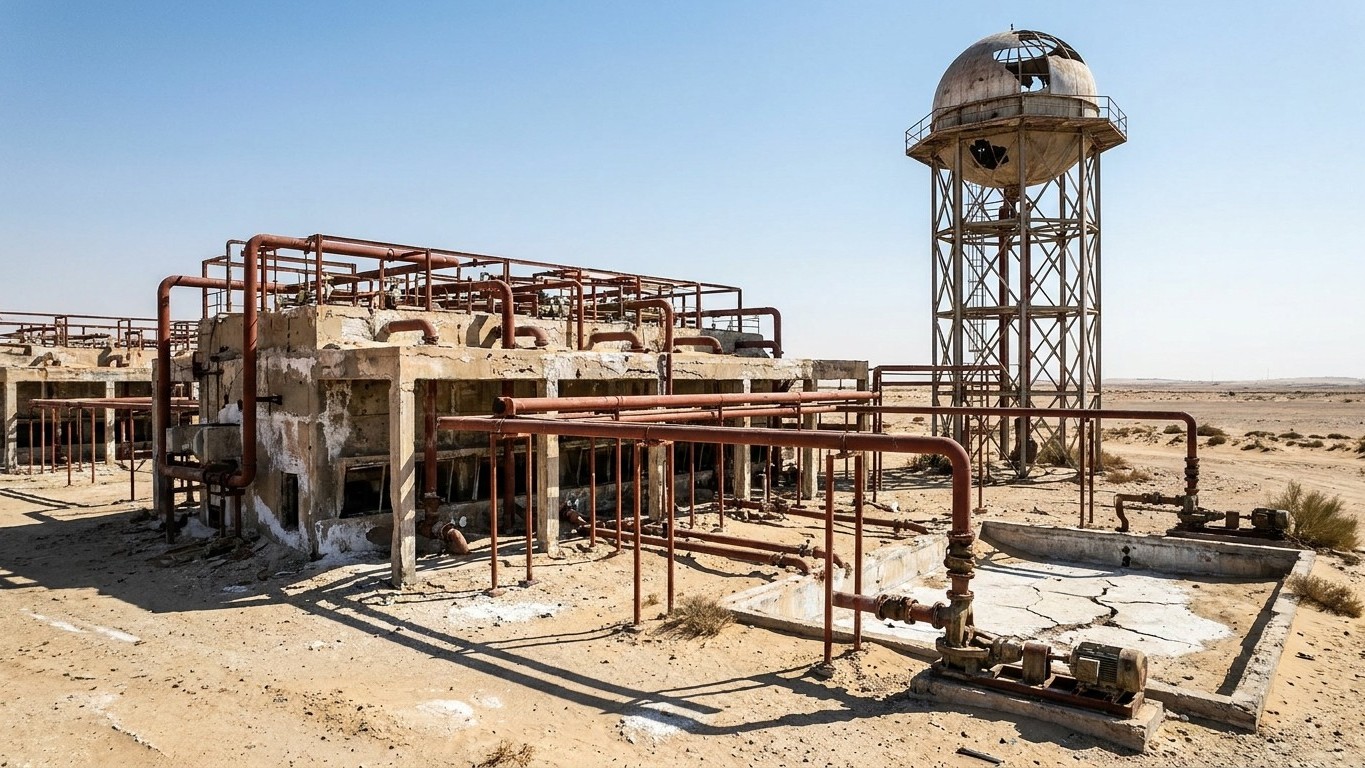
Forty-five million dollars. A brand-new plant, sprung from the ground in 2011 in one of the planet’s most arid landscapes. And fifteen years later, still not a single drop of treated water. In the Atacama Desert, in northern Chile, this desalination facility rusts quietly, its exposed pipes baked by sun and salt, a symbol of a waste the region can no longer afford.
The setting renders the scene almost absurd. This desert is classified as the driest non-polar region on Earth, with annual rainfall reduced to a few millimeters and some places where humans have never recorded any precipitation. Yet more than a million people live there, caught between the nearby Pacific Ocean and parched aquifers. Building a plant capable of turning seawater into drinking water in such a context did not seem extravagant on paper. It has even become the norm in the region: the country now counts dozens of such sites either in operation or in the pipeline.
Key takeaways
- A high-tech installation meant to bring water to an arid region remains hopelessly silent since its construction
- Around it, other desalination plants are operating and transforming entire cities — so why did this one stop?
- The true culprits behind this waste reveal the invisible flaws that sabotage even the best infrastructure projects
A desert that has nevertheless learned to drink the ocean
What makes the story of this phantom plant even more striking is that it is not isolated in a desert of technology. All around, Chile has multiplied successes. The Antofagasta region, neighboring the Atacama, hosts 13 desalination plants serving various sectors, while Atacama itself counts five. Since 2025, the city of Antofagasta has become the first large Chilean city to depend entirely on desalinated seawater, a system delivering more than 1,400 litres per second. A few hundred kilometers away, the Planta Desaladora de Atacama, commissioned in 2021, now supplies drinking water to several municipalities in the region and claims the title of the largest plant of this kind dedicated to human consumption in Chile.
The mining sector has not stood on the sidelines. In the face of aquifer depletion, giants like BHP or Antofagasta Minerals have invested heavily: for example, the latter opened in 2024 a desalination plant worth more than two billion dollars for its flagship Los Pelambres mine. The copper industry, which accounts for more than half of Chile’s exports, is now betting heavily on this technology to continue extracting ore without further drying up the region’s scarce freshwater reserves.
So why did this plant never run?
The question bears asking frankly: how can an investment of this magnitude remain a dead letter for more than a decade, in a country that has demonstrated mastery of this technology? Chilean desalination projects regularly confront three recurring obstacles, and this plant appears to have accumulated difficulties rather than avoided any of them.
The first lies with environmental procedures. Another major Chilean desalination project, the ENAPAC complex in the Antofagasta region, a one-billion-dollar investment for the mining sector, found itself subjected to judicial scrutiny that blocked progress for years. This kind of blockage is not exceptional: environmental permits for seawater intakes, pipelines crossing sensitive coastal zones, or brine discharge are subject to near-systematic disputes.
The second obstacle is financial. A complete desalination plant, with its pipelines and maintenance, can cost up to about two billion dollars for the largest mining installations. Even at the more modest scale of 45 million dollars, the financial structuring of a project can collapse if a industrial partner pulls out, if the initially projected water demand does not materialize, or if the promised electrical connection is never delivered. A desalination plant, let us recall, is costly to build and energy-intensive, making each installation dependent on a reliable power grid, still scarce in some pockets of the desert.
The third factor, less conspicuous but equally decisive, concerns the governance of public projects. Chile has experienced, in the water sector as in other infrastructure, cases where the award of contracts to consortia was not followed through due to a lack of institutional follow-up or political continuity between successive regional administrations.
The paradox of a country that lacks water while letting it rust
The irony is brutal. While this structure wears away under the sun, Chilean drought worsens year after year. The country is traversing what several experts describe as a megadrought for more than a decade, and some cities in the region have not seen a single drop of rain in more than ten years. Faced with this urgency, the state has shifted course: a recent law now authorizes the Ministry of Public Works to build or directly grant desalination plants intended for human consumption, with announced investments surpassing 500 million dollars for certain regions.
This legislative turn signals a tardy recognition. After years in which desalination was almost exclusively reserved for copper mines, drinking water for local populations is finally becoming a budget priority. But every plant left to rust represents a loss of trust: local communities, already wary of large industrial projects, remember the image of an abandoned construction site more than the promise of providential water.
This carcass of concrete and steel, corroded and broken, is therefore not merely a tourist curiosity for enthusiasts of post-industrial landscapes. It serves as a reminder that beyond technical prowess, each desalination plant remains suspended by a fragile triad of budget, politics, and environmental considerations. In a desert where water is worth its weight in gold, letting 45 million dollars’ worth of piping lie dormant is not merely waste: it is a real-time lesson in everything that can derail a project meant to save a region from thirst.
Sources : teamfrance-export.fr | pmc.ncbi.nlm.nih.gov | cqegheiulaval.com
