
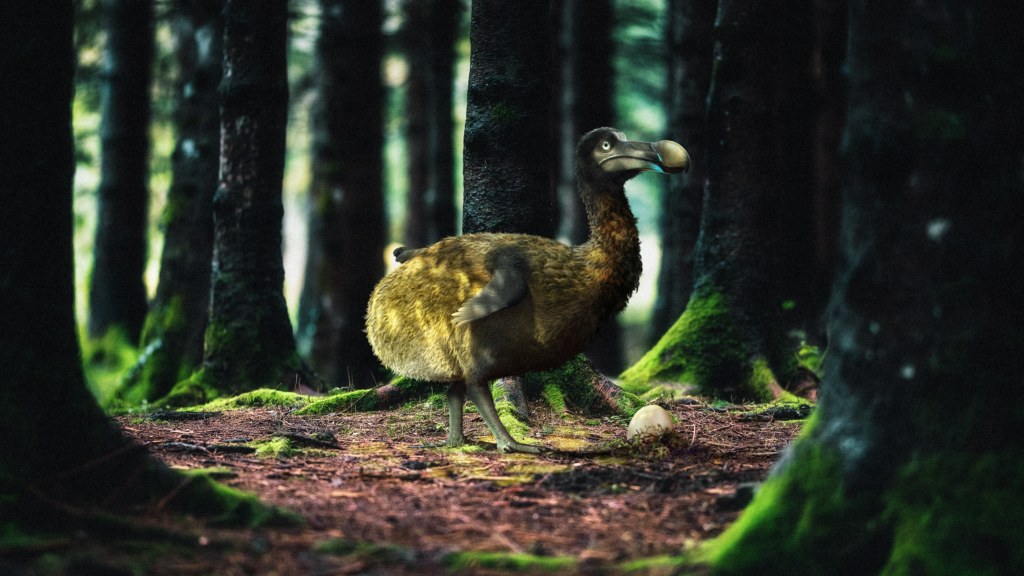
There are only two complete dodo skulls known worldwide, an endemic Mauritian animal that vanished at the end of the 17th century. Thanks to the digitization of one of these skulls, researchers have managed to virtually reconstruct its brain. However, the animal displayed characteristics more intricate than previously imagined.
A rare specimen scanned with a CT scanner
For reference, the dodo (Raphus cucullatus) was a flightless bird whose extinction dates back to the late 17th century, due to human activities. Over time, this animal became a symbol of species extinction caused by humans. Endemic to Mauritius in the Indian Ocean, the dodo stood about one meter tall and weighed between 10 and 20 kg. It had a massive body, a greyish plumage, small atrophied wings, and a large hooked beak.
Today, research on the dodo relies on very rare specimens. Indeed, only two complete skulls exist, one housed at the Oxford University Museum of Natural History (United Kingdom) and the other at the Natural History Museum of Copenhagen (Denmark). The Danish specimen has been recently analyzed with a high-resolution CT scanner, as reported in a publication in the Zoological Journal of the Linnean Society on August 5, 2026.
The procedure, performed with care not to damage the fossil, made it possible to carry out a highly precise 3D reconstruction of the skull’s interior and thus of the cavity that once housed the brain. Although brain tissues have obviously disappeared, they nonetheless left traces on the skull’s inner walls. This enabled paleontologists to virtually materialize the brain’s volume and to shed light on certain characteristics.
The dodo’s complexity finally revealed
In fact, the 3D scans allowed researchers to realize the dodo’s unsuspected complexity. According to the study’s authors, the bird’s brain size relative to its body was perfectly proportional to that of modern pigeons. Yet, given that pigeons are birds with excellent memory and recognized learning abilities, the dodo presumably possessed an intelligence quite normal for a bird of its lineage.
Furthermore, unlike the majority of modern birds that rely heavily on sight, the dodo featured exceptionally large olfactory bulbs. These bulbs were four times larger than those of the Nicobar pigeon, its closest living relative. Thus, the dodo could easily identify its food—fruits fallen to the ground, tiny invertebrates—in Mauritius’s dense forests. Let us also mention its beak, whose models revealed a complex network of neural and vascular channels. Hence, this beak was not only used to crack seeds or catch small prey. Indeed, it was a highly sensitive organ with which the animal explored its surroundings on the ground by touch.
Finally, the most surprising discovery of this study concerns the dodo’s brain’s visual area. Indeed, the scanners showed that its optic lobes were abnormally small, a morphology approaching that of nocturnal birds such as the kiwi or kakapo. For scientists, the dodo was certainly active at dawn, at dusk, and possibly during the night. It seems this rhythm allowed the dodo to avoid direct food competition with certain animals like giant tortoises, which shared the same diet and were active during the day.
