
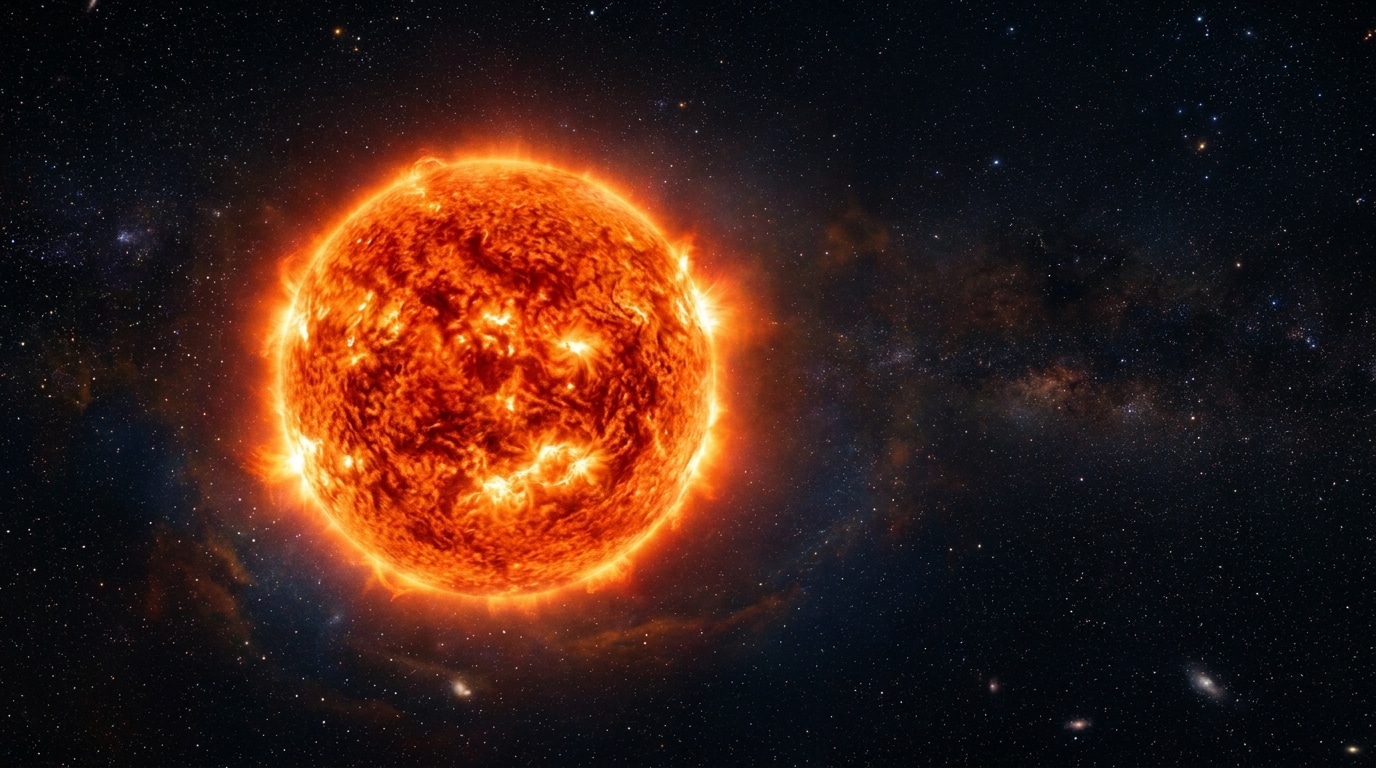
A cosmic red giant, in astronomy, designates a galaxy already rich in old stars, whose glowing red light betrays a long history. Yet the James Webb Space Telescope has just spotted one where it should never have appeared: at the dawn of the cosmos, when the Universe was only a few hundred million years old. A discovery that unsettles our certainties.
A red signal from the dawn of the cosmos that should never have existed
The galaxy bears a rather unpoetic name: EGS-z11-R0. It sits at a redshift of around 11.45. Translation for non-specialists: its light has traveled for more than thirteen billion years before reaching our instruments. We therefore see it as it was in the Universe’s early youth.
The redshift is this stretching of light caused by the expansion of the cosmos. The higher it is, the farther away and older the object. At such a level, we literally dive into the first moments of cosmic history.
What makes this galaxy so special is its color. At such distances, galaxies usually display a very blue hue, a sign of youth and newly formed stars. EGS-z11-R0, however, leans toward red. A signal that, normally, indicates a mature stellar population.
How the James Webb uncovered this anomaly billions of light-years away
Since its commissioning, the JWST has continually pushed the boundaries of what we can observe. It has already identified hundreds of galaxies with a redshift above 8, and around twenty beyond 10. Of these, fourteen have been confirmed by spectroscopy, the most rigorous method for validating a distance.
To gauge the scale of this feat, a reminder is in order. Before Webb, the farthest known galaxy was GN-z11, spotted by Hubble at a redshift of about 11.09. The current champion peaks at nearly 14.44, thanks to a survey with the evocative name: “ Mirage or Miracle ”. The old Hubble telescope now seems rather modest.
EGS-z11-R0 is part of this exceptional harvest. But it holds a title of its own: that of the most distant red galaxy ever identified. A distinction that is far from trivial, as we will see.
An “adult” galaxy in a Universe still in its infancy: the astrophysicists’ puzzle
Here’s the core of the problem. EGS-z11-R0 would display a stellar mass between 1.6 and 4 billion solar masses. In other words, the equivalent of several billions of suns already gathered, at a time when the cosmos had just begun to form.
Its star formation rate hovers around 10 to 40 solar masses per year. But more importantly, the data suggest a history of sustained and steady growth, not a brief fireworks display. This galaxy built its mass patiently, as if it already had a long past behind it.
The paradox is striking. According to classical scenarios, a galaxy so massive and evolved would take several billions of years to accumulate. Yet, it already existed when the Universe had only a few hundred million years. It’s akin to meeting a fully grown adult in a maternity ward.
What this red giant forces us to rethink about the origins of the Universe
This discovery is not an isolated case. The abundance of luminous and massive galaxies detected beyond a redshift of 10 easily exceeds theoretical predictions. A growing tension is taking shape between what we observe and what our models anticipated.
Two paths then emerge. Either the standard cosmological model itself has flaws, or our understanding of the astrophysics of the primordial Universe remains incomplete. Several hypotheses point to an abnormally high efficiency of star formation in these early cosmic ages.
In both cases, the message is clear: the young Universe knew how to forge massive structures far faster than we had imagined. The mechanism remains to be clarified, but the fact, itself, stands before us.
EGS-z11-R0 is therefore not merely another curiosity in Webb’s catalog. It embodies a crack in our certainties, an invitation to revisit the foundations of modern cosmology. And if the primitive Universe had been much earlier, much more fertile than our equations supposed? The answer may lie in upcoming observations. One thing is certain: the cosmos has not finished surprising us.
