
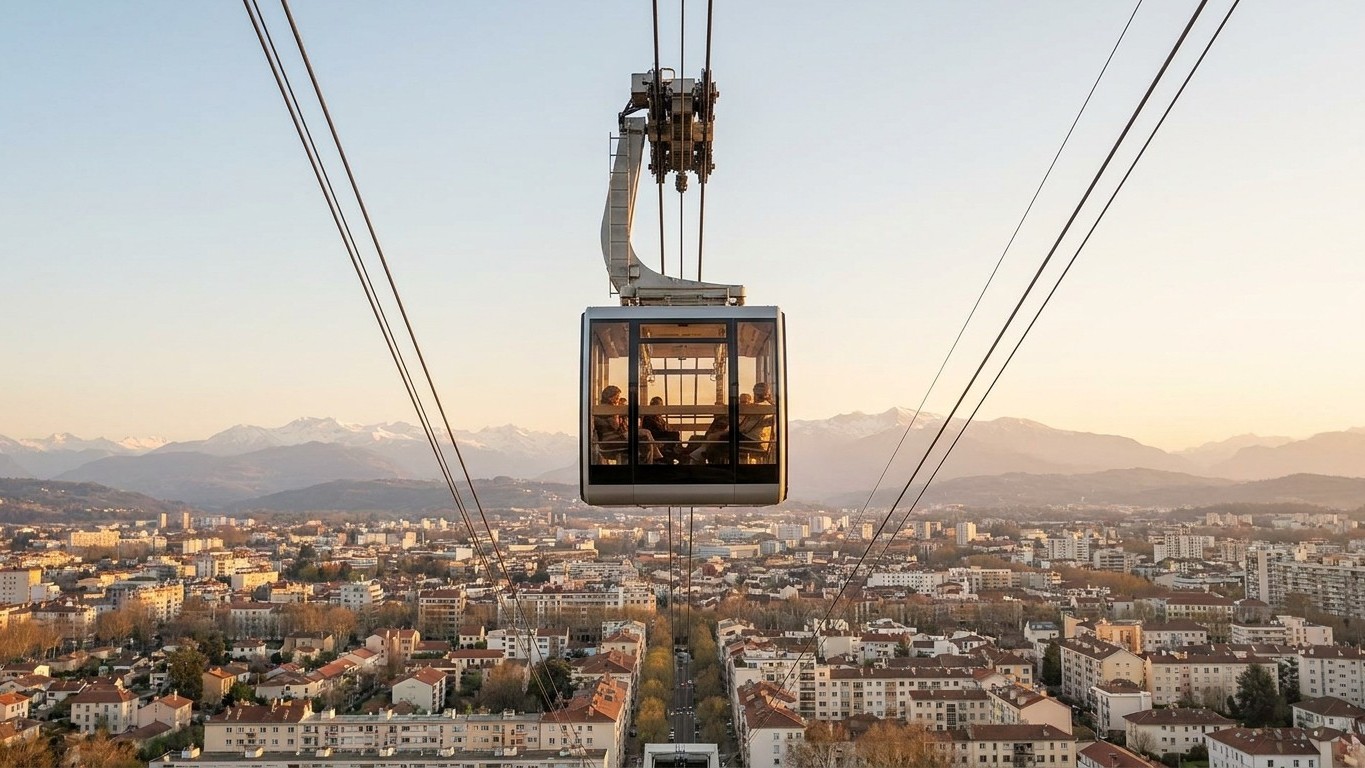
Three kilometers of cable, five pylons, and a bill that makes your head spin: 82.41 million euros. This is the amount invested in Téléo, Toulouse’s urban cable car, put into service in May 2022, roughly 27 million euros per kilometer. A figure that, on its own, encapsulates the entire debate surrounding this project since its launch: a technological bet that looks impressive on paper, but whose true profitability is questioned as ridership data accumulate.
À retenir
- A initial budget exploded by 12.8% even before user testing
- Actual ridership is steady but structurally below promises
- Prolongations planned are abandoned, signaling a new prudence from the authorities
A budget that climbed well before opening
The initial financial setup forecasted an operation budget of 82.41 million euros, covering design, construction, support operations and project management, of which 70.61 million were financed by Tisséo Collectivités. The remainder came from external subsidies: 11.8 million euros funded by contributions from various partners, with a substantial portion from Brussels. At the European level, Téléo benefited from 6.6 million euros in FEDER funding, more than half of the public subsidies that financed the project. The European Investment Bank completed the circle with a loan of 40 million euros, nearly half of the total budget financed for the Téléo construction.
But this initial envelope did not weather the shock of reality. In the midst of the health crisis, the Tisséo joint committee had to authorize a budget extension. During this committee, elected officials examined the increase in Téléo’s cost, rising by 14.16 million euros. After deducting the contingency provision originally foreseen, the Toulouse cable car ultimately cost 92.97 million euros, i.e., 12.8% more than planned. A surge for which the pandemic accounts for most of the responsibility: the direct and indirect impacts of the health crisis on the site led to an increase in construction costs of about 5.7 million euros. Overall, the infrastructure remains technically impressive: the chosen technology, named 3S for its three cables (two carriers and one haul rope), guarantees a proven, gentle, ecological, and safe mode of transport.
8,000 travelers per day promised, 6,000 observed
That is where the trouble lies. At the project’s unveiling, Tisséo set out precise ambitions. Tisséo anticipated 8,000 travelers per day on this new transport mode, a target justified by the real travel needs of the served area: in this zone, daily travel demand was estimated at 8,000 people. On paper, the route had everything to convince, connecting in ten minutes the Oncopole to Paul Sabatier University via Rangueil CHU, instead of around thirty minutes by road.
Reality turned out to be more modest. One year after opening, ridership stood at 6,000 users per day, a figure confirmed by Tisséo itself which acknowledged that it is slightly below the forecast, yet still relatively high according to the operator. Three years after launch, the cumulative tally measures this persistent gap: according to official data from Tisséo Collectivités, in three years nearly 5 million validations have been recorded, while Wikipedia reports that after two years more than 3 million users had used the cable car as public transport. In daily terms, this translates to the 6,000 travelers per day observed from the first year, i.e., 25% below the initial objective. The only notable peak remains the launch, where during the first weekend alone more than 50,000 passengers rode the cabins, a curiosity-driven surge that did not translate into sustained use at the level initially anticipated.
What the regional chamber of accounts reveals
This gap between promises and reality has not escaped the budget watchdogs. The Toulouse cable car is now among the files closely monitored by regional financial magistrates: among the topics chosen in Occitanie is Téléo, within the framework of a control program fueled by citizen involvement. The chamber has even received direct reports from citizens questioning the relevance of the investment, raising directly the thorny question: the announced budget was greatly exceeded, and the expected ridership does not seem to be achieved, by any means.
On the ground, the ambition to extend the network has also stalled. The project initially planned to extend the line east to Montaudran and west to Basso Cambo, potentially bringing the route to ten kilometers. But three years after service began, this prospect has receded: according to La Gazette du Midi, an extension project was even contemplated, but it now appears to be fading away. A retreat that speaks volumes about the prudence now adopted by local authorities in the face of a business model whose per-kilometer profitability remains, at best, uncertain.
A symbol more than a congestion-relief solution
There remains a paradox. Technically, Téléo works: comfortable cabins, accessibility for people with reduced mobility, breathtaking views of the Pyrenees, and a broad operating window from 5:15 a.m. to midnight. The cable car has even found an unexpected secondary life as a tourist and family destination, something the designers had not anticipated to this extent. But public transport should be judged first on its ability to relieve congestion in a region, not on its appeal to Sunday curiosities.
At 27 million euros per kilometer for ridership that is a quarter below forecasts, the question posed by the regional chamber of accounts deserves close attention: how many other French cities, lured by the modern image of aerial cable, are ready to repeat this same optimistic calculation before discovering, too, the gap between the promise and the number of validations?
Sources : occitanie-europe.eu | gazette-du-midi.fr | tisseo-collectivites.fr
