
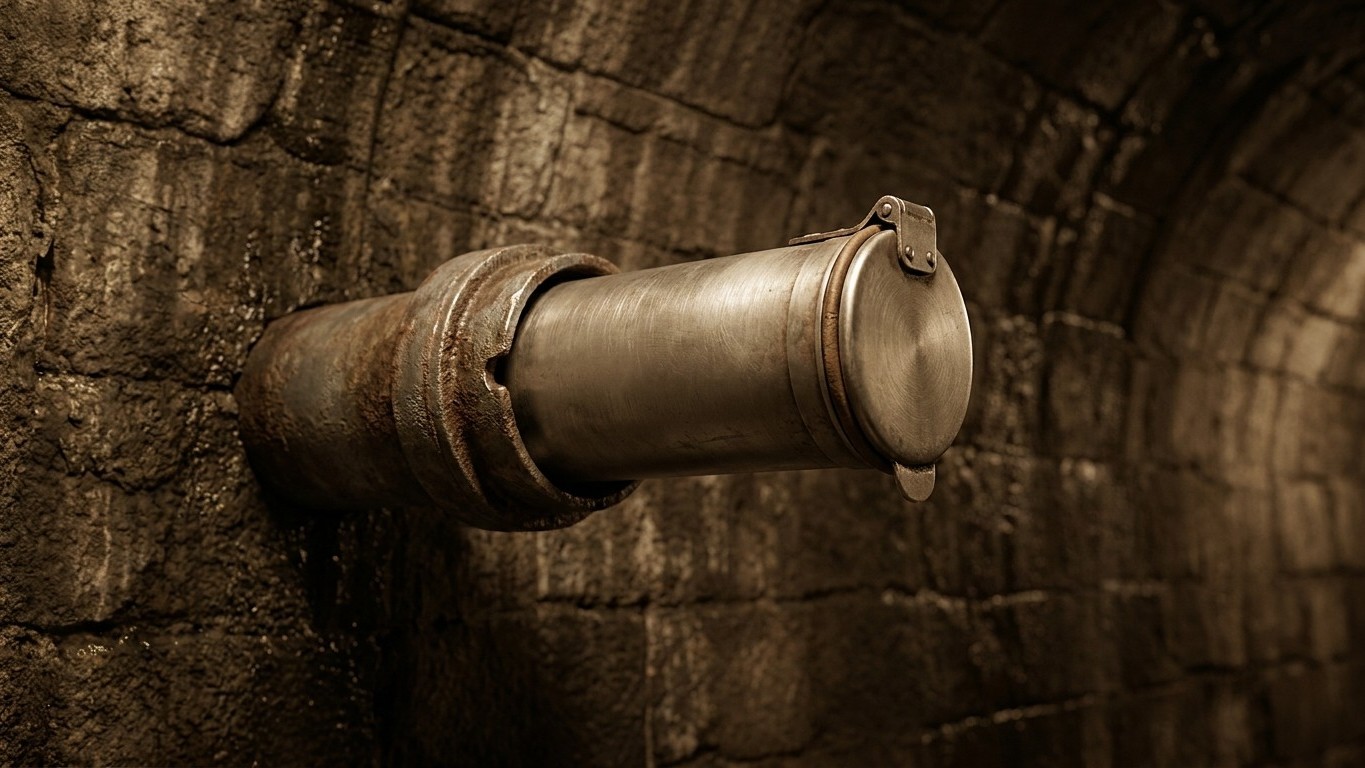
Thirty minutes. That was the time it took for a letter to traverse Paris from end to end, propelled through a steel tube buried beneath the pavement. From 1866 to 1984, the capital lived to the rhythm of a little-known subterranean network: the pneumatic post, a system of tubes whose metal cartridges were hurled from one post office to another by compressed air. At its peak, this mesh totaled 467 kilometers from 1934 onward, roughly the distance between Paris and Lyon, yet entirely buried beneath the city’s streets.
Key takeaways
- A network of 467 km of underground tubes operated secretly beneath Paris for 118 years
- The metal cartridges sped at 48 km/h through Belgrand’s sewers to deliver messages in 30 minutes
- 10 million messages per year at its peak — why did this technical marvel disappear?
A Response to Telegraph Congestion
The story begins with a bottleneck problem, not of cars but of messages. In the 1860s, the Paris electric telegraph network reached saturation, and the emperor decided to implement a pneumatic network, modeled on London’s, drawing on the work of chemist Ador. Before this solution, dispatching telegrams between major telegraph offices relied on horse-drawn carriages: in 1865, telegrams were delivered between the central office and the Bourse by a service of light two-wheeled vehicles making the 3-kilometer journey in 12 minutes with departures every quarter of an hour. A system judged too slow and too rigid for a city that was growing and whose streets were becoming clogged.
Initial trials took place at the end of 1866. A first line of 1,050 meters opened in December 1866 connected the Grand Hôtel, located at 12 Boulevard des Capucines, to the Paris-Bourse telegraph central, using a steel tube 65 mm in inner diameter laid in a trench about 1 meter deep. The following year, the system moved from experimental status to administrative infrastructure: in 1867, a first unidirectional circuit was created linking the telegraph centers of Place de la Bourse and 103 Rue de Grenelle. To lay these tubes without tearing up the streets, the administration hit upon a clever idea—reusing an existing network: the deployment was eased by using Paris’s sewers, redesigned by Eugène Belgrand starting in 1854. Thus, Paris underground acquired a second vocation: circulating urgent messages rather than wastewater.
Compressed Air, Cartridges, and Little Blues
The technical principle is simple in essence, even though its execution demanded substantial infrastructure. The message was slipped into a metallic cartridge called a cursor, a cylindrical container calibrated to fit precisely the tube’s diameter. The cartridge then whizzed under the pavement, propelled by compressed air and by vacuum, at speeds reported by sources ranging from 24 to 40 km/h. Other records mention even faster cursors: in the 20th century, thanks to a network of tubes installed in the sewers linking all Paris post offices, air-pressurized cartridges carried dispatches along the underground at 800 m/min, about 48 km/h. The air required for this propulsion did not appear out of nowhere: dedicated workshops, the famous “force centers,” housed steam engines and pumps that generated the pressure difference essential to moving the cartridges.
The service remained for a long time reserved for the administration, before opening to individuals. With the 1879 decree signed by Marshal Mac-Mahon, the network officially opened to the public and messages were no longer restricted by word count. Parisians quickly seized the novelty: 743,565 shipments were recorded in the first year after public access. The messages had to be written on a card or envelope of a very particular color, which earned them their popular nickname: the postal entries were dubbed “little blues” because of their color. Sending a pneumatic message cost more than a regular stamp, the equivalent of three to five times the price of a standard letter depending on the era, a luxury embraced to save precious time.
130 Offices, Ten Million Messages per Year
The network grew as the city expanded and usage diversified: stock market affairs, family emergencies, professional telegrams—everything that could not wait for the regular postman. The golden age lay in the interwar years. By 1934, the Paris network stretched to 467 km of tubes, served nearly 130 offices, and dispatched more than 10 million messages per year, becoming the largest and most densely connected network in the world. Once a cartridge reached its destination, it did not stop at the counter: specialized mail carriers, known as tubists, took over to deliver the missive to the recipient’s home, often in under an hour.
This express pace helps explain why pneumatic post long competed with a rival technology that struggled to develop. If the telephone network was slow to spread, pneumatic post carried parcels in under an hour. A delicious paradox: in 1930s Paris, an iron tube buried under the pavement proved more reliable than a still-burgeoning telephone, reserved for a minority of subscribers.
The End of a System Outpaced by the Telephone
The decline began after World War II, when the telephone became widespread in homes and businesses, soon followed by telex and then fax. The network aged, the pipes degraded, maintenance costs rose as usage collapsed. The final decision came in spring 1984: the network was abandoned on March 30, 1984 at 5 p.m. La Poste archives confirm the reason given at the time: pneumatic circulation had almost vanished, having been halted on March 30, 1984 at 5 p.m., the network’s obsolescence being cited as the cause.
Since that date, the tubes have never been removed. They still sleep beneath Paris’s asphalt, silent relics of a time when the speed of a message was measured in minutes of underground travel rather than milliseconds of fiber optics. The principle, however, has not entirely disappeared: some hospitals and large stores still use miniature pneumatic tubes to circulate samples or cash between departments, a discreet heir to a technology born to relieve the Second Empire’s telegraph congestion.
Sources: comitehistoire.laposte.fr | entierpostal.fr
