
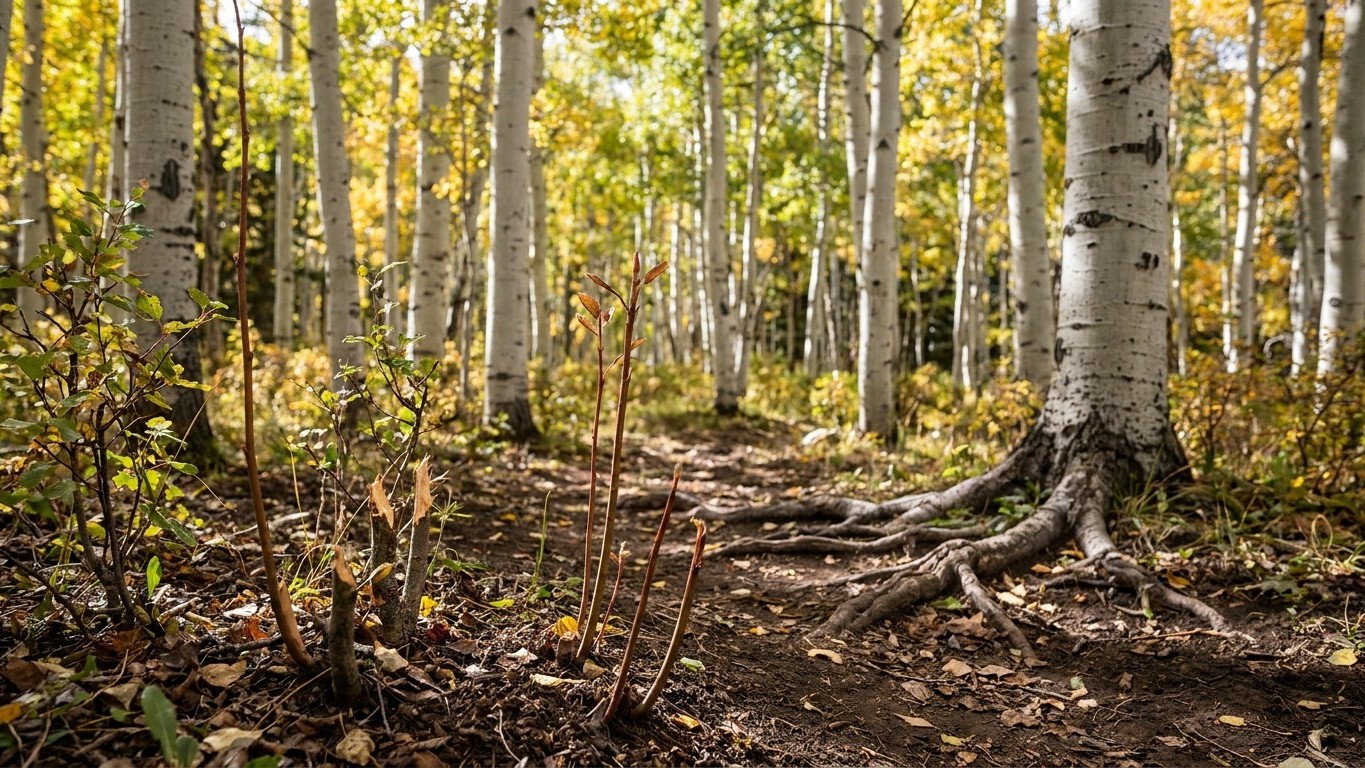
A third of an acre of forest that is actually a single tree: that is the peculiarity of Pando, this stand of Utah aspen that has fooling the eye for decades. Pando, a unique male quaking aspen in the Fishlake National Forest, spans 106 acres with about 47,000 genetically identical trunks linked by a single underground root system. The problem is that uncontrolled mule deer browsing is devouring the next generation before it can grow. An organism alive for millennia, threatened by a few dozen herbivores that are too quiet.
Key takeaways
- A single tree hides behind 47,000 trunks: how could this secret have remained hidden for so long?
- For 80,000 years, Pando has endured ice ages intact, but something threatens its spring survival
- Fences work wonders: what did scientists learn by protecting a portion of the colony?
One trunk, a thousand faces
From the ground, nothing distinguishes Pando from an ordinary forest. White trunks, leaves that tremble in the wind, a burst of yellow each autumn. But Pando is an ancient aspen (Populus tremuloides) with 47,000 genetically identical stems, connected to a vast underground root system. Its name comes from Latin and means “I spread,” a fitting name for a plant that turned a single seed into a clearing by sending new shoots from a shared root system.
Botanists took time to crack the mystery. Botanists working with the U.S. Forest Service spent decades confirming what seems impossible from a hiking trail: the forest is a clone, present, by the most cautious estimates, for at least 14,000 years. Some more recent genetic analyses even point to an age much older, up to 80,000 years for the root system according to some sources. The trunk you touch today is probably only 100 to 130 years old, but the root that feeds it has endured the end of the last glaciation.
On the scale, the result is dizzying. Together the stems and roots weigh about 13 million pounds, making Pando one of the heaviest living organisms on Earth, according to NASA Earth Observatory. Another way to say it: scientists estimate the colony weighs 6,615 tonnes, about 55 times heavier than the planet’s largest animal, the blue whale. Hard to imagine something so massive, while technically still a single individual.
The childless village
The drama of Pando is not played out in the treetops but at ground level. Each tender shoot pushing through the soil represents a chance for renewal. From August to October, when surrounding plants dry out, mule deer invade Pando to graze the young shoots, the replacement generation of the colony. The shoots don’t have time to become shrubs before they are chopped down to ankle height.
The comparison most often heard by researchers is striking. Ecologist Paul Rogers summed it up for NASA Earth Observatory: Pando looks like a village full of elderly people, with very few children to replace them. A simple image, but it says it all: without surviving young shoots, the organism ages without renewing itself, ultimately doomed to fade trunk after trunk.
Where does this outsized pressure from deer come from? Essentially from the disappearance of their natural predators. The predators that used to keep the herds moving—wolves, cougars, bears—have long been eliminated from the region. Without a threat, the deer linger wherever they please, including in the heart of the colony. And the worst part is that hunting can’t really fix the problem: hunting is restricted around Pando because it lies in a recreational area with chalets and campgrounds, and the deer have figured that out. They gather where they are safe. An unintended refuge, provided by the very tourist infrastructure itself.
The scientific assessment isn’t new, but it has sharpened over time. Ecologists Paul C. Rogers and Darren J. McAvoy reported in a 2018 PLOS ONE study that Pando’s recovery was hindered by mule deer browsing, with cattle also contributing to this pressure. A 2018 study examined 65 monitoring plots spread across fenced and unfenced areas of Pando, revealing that the presence of mule deer strongly affected regeneration success and that the best-protected and actively managed area produced the strongest response.
Fences, and a bet on the future
Facing this demographic bottleneck, forest managers did not give up. They tested several levers in parallel: targeted burns to recreate light conditions favorable to young growth, selective removal of conifers that nibble at the colony’s edges, and targeted culling of deer. None of these measures, taken in isolation, was enough to restore healthy regeneration across the entire 106 acres.
The most effective solution remains, for now, the simplest: fencing. About a third of Pando is currently fenced, and inside the enclosure, regeneration is spectacular. Elsewhere in the region, similar experiments confirm the trend: studies that fenced sections of the colony have seen young trees return, gaining more than three meters in just a few years. Proof that Pando’s regenerative capacity has not lost its vigor, once the deer are kept at bay.
Still, these enclosures are not a universal magic fix. Some zones protect the sprouts but exclude fire and the open spaces that the trembling aspen also needs. A delicate balance to strike between strict protection and maintaining natural disturbances (fires, canopy openness) which, historically, have always been part of the life cycle of this ecosystem.
The case of Pando goes far beyond the frame of a botanical curiosity isolated in Utah. It illustrates a broader mechanism, observed on several continents: the removal of large predators disrupts entire chains, to the point of compromising the survival of plant species that had endured ice ages unscathed. When apex predators disappear, mid-sized herbivores proliferate, and when these herbivores proliferate uncontrollably, the regeneration of long-lived plants halts; Utah’s aspens, the oaks of New England, and Central European deciduous forests live variations of the same story. A real-world ecology lesson, where the survival of the planet’s oldest resident ultimately depends on a well-placed fence.
Sources : spacedaily.com | spacedaily.com
