
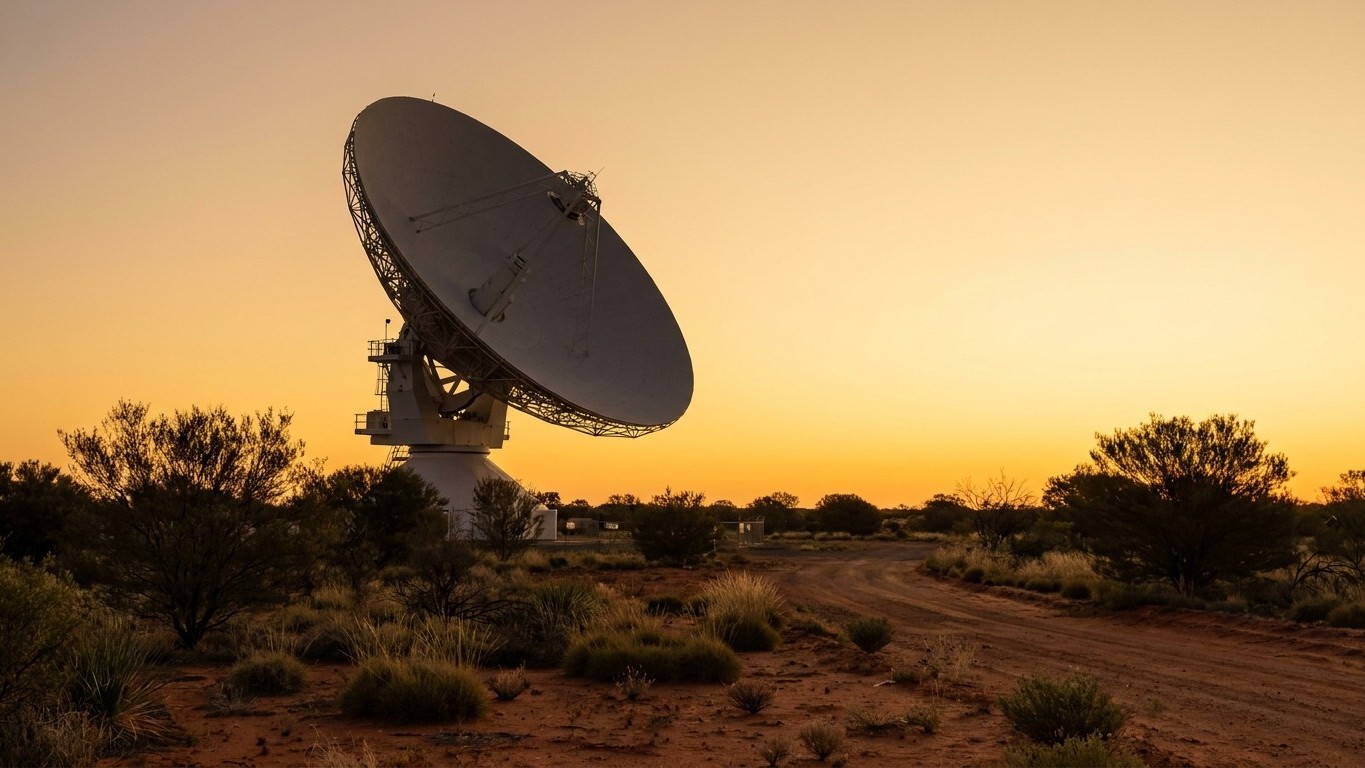
A telescope designed for radio astronomy in general, not specifically for studying quasars—then unknown—ended up relaying humanity’s first steps on the Moon. A few months after it began operating, it detected quasars, the most distant objects known in the Universe, a discovery that increased the size of the known Universe by tenfold. The Parkes radio telescope, in New South Wales, remains in operation today, more than six decades after its commissioning. And that July day in 1969 when it entered history, it was not even meant to be the lead instrument.
The site was selected in 1956 for CSIRO’s largest radio astronomy project of the time, a fully steerable 64-meter parabolic dish, commissioned in 1961 and still the largest single-dish radio telescope in the Southern Hemisphere. At the time, its construction was almost a feat: construction took just two years (“construction took only two years,” for an instrument meant to operate twenty years). It is now more than triple that expected lifespan, which is no small matter for a metal structure exposed to the winds and storms of the Australian bush.
Key takeaways
- A contract reduced to a single sentence changed the course of space history
- Parkes wasn’t meant to be in the spotlight, but a last-minute decision thrust it into the limelight
- Violent winds at 110 km/h nearly spoiled the crucial moment
A Simple Subcontractor Turned Global Star
Contrary to a stubborn common belief, Parkes was not the station assigned to receive the first images from Apollo 11. The mission’s original plan had Parkes serve as a backup to the 64-meter Goldstone dish and the 26-meter Tidbinbilla dish. The true star announced was Honeysuckle Creek, a NASA station near Canberra. It was the Honeysuckle Creek 26-meter antenna, near Canberra, that was the primary station responsible for receiving the first television images of the Moon and Neil Armstrong’s first steps.
The contract that brought Parkes into the loop was literally reduced to a single sentence. John Bolton and Robert Taylor met in February 1969, while the Australian Department of Supply was negotiating a contract with NASA for the use of Parkes Observatory during the Apollo 11 mission. After deciding they could work well together, Bolton insisted that the lengthy contract be pared down to a single sentence. A handful of words sealing the participation of an instrument that would, a few months later, beam the gaze of six hundred million viewers.
Eight and a Half Minutes That Changed Everything
In the early hours of July 21, 1969, Australian time, things did not go as planned. The lunar module touched down sooner than anticipated, which disrupted the choreography of the antennas. A NASA facility at Honeysuckle Creek transmitted the first eight minutes and thirty seconds before NASA decided that Parkes’ signal was of higher quality and began broadcasting it instead. Tom Reid, director of the Honeysuckle Creek station, sums up the unpredictable turn of events: “It hadn’t been planned this way, but that’s how it happened.”
The switch happened smoothly, almost naturally. Honeysuckle’s TV signal continued to be broadcast worldwide for six more minutes until the 64-meter Parkes dish came online. In general, the larger the dish, the better the image, and thus Parkes’ signal was chosen for the remainder of the lunar excursion. Concretely, this means that the vast majority of the global broadcast—the next two hours and twelve minutes of live coverage as the astronauts explored the lunar surface—went through this rural New South Wales antenna, thousands of kilometres from any space control center.
The episode could have ended abruptly. While everything was fully oriented toward the Moon, Parkes was struck by a series of violent wind gusts reaching 110 km/h, shaking the control room. A nuance that the 2000 film The Dish popularized in Australia, sometimes romanticizing certain details. Tracking the signal under these conditions was almost a mechanical miracle: as the winds subsided, the Moon entered the field of view of the telescope’s off-axis receiver just as Aldrin activated the camera, a timing feat to behold.
An Instrument That Refuses to Retire
What stands out about Parkes is its longevity. Most scientific equipment from that era has long since found its way into museums or landfills. Not this one. Murriyang, Parkes’ radio telescope, has been active for more than sixty years, and thanks to regular upgrades, it continues to stay at the forefront of discovery. The name Murriyang, moreover, is not accidental: it is a Wiradjuri name, bestowed in 2020 by the site’s traditional owners, in homage to the Aboriginal community that has inhabited these lands for millennia.
The secret of this longevity lies in a policy of ongoing renovation rather than mere maintenance. The surface, the control system, the focal cabin, the receivers, the computers, and the wiring have all been upgraded, some multiple times, to keep the telescope at the cutting edge of radio astronomy. Today the telescope is ten thousand times more sensitive than at its commissioning. The hull is sixty years old, but its guts bear little resemblance to those of 1961. It is a bit like driving an antique car whose engine, transmission, and electronics have been replaced every decade, while preserving the original bodywork.
Today, the instrument hunts fast radio bursts, maps hydrogen across our galaxy, and occasionally continues to assist contemporary space missions. The observatory features a busy visitor center, drawing about 100,000 visitors per year, curious to see up close this metallic disk that once, unknowingly, guided the world’s gaze toward the Moon.
Sources: phys.org | atlasobscura.com
