
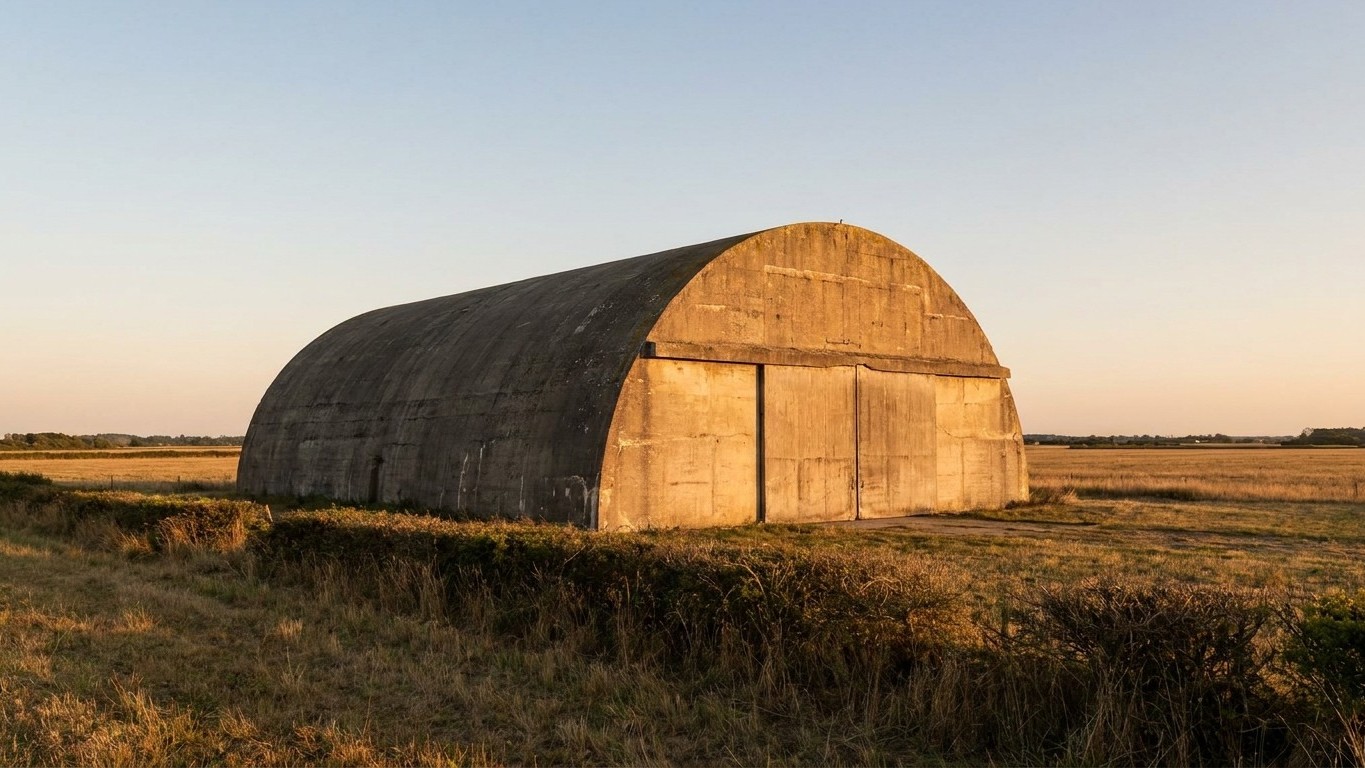
A 150-meter-long hangar, all in reinforced concrete, completed for a war that had just ended. This is the reality of the airship hangar at Écausseville, in Manche: this concrete colossus was finished in 1919 and its door in 1920, while the armistice had been signed on November 11, 1918. A delay of several months that alone sums up the logistical absurdity of the Great War, but which paradoxically saved this building from oblivion: today it is the last survivor of its kind in France.
Key takeaways
- A giant hangar ordered in a hurry during the war, completed well after the armistice
- A technical feat: the third major reinforced concrete structure in France in the early 20th century
- The only survivor of twelve military hangars, repurposed into a centennial tourist attraction
A race against time doomed from the outset
Everything begins in 1916. During World War I, the French Navy decides to employ airships to detect German submarines and hurriedly builds twelve bases, including the one at Écausseville. The chosen site was no accident: a field in the hamlet of La Bazirerie, sheltered from the prevailing westerly winds, would allow takeoffs with rising air. The idea is simple, the urgency maximal: to hunt the German U-boats that were strangling French supplies from the Atlantic.
Two hangars were ordered on the same day, December 6, 1916. The first, wooden, went up quickly: construction by the Sainte-Beuve et Garnier company of a wooden hangar spanned January to August 1917, and it soon housed a Sea Scout-type airship. Eight months of work, and the matter was settled.
The second hangar, however, took a very different turn. On October 31, 1917, the Army decided to add a second hangar, this time made of concrete, intended to house a ZD3-type airship. An audacious technical choice for the era, but it would come at a high cost in delays: the building was constructed by Etablissements Fourré et Rhodes between 1917 and 1919, in twenty-one months, compared with eight required to erect a similar wooden hangar on the same site. Twenty-one months versus eight. The gap is not insignificant: it reflects the difficulty of carrying out a reinforced concrete project amid wartime shortages.
Reinforced concrete, a feat born of scarcity
Why so much delay? Because France was lacking in everything, including iron. A gap caused by the use of innovative techniques and new materials: measured, homogeneous mortars, aggregates drawn from specific quarries, steel reinforcements hard to come by during the war. The hangar, moreover, is no small work in the history of French civil engineering: it was only the third major reinforced concrete structure built at the start of the 20th century, and it long served as a teaching reference for future engineers, a role it fulfilled for years as a calculation model in G. Espitallier’s manual “Cours de Béton armé” intended for the Ecole Spéciale des Travaux Publics.
Behind the plans lies a name: engineer Henry Lossier, who designed a vaulted structure based on the Hennebique method. Technically, the work still impresses today: according to the official file from the Ministry of Culture, it measures 150 meters long, 24 meters wide, and about 28 meters high. Inside, the space is vertigo-inducing: the interior opens up to a clear span of 24.50 meters in width and a height of around 40 meters. A cathedral of concrete, literally, set in the middle of the Norman countryside.
But time fought against the project. When the sliding door, an Eiffel design, was finally installed in 1920, the war for which all of this had been devised had ended more than a year and a half earlier. The hangar never saw a single German submarine hunted from its skies. Ironically: in the end it never served for airships, but its sturdy construction and its isolated location in the middle of the Norman countryside ensured its survival until its heritage designation.
From useless military hangar to a listed heritage treasure
Of the twelve bases built in a hurry by the Navy during the war, only one has remained intact through the century. This century-old remnant is the sole survivor among the 12 hangars built during World War I. The others, mostly wooden, disappeared in the following decades, victims of the elements, demolitions, or bombardments in World War II. Écausseville, for its part, endured the blows: saved from the Normandy bombardments in 1944, it was classified as a Historic Monument in 2003.
In the meantime, the building underwent a rather unexpected renaissance for a failed airship hangar. From 1946 to 1994, it served as a storage depot for the Navy, with a brief period (1967-1969) devoted to tests for the French atomic bomb. A World War I relic repurposed, during the Cold War, to serve France’s nuclear deterrence: hard to imagine a more surprising trajectory for a building born of logistical failure.
The next phase leans more toward heritage preservation than military use. The Franco-American Association of Normand airfields of the 9th US Air Force bought the place in 1999 for 200,000 francs, before the Montebourg region Community of Communes bought the hangar in 2008. The site, today managed by the Friends of the Hangar Association, reinvented itself as a destination of unusual tourism: one can now practice aeroplume, a kind of balloon-airship with beating wings, beneath this concrete vault conceived for a war that never fought there. Even the traces left by its successive occupants have gained historical value: the building hosts a large number of graffiti from 1930 to 1969, many of them German and American, which themselves are listed as monuments. A century after its ill-fated completion, the Écausseville hangar has not fulfilled its original mission, but it has found a far more enduring one: to stay upright.
Sources: smart-appart.fr | cilac.com
