
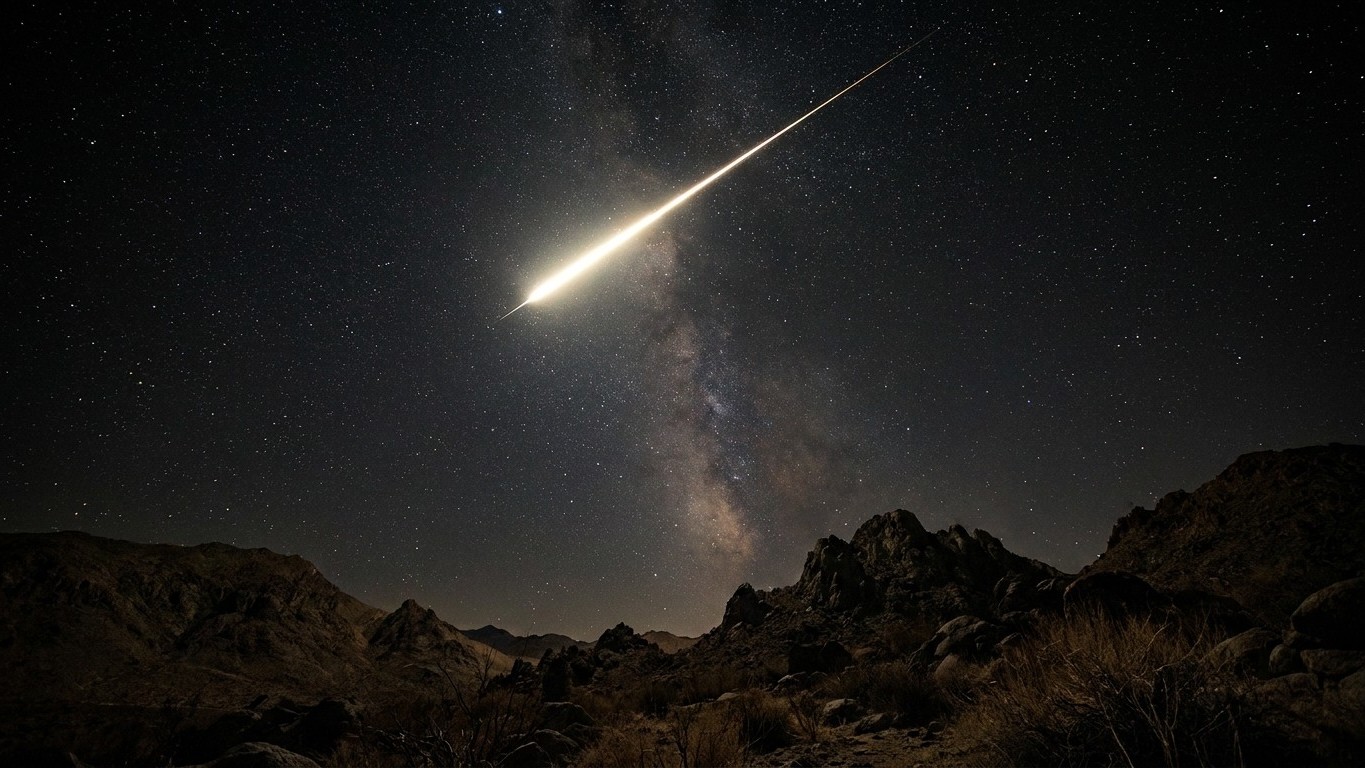
Every August night, lifting your gaze toward Perseus, we are in fact witnessing the sacrifice of a comet twice as large as the asteroid credited with wiping the dinosaurs from the map. Swift-Tuttle is a great celestial body whose core spans 26 kilometers in diameter, almost twice the size of the object believed to have caused the dinosaurs’ extinction. The grains that burn up in our atmosphere are not anonymous dust adrift in the void: they are the remnants of one of the largest objects that regularly cross Earth’s path.
109P/Swift-Tuttle is the largest known periodic comet to frequently cross Earth’s orbit. It was spotted for the first time in 1862, almost simultaneously by two American astronomers who did not know each other. American astronomer Lewis Swift observed it on July 16, 1862, and his compatriot Horace Parnell Tuttle observed it on July 19, 1862, which led to its being named after the two discoverers. Three years later, a third name entered history: the Italian Giovanni Schiaparelli, who established the link between this comet and the meteor shower observed every summer. It was Schiaparelli who, in 1865, realized that this comet was the origin of the Perseids. Before him, no one imagined that a phenomenon so regular and so terrestrial could have such a distant origin.
Key Takeaways
- The Swift-Tuttle comet is twice as large as the asteroid blamed for wiping out the dinosaurs
- The regular Perseids display hides a celestial mechanism dating back millennia
- In 2126, this cosmic giant will become visible to the naked eye again for the first time in 134 years
A 133-year ride, but a permanent ribbon of dust
Here is the paradox that often confounds: the comet itself only passes near the Sun once every 133 years. Comet 109P/Swift-Tuttle takes 133 years to orbit the Sun once, it reached its last perihelion in 1992 and will return again in 2126. So why are the Perseids on cue each August, without fail? Because the comet itself no longer has anything to do with the yearly spectacle. At each pass near the Sun, solar heat sublimes the ice of its nucleus, tearing off dust grains that do not follow the main body. This material does not follow the comet: it lingers behind it, stretched into a long ribbon along its trajectory, and the ribbon remains in place permanently, whether the comet is nearby or not; it has accumulated thus over thousands of years.
Grains of sand, but a speed that changes everything
Do not mistake the nature of what burns in the sky. These grains are not rocks: their sizes range from a grain of sand to a pea, and their mass is measured in fractions of a gram. What turns these cosmic confetti into streaks of light visible to the naked eye from a garden is the velocity with which they strike the atmosphere. Each year between July 17 and August 24, Earth plows into this cloud at 30 km/s, while the grains arrive in a nearly frontal direction, giving a relative speed of 59 km/s, or 212,000 km/h.
A comparison helps measure the energy at play. A particle weighing a tenth of a gram launched at 59 km/s carries 174,000 joules of kinetic energy, the equivalent of about forty grams of TNT, concentrated into an object small enough to fit on a nail. It is this energy, entirely dissipated in a fraction of a second in the upper layers of the atmosphere, that produces the bright flash we call a shooting star. Nothing magical, therefore: just pure physics, where mass matters less than speed.
The largest regular visitor to Earth’s neighborhood
What truly sets Swift-Tuttle apart from other bodies crossing our orbit is its scale. The core of Swift-Tuttle measures about 26 kilometers in diameter, roughly twice the size of the object blamed for wiping out the dinosaurs. It stands by far as the largest near-Earth object, whether asteroid or short-period comet, to have crossed Earth’s orbit and come close to it on multiple occasions. A figure that boggles the mind when you recall that most asteroids monitored by space agencies are only a few hundred meters across at most.
That size, moreover, sparked a notable scientific scare in the 1990s. Upon its rediscovery in September 1992, the date of perihelion passage differed by 17 days from the 1973 prediction, and it was calculated that if the next passage, planned for July 2126, bore a similar shift, the comet could strike Earth on August 14, 2126—a scenario taken seriously given the nucleus’ size. Further observations helped rule out this catastrophe scenario. As Paul Chodas, head of NASA’s Center for Near-Earth Object Studies, summarizes: “its orbit passes very close to that of Earth, which over the years has made it an object considered dangerous. Today, we know its orbit well enough to state that we are safe from an impact for thousands of years.”
A rendezvous in 2126, but not only for the Perseids
The next pass of Swift-Tuttle near the Sun promises a spectacle quite different from the subdued one in 1992. During its last pass in 1992, it was too faint to be visible to the naked eye; the next pass, in 2126, could render it comparable in brightness to Hale-Bopp of 1997, if forecasts hold. Astronomers of that future generation will thus be able to observe directly, in the sky, the object responsible for the year’s most popular meteor shower, whereas we typically only see its specks.
While awaiting this distant rendezvous, the trace of Swift-Tuttle continues to grow richer: each passage adds a new ribbon of dust, slightly offset from the previous ones, which explains why some years the Perseids are denser than others. The comet has left the inner solar system for more than thirty years already, but it continues, without directly doing so, to light up our summers.
Sources: ccstib.fr | journaldelastronomie.fr
