
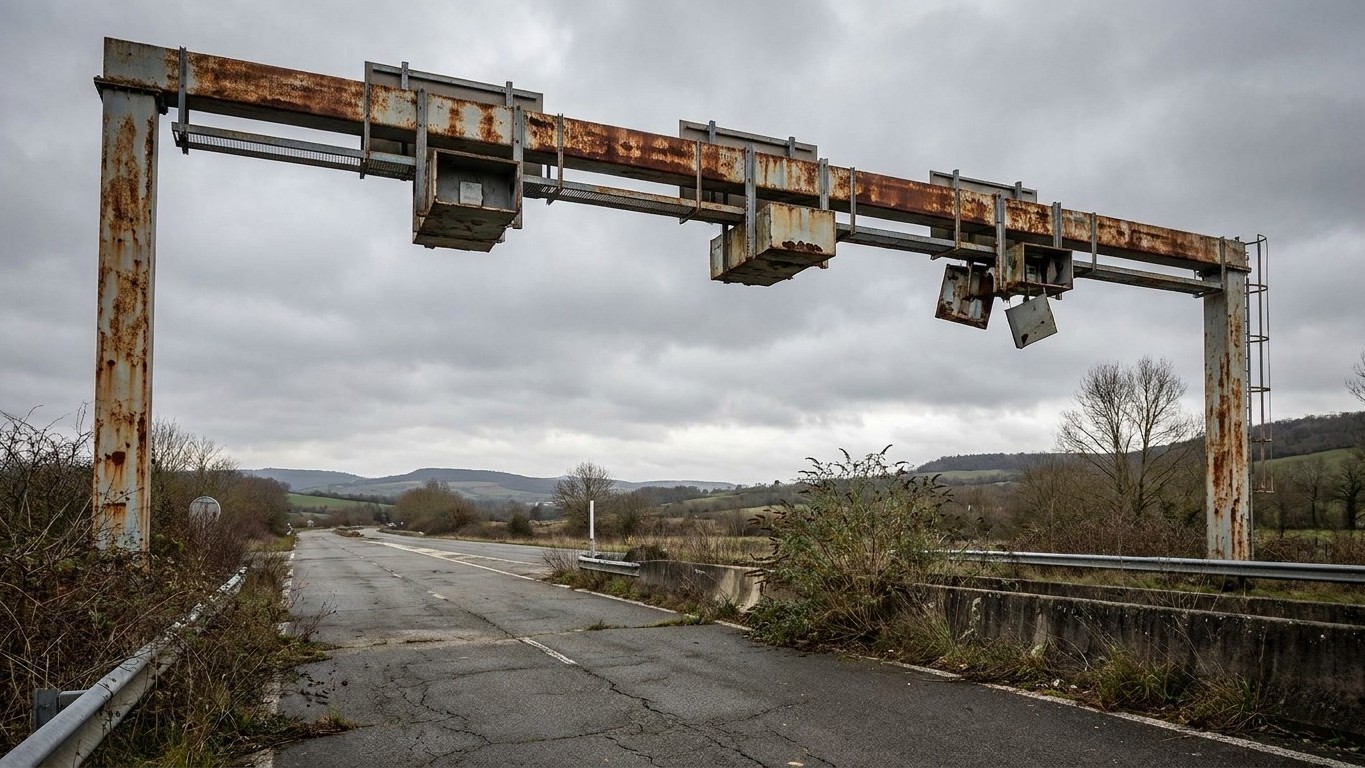
One hundred seventy metal gantries planted over France’s motorways, which never actually served any purpose. That is the harshest summary of the ecotax, the weight-based toll on trucks intended to fund the transition of transport infrastructure and presented in 2009 as one of the flagship measures of the Grenelle de l’environnement. Fifteen years on, the system continues to cost the state dearly, and its remnants still rust along the roadsides.
The principle seemed virtuous enough: make trucks pay by the kilometer to finance cleaner alternatives to road transport. On paper, the ambition was real. The ecotax was supposed to bring in nearly €890 million in net revenue each year for public administrations, including €684 million dedicated to financing national transport infrastructure. Funds earmarked for roads, bridges, and secondary rail. In practice, the story headed down a very different path.
Key takeaways
- 170 metal gantries installed on highways for a system that never functioned
- More than a billion euros spent on a project quickly abandoned and compensated
- Dozens of millions paid each year for an infrastructure that stalled
A costly showcase from its construction
Even before collecting a single cent, the scheme swallowed substantial sums. One hundred seventy gantries, 230 control terminals for secondary roads, 720,000 boxes intended to equip trucks, not to mention a state-of-the-art data center: all of it had cost €652 million. An infrastructure conceived as modern, nearly futuristic for the era, with sensors and cameras gnawing above the asphalt.
Then came the bonnets rouges upheaval in 2013, the suspension of the scheme, and finally its definitive termination at the end of 2014. The contract tied the State to the Ecomouv’ consortium so tightly that breaking the agreement cost a fortune. The state ultimately faced a heavy bill: €957.58 million in compensation to Ecomouv’ and its partners, and €70 million to implement the ecotax, then undo it. To cushion the budgetary shock, this bill was not paid in a single tranche.
Dozens of millions per year for nearly a decade
That is where the real issue lies: the annual cost, spread out, almost invisible in the public accounts. Nearly €518 million in compensation was paid in 2015, and the remaining €440 million from 2016 to 2024 was paid out, amounting to about €50 million per year. Fifty million every year, for a system that stood still. Paying to achieve nothing: perhaps the most economical definition of waste.
And this time-lag itself generated an additional cost. A €35 million overrun tied notably to interest on debt, because the state paid interest on debt that produced not a single euro of revenue. Borrowing to finance the abandonment of a project meant to bring in money: the paradox sums up fifteen chaotic years of management in a single line.
When it came to selling off the equipment, the scene turned comical in terms of management. The furniture of the Eco-Mouv center in Metz was sold for 17% of its value. Worse for the IT side: the servers were sold for 2% of their acquisition cost, the perfect symbol of an investment with no return. In the end, on a fleet valued at several hundred million euros, the state recovered only €2.19 million.
The foregone revenue still weighing on the roads
The worst isn’t found in the expenditure but in what was never collected. The Court of Auditors, in its annual report, quantified this foregone revenue over the entire period of operation that should have run until 2024. According to the Court, the foregone revenue for the planned operating period reached €9.83 billion. A figure to put into perspective: roughly the annual budget of the Ministry of Justice, or the equivalent of ten years of funding for the secondary rail network.
Without this money, local authorities had to fend for themselves. Elected officials at the time did not hide the state of the secondary road network. According to remarks reported by franceinfo, former deputy Philippe Duron estimated that at least €500 million per year would be needed to renovate our roads. Yet the State contributed only €350 million. To partly offset the gap, the government chose the politically simplest route: raise an existing tax rather than invent a new one. An increase of the TICPE by 4 euro cents per liter of diesel for heavy goods vehicles was introduced from January 2015. But this measure mainly weighed on French hauliers, while foreign trucks, which account for nearly 40% of traffic, contributed only around 2% of the revenue flow.
Carcasses still standing, a dismantling continually postponed
Today, still in 2026, the gantries have not disappeared from the landscape. A first call for dismantling, launched in 2015, produced nothing due to a lack of interested companies, and the contract was eventually canceled. Since then, the dismantling question remains unresolved, with a figure that makes the eyes glaze over in light of its apparent modesty: dismantling would cost around €7 million more today, a paltry sum in the face of the waste but politically impossible to bear. Seven million euros to erase the traces of a project that cost a billion: to this day, no one has been willing to shoulder this final budget item.
What this file mainly reveals is the chronic difficulty for the French State to assess risk before committing to a large-scale infrastructure contract. The Court of Auditors did not mince its words in its verdict, judging that the decision to abandon the tax constituted a “policy failure” taken “without a legal basis.” The gantries still rust above rural roads, mute witnesses to an ecological ambition turned into a budgetary sinkhole. And one question remains that no one in Parliament or at Bercy seems eager to answer: who will ever pay to remove what never served?
Source: lemondededemain.fr
