
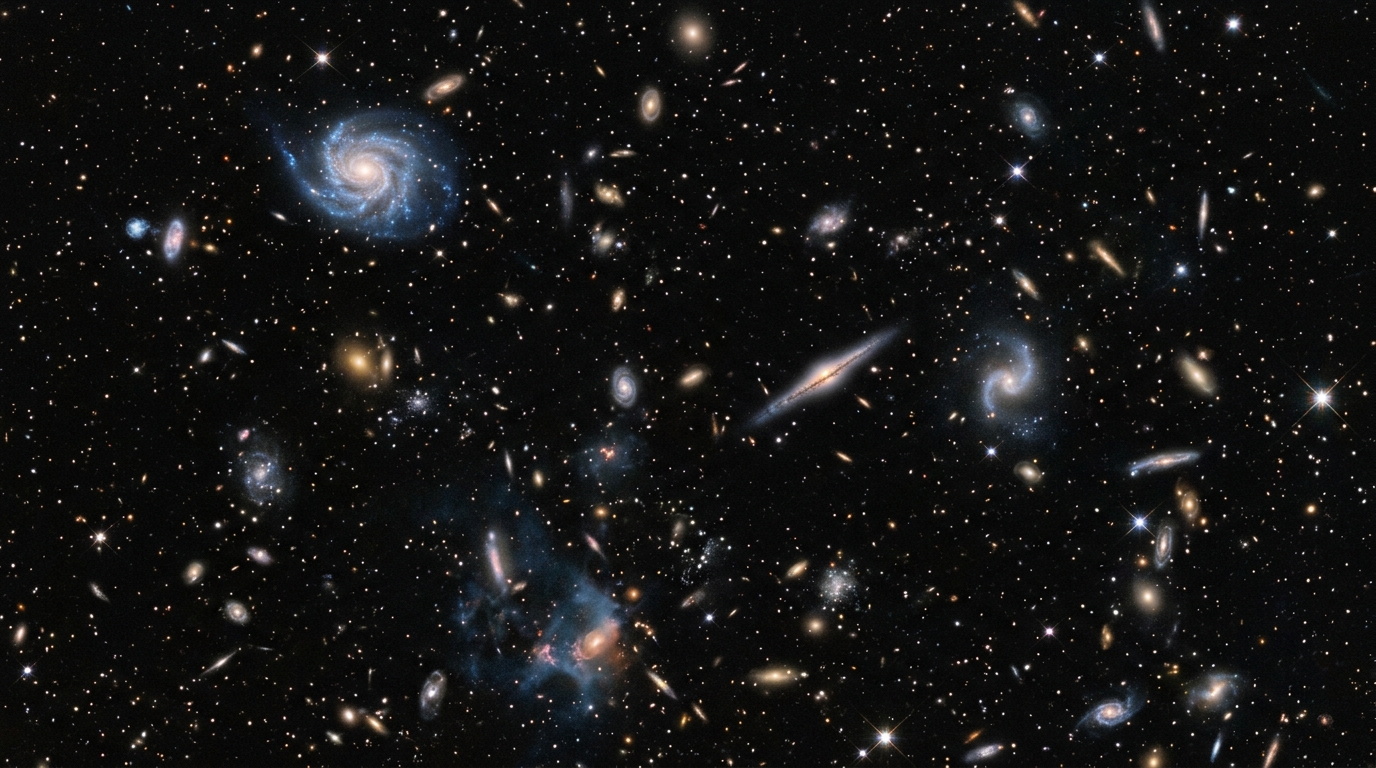
A number doesn’t fit, and the whole universe trembles. Two ways to measure the rate at which the cosmos expands yield different results, and the gap is now too large to credit to luck. On one side, the fossil echo of the Big Bang, captured for decades by our most sensitive instruments. On the other, the light of nearby stars, measured with unprecedented precision thanks to the latest space telescopes. Two rigorous methods, two incompatible results: either an instrument is deceiving us somewhere, or physics itself hides a flaw we have not yet named.
When the primitive universe contradicts the present universe
To understand why this story stirs the scientific community so much, one must trace back to the heart of the problem. Cosmologists have two main windows onto the universe: one peers far back into the past, to the cosmic microwave background, this fossil radiation emitted a few hundred thousand years after the Big Bang. The other surveys the nearby universe, here and now, through neighboring galaxies and their stars. In theory, these two windows should tell the same tale and yield the same value for the famous Hubble constant, the number that describes how quickly space is stretching.
But they do not tell the same story. The measurements derived from the cosmic microwave background give a value of about 67.2 kilometers per second per megaparsec, while local observations, based on nearby stars and galaxies, point to a much faster expansion. This gap, known as the Hubble tension, continues to widen across campaigns conducted with the Hubble and James Webb telescopes, to the point of becoming one of the most stubborn puzzles in modern cosmology.
Two methods, two truths, one cosmos
Last spring, the international H0 Distance Network collaboration published the most precise direct measurement of the local expansion rate to date, in the journal Astronomy & Astrophysics. The result: a Hubble constant of 73.50 ± 0.81 kilometers per second per megaparsec, i.e., just over 1% precision, an impressive technical feat given how challenging cosmic distances are to establish. To achieve this, researchers combined several independent distance-determination methods, notably the Cepheids, those variable stars that serve as true yardsticks, but also red giants and carbon stars.
The result directly contradicts the value derived from the cosmic microwave background. The gap between the two measurements now stands at about five sigma, the formal discovery threshold in experimental physics. In concrete terms, there is less than a 1 in 3.5 million chance that this discrepancy stems from a mere statistical coincidence. In other words, the early universe and the present universe do not seem to agree on their own rate of expansion, and this disagreement is no longer background noise but a genuine physical signal.
Tracking down the culprit: faulty telescope or missing physical law?
In the face of such a disagreement, the first reaction among scientists naturally was to suspect instrumental or methodological issues. Some researchers, including the team led by Wendy Freedman, had suggested that the tension might fade once the effects of stellar crowding or interference from interstellar dust are properly accounted for, which could subtly bias distance measurements. A tempting hypothesis that would have allowed closing the case without upending our fundamental knowledge.
But the James Webb Space Telescope’s infrared vision, capable of piercing cosmic dust far more effectively than its predecessors, allowed this track to be tested with unprecedented rigor. The result: the values remained unchanged. The locally observed rapid expansion is not an optical illusion but a physically real phenomenon confirmed. The study, led notably by researchers at the Harvard-Smithsonian Center for Astrophysics, thus rules out systematic errors as the sole possible explanation. Separately, the final mapping from the ACT telescope confirmed the measurements derived from the cosmic microwave background, while clearly opposing the local data. Two reliable instruments, two stable results, and still no technical flaw identified to explain the discrepancy.
What this anomaly is already changing about our view of the cosmos
If the instrumental hypothesis collapses, there remains only one serious possibility to explore: unknown physics lurking behind this disagreement. The standard cosmology model, the one that has described the universe for decades with remarkable success, could simply be incomplete. Some researchers envision the existence of a form of dark energy that would evolve differently across epochs, thereby altering the local expansion speed without affecting the measurements from the cosmic microwave background. Others bring up an additional component of dark matter, still invisible to our instruments, that would subtly disturb the cosmos’s balance.
What makes this puzzle especially fascinating is precisely the absence of an obvious answer. We have two independent, precise, and reliable measurements of the same fundamental quantity of the universe, and they stubbornly refuse to converge. Such a situation had not occurred in cosmology for a long time, a field accustomed to refining its models rather than having them challenged so directly.
The Hubble tension is therefore no longer a mere technical detail for specialists. It has become the symbol of a turning point for astrophysics, the moment when two rigorous ways of probing the cosmos—one looking toward its deepest past, the other toward its nearest present—tell two different stories. Whether the solution comes from a new form of dark energy, a still-mysterious dark matter, or a completely new ingredient no one has yet imagined, one thing now seems clear: our understanding of the universe, no matter how solid, still hides a shadow that neither telescopes nor current equations can illuminate.
