
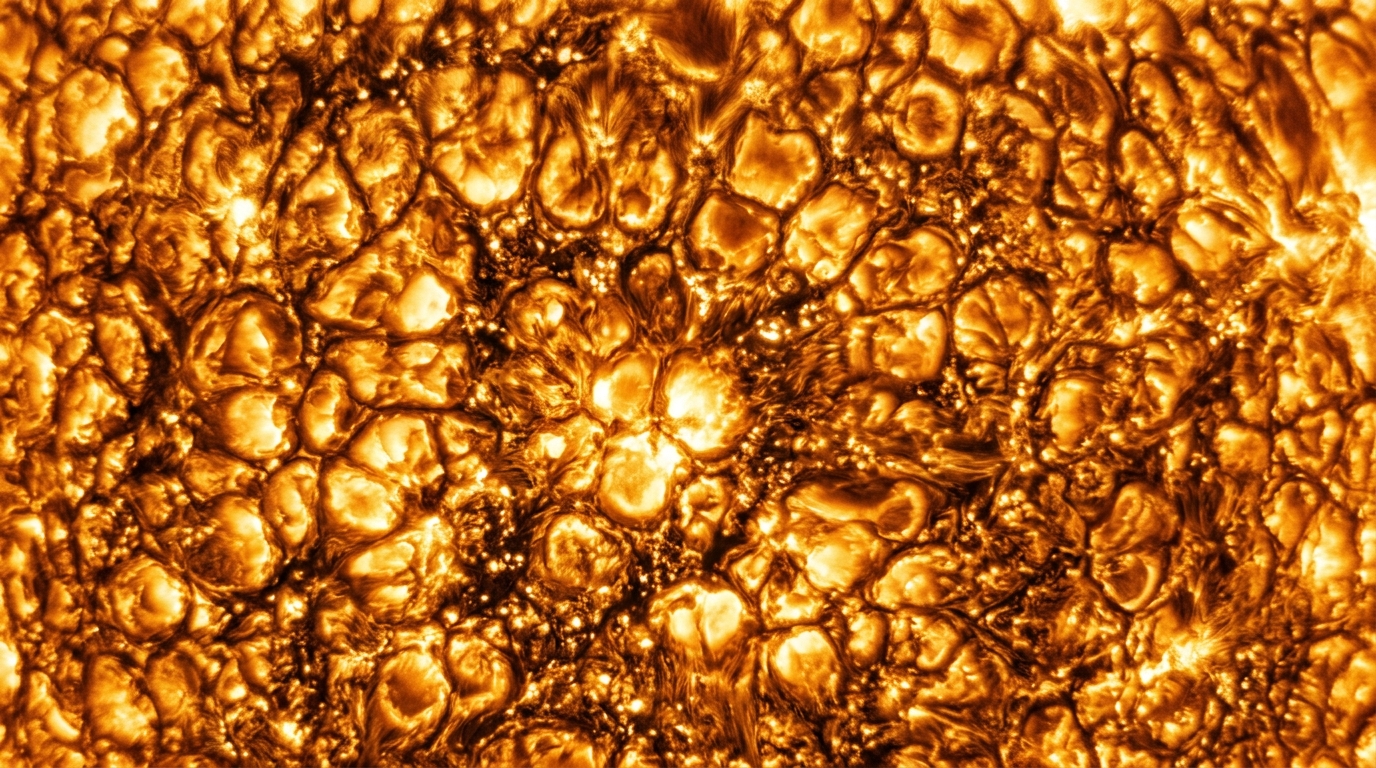
And what if one of the Sun’s oldest mysteries has finally begun to yield a first clue, hidden in plain sight for a century and a half? For decades, astrophysicists have wrestled with a major puzzle: why the solar corona, this thin atmosphere that surrounds our star, exhibits a temperature of around one million degrees Celsius, while the surface of the Sun just beneath it remains much cooler? This thermal paradox has never found a definitive explanation. But thanks to the Daniel K. Inouye Telescope, installed on Maui in Hawaii and regarded as the largest ground-based telescope dedicated to solar observation, a fresh hint has emerged. With its four-meter-diameter mirror, this instrument captured images with unprecedented precision, revealing structures so tiny that they had remained invisible for 150 years.
Whirlwinds Hidden for 150 Years Have Finally Been Uncovered
Credit: © NSF/NSO/AURA/MPS
By observing the solar photosphere at a wavelength of 416 nanometers, the teams from the National Solar Observatory were surprised to uncover thousands of plasma whirlwinds that had remained undetectable until now. These structures measure only a few tens of kilometers across and undoubtedly existed on the Sun’s surface from time immemorial, yet their scale was too fine for prior instruments. It was the exceptional resolution of the Inouye Telescope—the finest ever achieved for imaging the photosphere—that made them visible.
A curious side-note about this discovery: the observations were not initially intended to advance science. They were primarily meant to test and calibrate the telescope’s technical capabilities. It was only after the researchers analyzed the captured images that they realized they were looking at something unprecedented. A solar physicist even compared these swirling patterns to Van Gogh’s famous Starry Night, given how the arrangement of these structures evokes the painter’s brushstrokes. A striking image to describe a natural phenomenon of extraordinary complexity.
Kelvin-Helmholtz: A 19th-Century Theory Validated on the Sun
These whirlwinds aren’t mere visual curiosities. They represent the first direct observation, at the Sun’s surface, of a physical phenomenon known since the 19th century: the Kelvin-Helmholtz instability. This mechanism arises when two fluids move at different speeds relative to one another, creating friction that gradually winds into spirals. This phenomenon is also familiar on Earth and on planets such as Jupiter or Saturn.
On the Sun, these are magnetized plasma streams sliding past each other at different velocities, triggering the emergence of these vortices. Researchers noted that these whirlwinds tend to cluster along the borders of magnetic regions, sometimes accompanied by fine, dark streaks. In other words, a theory more than a century old, conceived to describe terrestrial flows, now finds spectacular confirmation on the scale of our star.
Computer Simulations That Fit Reality Perfectly
To ensure that these observations indeed corresponded to the Kelvin-Helmholtz instability, rather than an artifact or another unknown phenomenon, scientists compared the images captured by the Inouye Telescope with computer simulations of the solar photosphere. The result was remarkably convincing: the alignment between the theoretical models and the real data, even when scrutinized for fine details such as the average spacing between the various whirlwinds, left little room for doubt.
This agreement between theory and observation marks a major breakthrough. It not only validates a long-suspected physical mechanism that had never before been confirmed on the Sun, but also opens the door to new methods of analysis. The teams now plan to employ computer programs capable of automatically identifying these whirlwinds in upcoming image series, in order to better quantify their frequency and large-scale behavior.
The Mystery of the Solar Corona Could Finally Find Its Key
Beyond the technical achievement and the visual awe, this discovery could have tangible implications for our understanding of the Sun. Scientists think these plasma vortices play a role in the energy buildup that drives solar eruptions and coronal mass ejections. Yet the most exciting hypothesis perhaps concerns the heating of the solar corona.
This thin atmosphere surrounding the Sun exhibits temperatures that boggle the mind, and no comprehensive explanation has yet asserted itself. The newly observed whirlwinds could be the missing piece of this thermal puzzle, transferring energy from the surface up through the upper layers of the solar atmosphere. The upcoming observations, coupled with automated monitoring of these structures, should enable more precise measurements of their real contribution to this phenomenon.
This announcement comes at a moment particularly favorable for astronomy enthusiasts. A total solar eclipse is indeed anticipated in the coming days, visible notably from parts of Spain, offering an opportunity for a whole generation of observers to witness our star under a different light, while scientists continue to unravel its deepest secrets.
From these thousands of whirlwinds, each only tens of kilometers across, perhaps the key to a mystery as old as modern astrophysics is beginning to emerge. Between validating a centennial theory and the hope of finally solving the solar corona enigma, the Inouye Telescope reminds us that the Sun, studied for centuries, still has surprises in store. Now the question remains: what other finer or more fleeting structures await revelation by the next generation of instruments.
