
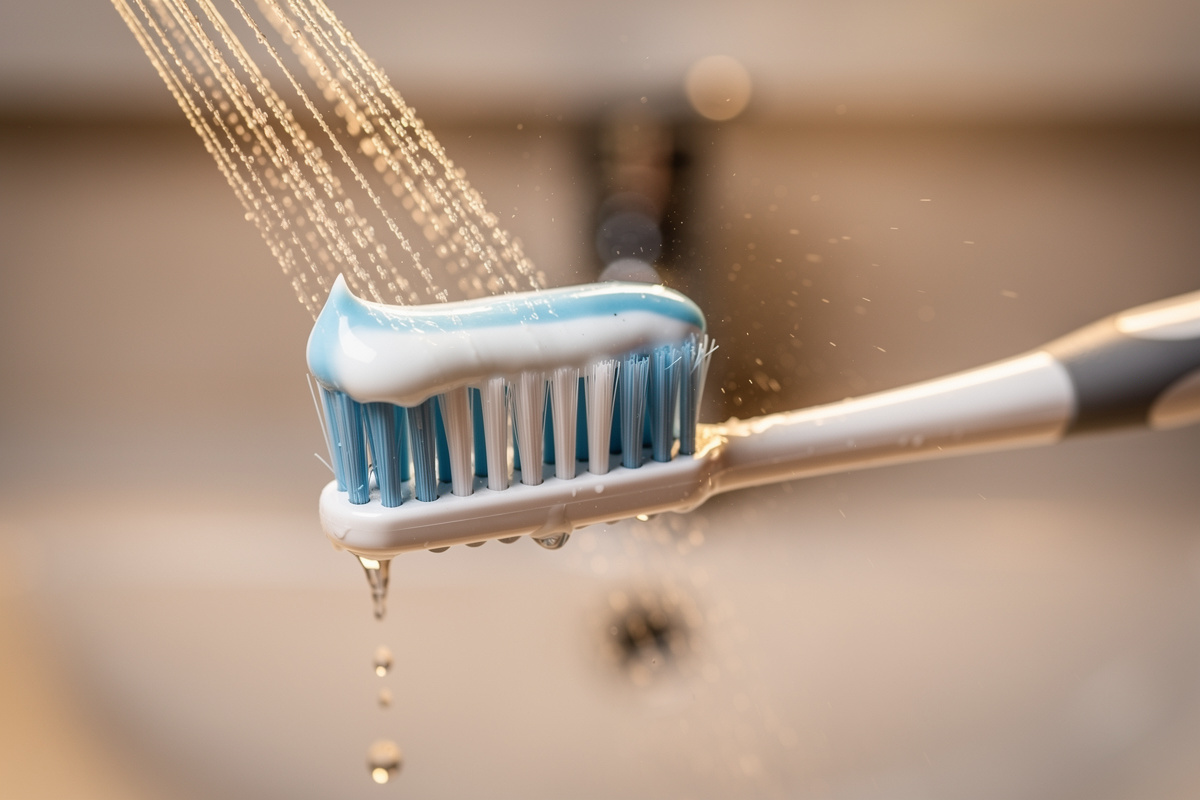
A habit repeated mechanically for four decades may seem carved in stone, as solid as washing your hands before meals. And yet, what appears to be a simple hygiene reflex can, in some cases, nearly entirely nullify the effect of the product supposed to protect our teeth. This is exactly what plays out with mouth rinsing after brushing, a gesture so ingrained in our habits that we no longer question its usefulness. Yet behind this banal routine lies an error that many French people commit without realizing it, and which could well change the game for the health of their enamel.
Forty years of a gesture I thought was harmless
Since childhood, we have been taught to brush our teeth, then rinse our mouth with a bit of water, as if to neatly close the morning and evening ritual. This gesture, passed down almost as an obvious family rule, has been repeated thousands of times without ever being questioned. We naturally associate rinsing with cleanliness: we want to feel a fresh mouth, free of the toothpaste taste, as if the water were sealing the work done by the toothbrush.
But this reflex, reassuring as it is, goes precisely against what modern toothpastes seek to achieve. For it is not brushing itself that durably protects the enamel, but what remains after brushing. And it is precisely this step that we sabotage, unintentionally, by rinsing abundantly with clear water.
Fluoride needs time, not water
The active ingredient found in almost all toothpastes is fluoride. Its role is simple to understand but fascinating in its mechanism: it strengthens the enamel’s structure and helps it remineralize, especially in areas weakened by the early stages of decay. The problem is that this action does not happen instantly. Fluoride needs to stay in contact with the teeth for several minutes to bond effectively to the enamel.
Or, when we rinse our mouth heavily right after brushing, we dilute and remove a large portion of this fluoride before it has time to act. Estimates advanced by dental health experts speak of a loss of up to 60 % of residual fluoride when rinsing is immediate and generous. In other words, we literally wash away a good part of the toothpaste’s effectiveness, just after we’ve spent two solid minutes brushing our teeth.
This mistake that almost everyone repeats daily
What makes this situation almost comical is its scale. The vast majority of adults in France rinse their mouths with water after brushing their teeth, often out of pure habit or for that sought-after sensation of immediate freshness. It is hard to imagine that such a universal gesture could be considered a mistake, given how logical and harmless it seems.
This habit is all the more stubborn because it was passed down to us without ever being accompanied by clear explanations. No one really told us why we should rinse, nor, more importantly, why we should not do so. Result: the gesture has repeated itself from generation to generation, like a cleanliness routine taken for granted, without questioning its real impact on protecting our teeth.
What dentists really say about rinsing
In France, the Union for Oral Health recommends not rinsing the mouth with water after brushing, but simply spitting out the excess toothpaste. A guideline that aligns with what remains in Britain by the UK health authorities, for whom water dilutes and carries away the active agents of toothpaste before they have time to act fully on the enamel. The World Health Organization goes in the same direction, emphasizing the importance of leaving fluoride in contact with the teeth for a prolonged period.
It should be noted, however, that opinions are not entirely unanimous: some French health information sites advise thoroughly rinsing the mouth after brushing, which can sow a little confusion among patients. This divergence partly stems from the fact that no definitive scientific data formalizes the question. But in the very logic of fluoride’s action, the longer it stays in contact with the teeth, the more likely it is to be effective in strengthening the enamel.
The new habit that changes everything in thirty seconds
The good news is that correcting this habit requires no special effort, nor any extra equipment. It suffices to spit out the excess toothpaste without running the tap, or, if desired, to rinse very lightly with a tiny amount of water, all in one go. The aim is not to keep a mouthful of paste or a disagreeable texture, but to avoid massively diluting the fluoride right after brushing.
This new reflex makes even more sense in the evening, at bedtime. Saliva production slows down markedly at night, which means that the fluoride present on the teeth has a much longer window to act, without being naturally renewed by saliva as it can during the day. Adopting this action before sleep therefore allows you to fully take advantage of that nocturnal window to strengthen the enamel over the long term.
What to remember before picking up your toothbrush again
Beyond the mere brushing technique, it is the following actions that seem to make all the difference in the long run. Using a fluoride toothpaste appropriate for age, with a concentration between 500 and 1450 ppm up to six years old, then higher than 1450 ppm thereafter, is not enough on its own. One must also give fluoride time to play its full role, without rinsing it away prematurely with a large amount of water.
This observation ultimately invites us to rethink some automatons we have always taken for granted, and to accept that a gesture repeated for decades might deserve adjusting in light of newer recommendations. Oral health, like many other fields, evolves with new observations, and it is never too late to adapt one’s habits.
So, the next time you brush your teeth, perhaps you’ll resist the urge to let the tap run. A simple spit-out, without heavy rinsing, could well be the small change that protects your enamel for decades to come.
