
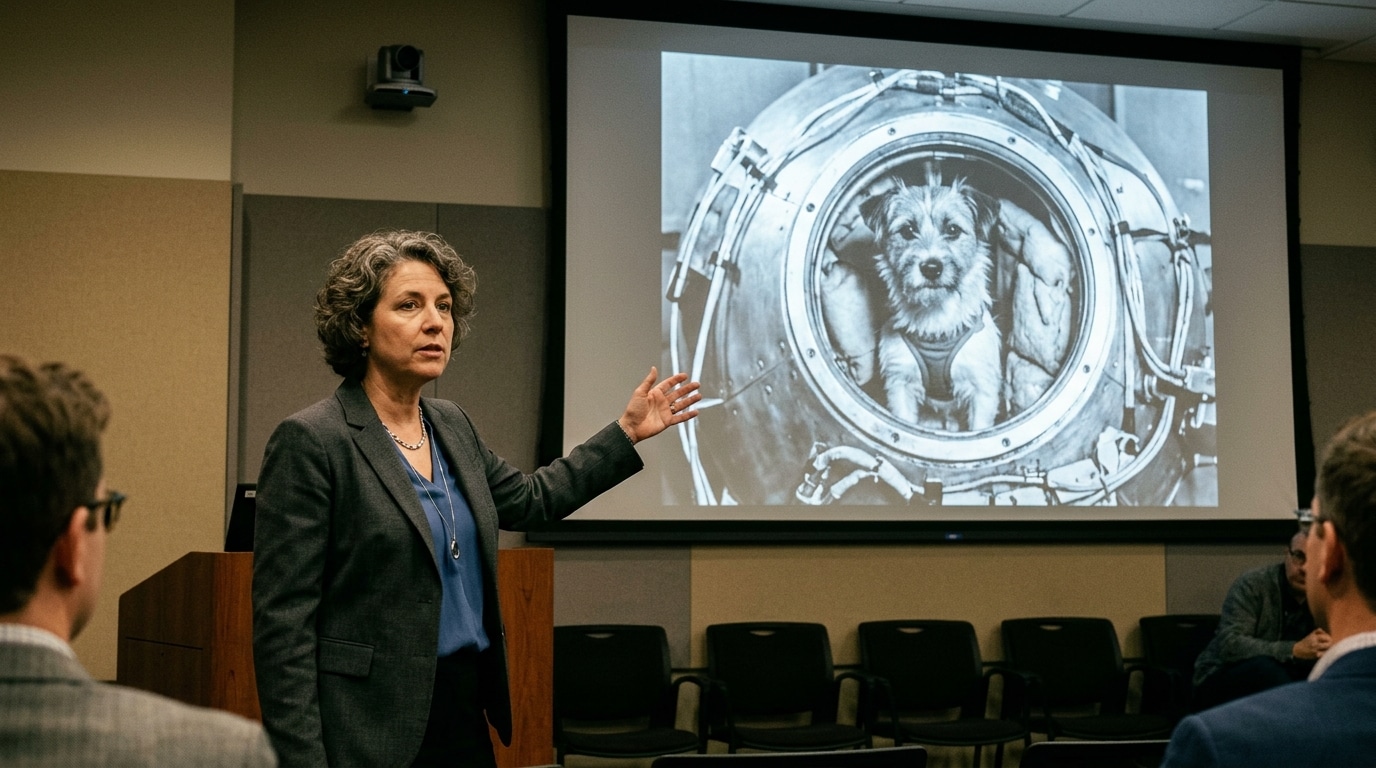
There is an image that has comforted entire generations: a small female dog quietly heading toward the stars, drifting off to sleep peacefully in her craft above our heads. For nearly half a century, this reassuring version circulated from book to book, from documentary to documentary. Laika, the first living creature to orbit the Earth, would have lived a few serene days before a painless end. A beautiful story. Except that it was false. The reality, long buried behind the Iron Curtain, turned out to be much harsher. And it would take until the early 2000s, and a Russian scientist breaking the silence at a conference in Texas, for the truth to surface. A look back at a state lie that lasted forty-five years.
A Street Dog Propelled into Cold War Guinea Pig Status
Before becoming a global icon, Laika was merely a stray picked up on the streets of Moscow. Soviet engineers were seeking animals that could endure cold, hunger, and stress. A street creature, they believed, would better withstand extreme conditions than a pampered pet. Thus this little female, weighing only a few kilograms, was chosen for a one-way voyage.
To grasp the context fully: after the triumph of Sputnik 1, Nikita Khrushchev demanded a new feat to celebrate the 40th anniversary of the Russian Revolution. The schedule was untenable: Sputnik 2 was designed and assembled in four weeks, in a frenzy of urgency, without any serious prior study. From the outset, one certainty was settled in the corridors of the space program: Laika would never return. The spacecraft simply was not equipped to descend.
The Official Version: a Lie Maintained for 45 Years
On November 3, 1957, Sputnik 2 launched with Laika aboard, making her the first living being to orbit our planet. A resounding achievement. But to cloak this feat in an acceptable varnish, the USSR told a carefully calibrated story. According to the authorities, the dog would have survived several days in good health, providing valuable data, before dying peacefully.
Versions followed, each softer than the last. Sometimes poisoned food prepared to spare her the suffering of the heat, sometimes an asphyxia without pain once her oxygen reserves were exhausted. By the late 1990s, some Russian sources began to crack the tale, suggesting she died after four days due to overheating. But the full magnitude of the tragedy remained concealed.
Houston, 2002: Dimitri Malachenkov Breaks the Silence
The truth came to light at the World Space Congress, in Houston, Texas. It was there that Dimitri Malachenkov, one of the scientists who worked on the mission, spoke up to disclose the facts as they actually unfolded. And his testimony decisively swept away the official, heroized narrative.
The problem surfaced as soon as the satellite reached orbit. The craft failed to separate from its final propulsion stage, as planned. Result: the thermal regulation system, already cobbled together in a rush, collapsed. The temperature rose to 40 °C inside the cabin. It was impossible, in such a short time, to have built a reliable device. Laika died of overheating and stress, between five and seven hours after launch. Not after several days of serene life, but in mere hours of agony, literally roasted alive in her cabin.
What Laika’s Death Really Changed
The spacecraft, for its part, continued its quiet journey for several months, carrying the little dog’s remains. It completed 2 570 rotations around the Earth before disintegrating in the atmosphere, over the Caribbean, in the spring of 1958, approximately five months after launch. An orbital tomb reduced to dust.
As tragic as it was, the mission delivered a crucial insight: a living organism could survive the launch into orbit and endure, at least for a time, the effects of microgravity. These early data opened the way to crewed flights. Without Laika, without her imposed sacrifice, the path to Gagarin and humanity’s space adventure would have been far more uncertain. She was, albeit involuntarily, an absolute pioneer.
One question remains that continues to trouble. For forty-five years, the world was offered a soothing fiction rather than the truth. Should this be seen as merely the mechanics of a propaganda machine concerned with its image, or as humanity’s universal reluctance to face the price paid by the first explorers, human or animal? Today, Laika is no longer simply the symbol of a technical achievement: she reminds us that every great leap forward is sometimes accompanied by a silence that must, sooner or later, be broken.
