
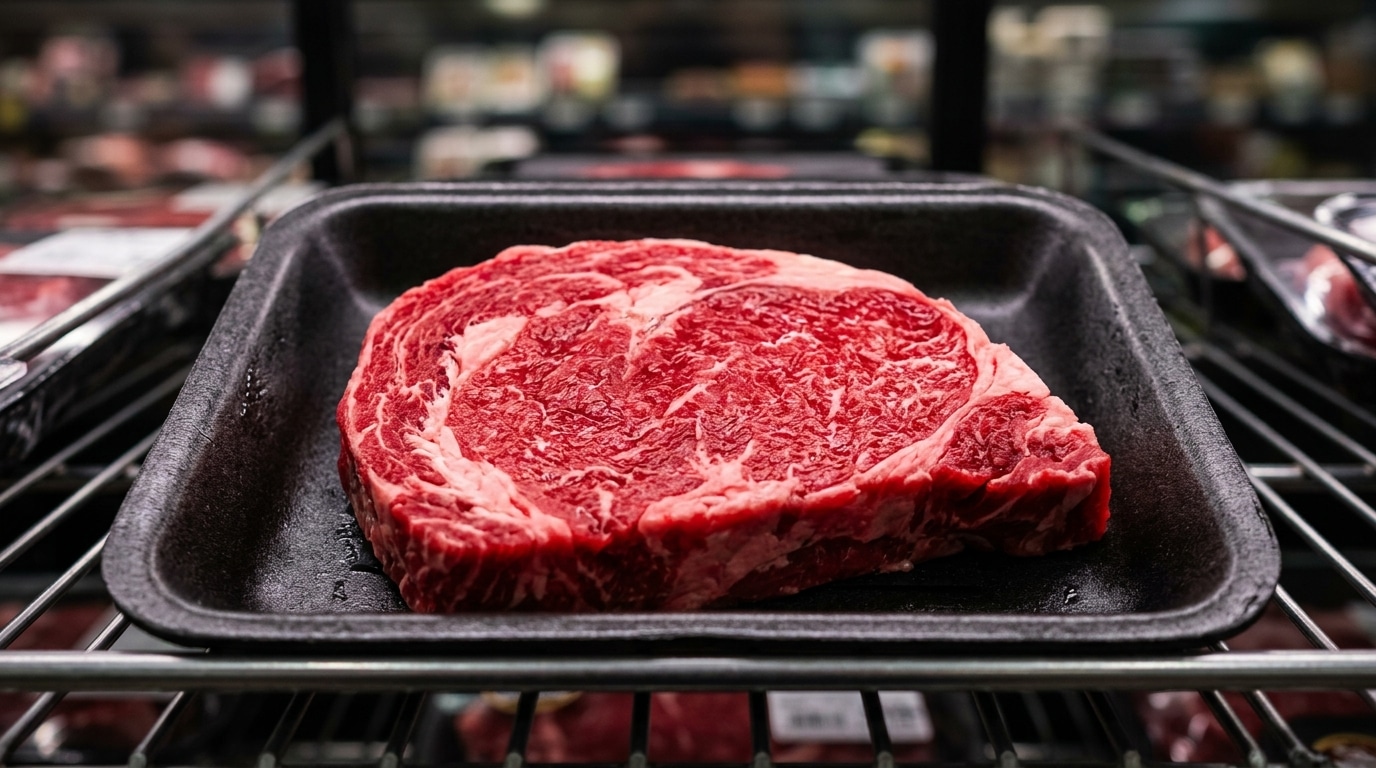
You stand before the display, your gaze gliding over the trays and stopping dead on the one whose meat shows a brilliant red, almost glowing. Instinctively, you grab it, convinced you’ve chosen the freshest. This gesture, repeated by millions of consumers every day, convinced that the intensity of the color betrays quality. Yet this natural reflex rests on a huge misunderstanding. This appetizing red that makes you cave in doesn’t really come from the meat itself, but from a discreet conditioning technique, perfectly legal, and that nothing on the label mentions. A dive into the chemical backstage of your beef tray.
That brilliant red that lures you has never been a sign of freshness
For as long as we can remember, in our collective imagination, a good piece of meat is bright red. This intense color instantly evokes freshness, vitality, the product that has just arrived on the shelf. Conversely, meat that leans toward brown inspires caution, as if it were going bad. It’s a set of associations so deeply ingrained that it guides our purchases without us realizing it.
But the truth is: this belief is largely misleading. The color of a cut of meat tells almost nothing about its actual state of preservation. It depends on a natural pigment present in the muscle, myoglobin, whose hue varies according to the conditions in which the meat is kept. And those conditions on the shelf are carefully orchestrated.
80% Oxygen in the Tray: The Real Secret Behind the Color
The method has a technical name: modified atmosphere packaging. The principle is simple to understand. Before sealing the tray, ordinary air is replaced with a carefully dosed gas blend. For red meat, this mix is particularly rich in oxygen, often between 60 and 80%, while the air we breathe contains only about 21%. The rest of the volume is generally made up of carbon dioxide, which slows the growth of bacteria.
Why such a high concentration of oxygen? Because it is precisely the oxygen that keeps myoglobin in its so-called oxygenated form, the one that gives that famous bright red. Bathed continuously in this saturated atmosphere, the meat preserves its glow much longer than it would in the open air. In other words, this flamboyant color is the result of a true packaging effect, not an intrinsic indicator of quality. Rest assured: all the gases used—oxygen, carbon dioxide and nitrogen—are natural components of the surrounding air. In Europe, the use of carbon monoxide is strictly prohibited in foods.
When Exposed to Air, Meat Browns Within a Few Hours, and That’s Perfectly Normal
You’ve surely noticed that, once taken out of its packaging, meat can start browning within a few hours. Panic? Not at all. This color change has nothing to do with spoilage: it’s simply a chemical reaction. Deprived of its oxygen-saturated atmosphere, the myoglobin changes state and takes on a duller, sometimes brownish hue.
The pigment actually comes in several shades depending on the circumstances. When oxygenated, it yields bright red; when oxidized, it turns brown; reduced, it tends toward purple. This is also why vacuum-packed meats look noticeably darker, almost purplish: without oxygen, the pigment remains in its reduced form. The meat is by no means worse, nor less fresh. It simply has a different color.
What the Label Will Never Tell You, and How to Really Judge Your Meat
Here’s the most confusing point: this packaging technique, perfectly legal and widely used, does not appear clearly on the label. Nothing tells you that the red seen through the plastic wrap is the result of an atmosphere enriched with oxygen. In such conditions, it’s hard to base your choice solely on color.
So, how do you truly assess meat? Rely on concrete, reliable cues. First, check the use-by date and the integrity of the packaging. A crucial note: if the tray is punctured or swollen, if the product seems altered or emits a strong odor upon opening, do not consume it, even if the date hasn’t passed. These signals, unlike color, never lie. Smell and texture remain your best allies when deciding.
Ultimately, that vivid red that has persuaded us for so long is merely an elegant staging, a visual language that speaks to our instincts without telling the whole truth. Next time you hesitate at the stall, perhaps you’ll view these trays with a more informed eye. And perhaps, in the end, learning to decode what’s playing out behind the plastic will be the best way to take back control of your dietary choices?
