
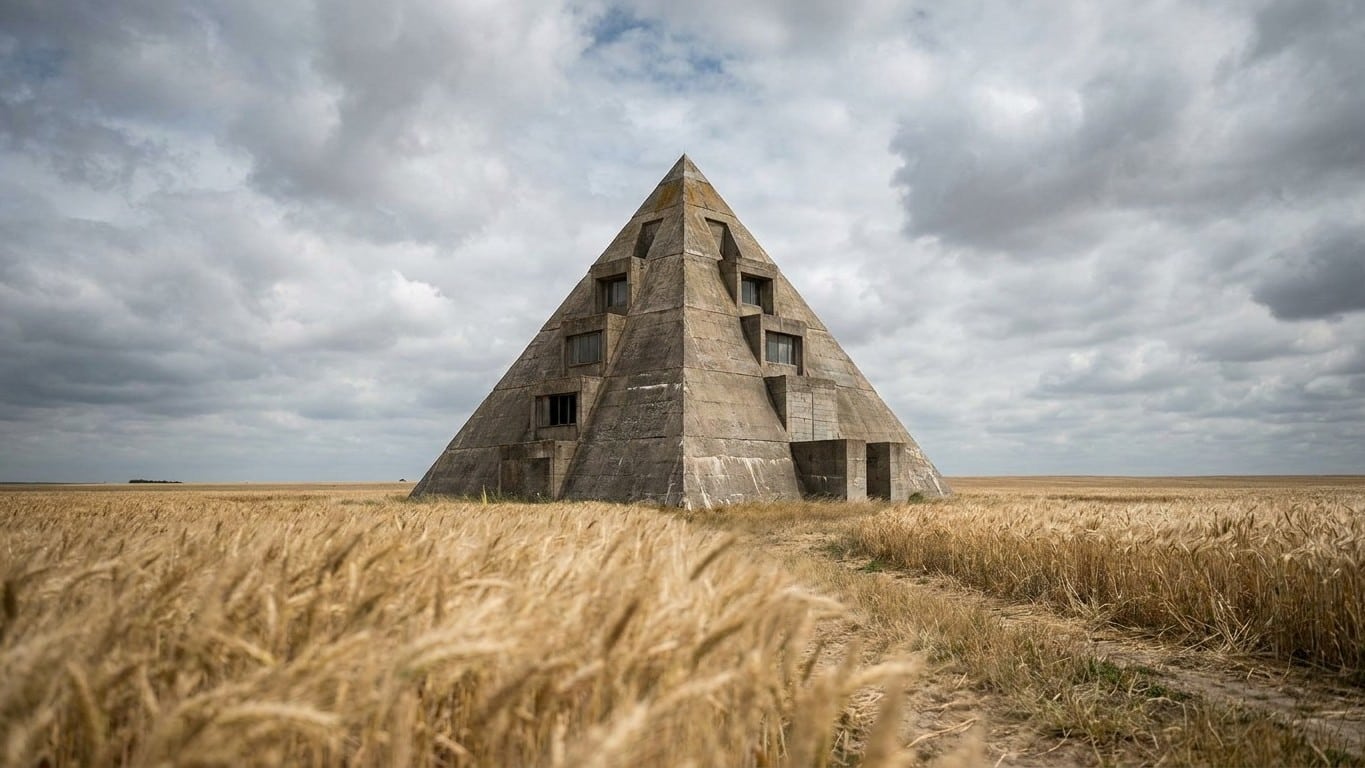
Five billion seven hundred million dollars. A single day of full operational service. That is the brutal summary of the Nekoma Pyramid’s story, the concrete block that has stood in the middle of North Dakota’s wheat fields for more than half a century.
The site is officially named the Stanley R. Mickelsen Safeguard Complex. It cost about $5.7 billion, and its radar system took the shape of a pyramid. That amount, colossal for the era, is today worth roughly thirty billion dollars. The Safeguard system it controlled cost $5.7 billion, or about $32 billion in current value, roughly the price of three nuclear aircraft carriers. Three carriers for a radar that would, in practice, have served only a handful of hours. The anecdote is enough to make any American taxpayer wince.
Key takeaways
- A colossal structure built under the shadow of nuclear fear that was shut down before it truly served
- The SALT negotiations with the USSR made the project obsolete overnight
- This monument to 1970s paranoia is reborn today as a data center for cryptocurrencies
A birth and an administrative death in 24 hours
The chronology is almost comic, if it weren’t so expensive. The military base was the first part of a ballistic missile defense (ABM) system planned in twelve components. It opened on October 1, 1975. On October 2, the House of Representatives voted to close it. Twenty-four hours. That is how long it took lawmakers to deem the installation obsolete, too expensive, or strategically unnecessary in light of evolving negotiations with Moscow.
Yet the site did not close its doors overnight. The base remained operational until February 10, 1976. Another source places the definitive end a little later: the system was declared fully operational in October 1975 and shut down in April 1976. In any case, between the colossal investment made since 1970 and the final shutdown, only a few months of actual service elapsed for a project that had demanded five years of work.
A concrete giant born of nuclear fear
The project dates back to the late 1960s, during the height of Cold War paranoia. It was meant to protect Minuteman missile silos at Grand Forks Air Force Base from a Soviet strike. Authorized by Congress in 1969 and built between 1970 and 1974, the complex integrated two major electronically scanned radars: the Perimeter Acquisition Radar, which scanned the North Pole for incoming missiles, and the Missile Site Radar, housed in the five-story concrete pyramid. This structure served as the command center, directing thirty long-range Spartan missiles and sixteen Sprint high-speed interceptors.
The construction itself was a feat of scale. At its peak, more than 3,200 workers labored under extreme weather conditions. The build required 714,000 cubic feet of concrete, 27,500 tons of reinforcing steel, and more than 2,200 miles of cabling. The pyramid alone represented a spectacular expense: it cost almost $140 million, or about $800 million in today’s dollars. Its walls were not decorative: the four-foot-thick concrete walls were hardened against nuclear effects, the structure comprising 27,500 pounds of steel and 714,000 cubic feet of concrete.
The Russo-American détente, the true driver of the failure
The fiasco did not stem from an abrupt improvisation. It grew out of a diplomatic agreement that rendered the project obsolete even before it could be completed. After negotiations with the Soviet Union as part of the 1972 SALT talks, the United States and the USSR were each limited to two ABM sites; contracts to defend Malmstrom Air Force Base in Montana and Grand Forks were already signed, so those two projects continued. The Montana site, however, never came to fruition: construction was delayed by social conflicts and was never finished.
Nekoma thus remained the sole completed example of a program that originally envisioned twelve. The Nekoma Safeguard complex, which defended Grand Forks Air Force Base, was one of twelve Safeguard systems planned for the country, and the only one completed. Some former military personnel still view it as a disguised diplomatic victory. Many, like the retired non-commissioned officer Clinton Esckilsen, credit the Safeguard program with bringing the Soviet Union to the negotiating table. The argument holds water: billions were saved by not building the other eleven bases, and nearly half of the $5.7 billion spent went into research and development that would have occurred anyway. A useless radar, then, but not necessarily money entirely wasted if one follows this optimistic interpretation.
From a Cold War symbol to a bitcoin farm
For decades, the pyramid languished, emptied, looted, exposed to the elements in a corner of the country where winds and harvests pass by. It was gradually dismantled and emptied of its valuable components over the following decade; its sixteen stairways and supporting beams were removed to prevent visitors from accessing the floors, while all sensitive equipment and missiles were transferred to other bases. The place even faced stubborn environmental issues, with several costly cleanup campaigns removing millions of liters of contaminated water from underground structures.
The site changed hands several times until it was acquired by the county authorities. The Cavalier County Job Development Authority bought the tactical portions of the Safeguard complex in 2017, including the pyramid. The latest project is as surprising as it is amusing: the North Dakota governor announced that a data-center developer specializing in cryptocurrency and sustainability planned to convert the facility into a secure high-performance computing data center, with an on-site greenhouse heated by the heat generated by the servers. A symbol of 1970s nuclear paranoia recycled into a bitcoin facility and winter vegetables: it’s hard to imagine a more ironic jab at history.
Sources: clui.org | grandforksherald.com
