
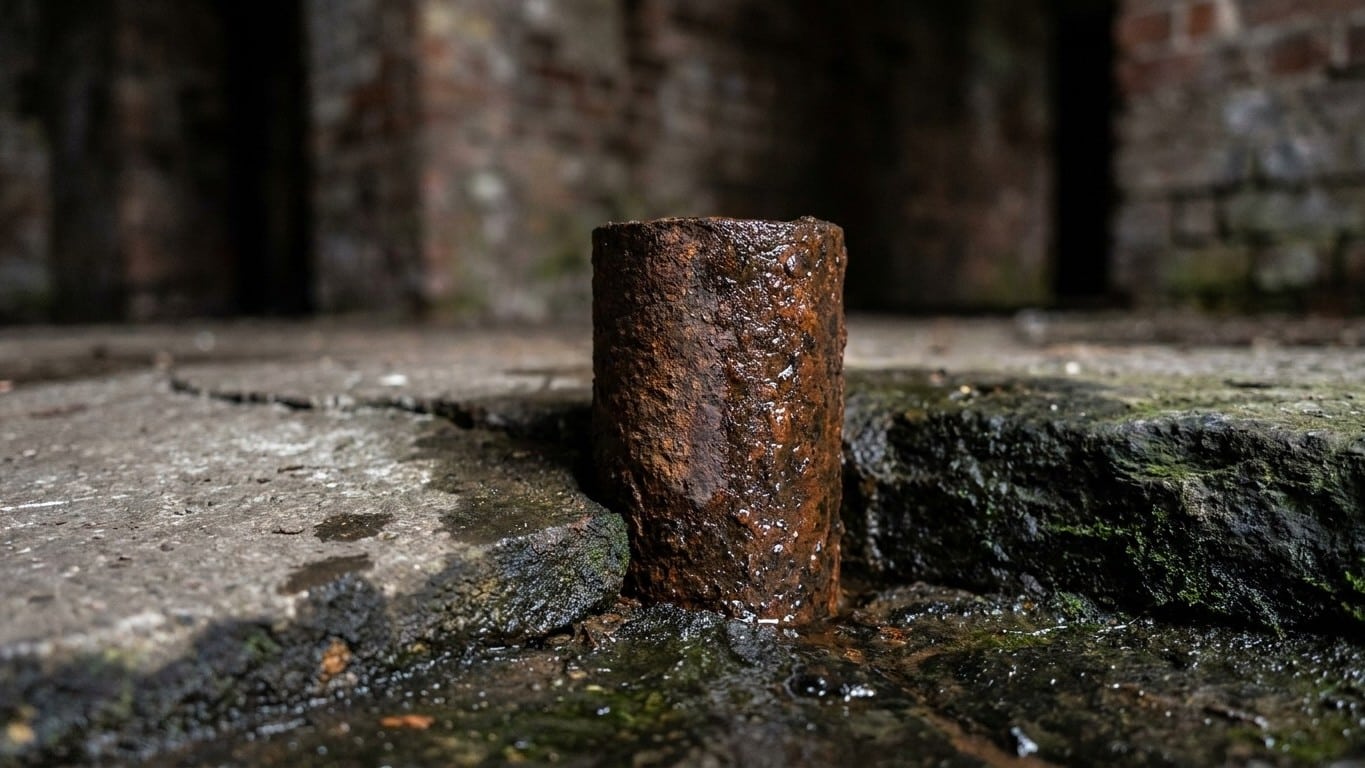
Under the Parisian pavement, between water pipes and electrical cables, kilometers of 6.5-centimeter-diameter metal tubes still lie dormant today. No one has ever come to remove them. Since March 30, 1984, precisely at 5:00 p.m., this network that carried mail across Paris in less than an hour has fallen silent for good, leaving its conduits abandoned in the city’s sewers.
This system was the pneumatic post. An underground ancestor of mail, capable of transmitting a letter from one end of Paris to the other faster than a bicycle courier today.
Key takeaways
- An underground network capable of delivering mail faster than a bicycle courier
- 427 km of tubes still buried under Paris, invisible and forgotten for four decades
- Why authorities never undertook to remove these vestiges of the Belle Époque
A mail propelled by compressed air
The story begins under Napoleon III. Noting that the Paris electric telegraph network was reaching saturation, the emperor decided to implement a pneumatic network, modeled after the London system, drawing on the work of chemist Ador. The first trials took place in December 1866 on a one-kilometer line linking the Paris Stock Exchange to the Grand Hôtel on Boulevard des Capucines. Two years later, the first official line, reserved for administrations, connected the two largest telegraphic centers of the capital, the Stock Exchange and the central post on Rue de Grenelle.
The principle is simple on paper, extraordinary in practice. You slide your letter into a slider, this metal cylindrical capsule designed to fit snugly into the underground tubes of 6.5 centimeters in diameter. The cartridge then travels under the road, propelled by compressed air and by vacuum, at a speed reported by sources to range from 24 to 40 km/h. The message generally arrived in the hands of specialized couriers who promptly delivered it to the right address, in less than an hour and a half from deposit to delivery. At a time when the telephone remained a rare luxury, this was a silent revolution.
The engineer Belgrand, the very one who redrew the Paris sewer network at the same time, played a key role in this underground coexistence. From 1868, the tubes were laid in the broad sewer conduits installed by Belgrand. Paris thus became the first city to stack, beneath its streets, a wastewater network and a rapid communications network. The eight plants that supplied the system with compressed air, at Breteuil, Forest, Valmy or Pajol, acted as the city’s true mechanical lungs.
Des « petits bleus » de la Bourse aux ministères
The network remained long reserved for administrations. With the 1879 decree signed by Marshal Mac-Mahon, it officially opened to the public and correspondence became real postcards carried through tubes. They were nicknamed the “little blues,” in reference to the color of the paper used. The success was immediate among business circles and the Parisian bourgeoisie, who found there an unbeatable way to fix a meeting in just a few minutes.
The expansion continued relentlessly for half a century. By 1879, there were already 71 kilometers of lines serving 40 offices in Paris. The network then climbed to its zenith: in 1934, the Paris pneumatic network reached its peak with a length of 427 kilometers, serving 130 offices in the capital and distributing about ten million pieces of mail per year, with a maximum of 30 million messages in 1945. There was a single expansion outside Paris’s borders, toward Neuilly-sur-Seine, where a bourgeois clientele fond of pneumatic mail resided as early as 1914.
The price of sending was no trivial matter. By 1957, the cost of a pneumatic dispatch rose to five times the price of a postal letter, whereas the ratio had stayed at one to three since 1902; this ratio would reach 7.8 in 1975. Sending by pneumatic mail became increasingly expensive as the service declined, a classic vicious circle for aging infrastructure facing cheaper competitors.
Why these tubes were never removed
The network’s end was not caused by a dramatic failure, but by slow technical obsolescence. As early as the 1960s, maintenance became a bottomless pit. In 1966, 57% of 80 mm tubes were worn, as was 65% of 65 mm tubes, triggering cascading incidents: 270 cartridge jams in 1970 had to be retrieved from the sewers. Imagine agents wading through Paris’s conduits to retrieve a letter jammed between two bends in a tube, all for a message that could have gone by telex in a few seconds.
The telex, then the fax, delivered the coup de grâce. The infrastructure aged, maintenance costs became prohibitive: the Ministry of Posts and Telegraphs announced closure for March 30, 1984, and on that Friday at 5:00 p.m., the service stopped. The shift moved to newer technologies: this closure coincided with the opening a few months earlier of two new postal services, Posteclair, a public telex-fax service created in late 1983, and Postexpress, a rapid parcel delivery system in the Paris region created in January 1984. The tubists, these specialized couriers who ran through the underground corridors, were for the most part reassigned to this new parcel service.
And the tubes, then? No one deemed it useful to extract them. Digging under a whole city to remove conduits that had become useless would cost a fortune, with no practical benefit, the space they occupy being marginal compared to water, gas, or fiber networks that already share the pavement. Material vestiges still sleep beneath the capital’s asphalt, segments of tubes survive in the sewers, invisible to the millions of Parisians who walk above them every day without suspecting them.
A detail still amuses postal historians: in 1970, part of the network had already shifted to a more modern material, since there were 18 kilometers of plastic lines alongside the original steel tubes, some laid as early as the 1860s. These heterogeneous vestiges, century-old steel and Pompidou-era plastics, form today a buried time capsule that even sewer workers rarely cross, so much have the pneumatic tubes blended into the inextricable technical landscape of Paris’s underground.
Sources: comitehistoire.laposte.fr | comitehistoire.laposte.fr
