
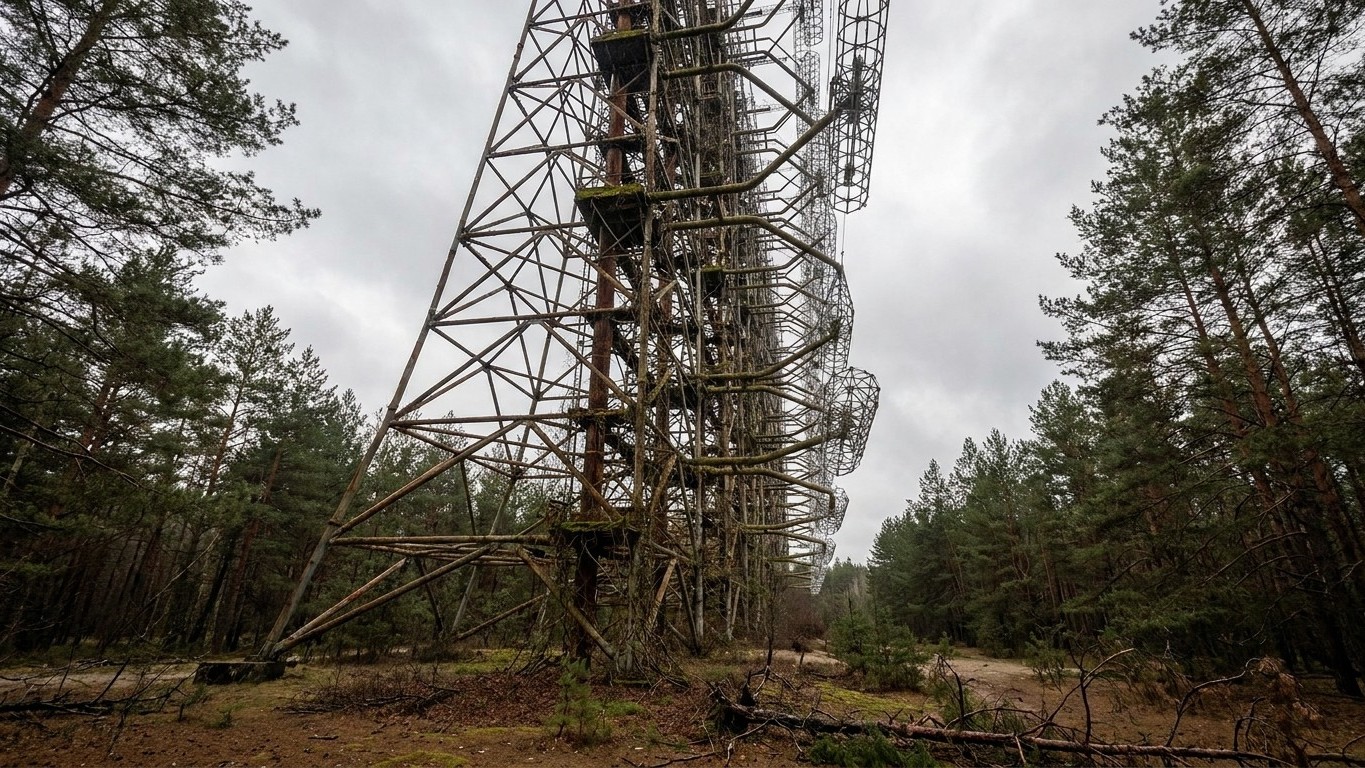
Since 1989, a 700-meter-long and 150-meter-high steel carcass has rusted quietly in the Chernobyl exclusion zone. Its name: Duga-1. For thirteen years, this antenna sent a signal so powerful that it disrupted radio communications worldwide, from commercial air traffic to shortwave amateur radio enthusiasts. A global electronic racket, triggered by a structure that Soviet maps cheekily presented as a children’s holiday camp.
Key takeaways
- A 700-meter steel structure hidden under a fictitious identity: how the Soviets camouflaged their most ambitious project
- The mysterious signal that wreaked havoc on global airwaves for thirteen years without anyone really knowing its origin
- A technology worth a billion rubles that became obsolete before it could complete its first genuine mission
A steel wall planted in the Ukrainian forest
The Duga radar antenna stretched 700 meters in length and 150 meters in height, and the Soviets built two of them—one near the town now abandoned of Chernobyl, called Duga-1, and another in Siberia. From afar, the whole thing looks like a metal wall rising out of nowhere amid the pines. Up close, you discover a colossal, decaying structure, made up of hundreds of antennas and devices. The project was anything but trivial: constructing the site at Chernobyl-2 cost twice as much as building the Chernobyl nuclear plant itself, a staggering investment for the era.
The purpose of this technological behemoth was encapsulated in a single sentence: to monitor the American sky. The radar system’s primary objective was to detect and track intercontinental ballistic missiles launched from the United States, providing the Soviet leadership with early warning in the event of a nuclear strike. Technically, the installation rested on a physical trick as elegant as it was energy-hungry. Duga used shortwave radio signals capable of traveling thousands of kilometers thanks to a technique called “beyond line of sight” radiolocation, designed to detect the flames of exhaust from missiles at launch. An achievement for the 1970s, but it demanded colossal power consumption, to the point that some estimates suggest a third of the neighboring power plant’s output went to it.
The tapping that drove radio amateurs around the world crazy
On July 4, 1976, something strange flooded the shortwave bands. For the first time in 1976, the world heard this repetitive, insistent pulse, reminiscent of a woodpecker’s tapping, emitted by the transmitters. The sound, a mechanical and obsessive clack, intruded on amateur radio transmissions, aircraft communications, and even certain Western military frequencies. Its power was extraordinary: the Duga systems were immensely powerful, sometimes exceeding 10 MW, broadcasting on shortwave bands, and appearing without warning as a sharp, repetitive tapping at 10 Hz. It quickly earned itself a memorable nickname.
The nickname stuck: the antenna’s signature signal could be heard across much of the northern hemisphere’s shortwave, resembling the tapping of a Russian woodpecker, hence the quick sobriquet “Russian Woodpecker.” Complaints poured in from around the world, with no clear response from Moscow. Random frequency hops disrupted legitimate broadcasts, amateur radio operations, oceanic commercial aviation communications, and utility transmissions, triggering thousands of complaints from many countries. In the face of this unresolved mystery, Western imagination ran wild. While radio insiders understood it was some form of beyond-the-horizon radar, conspiracy theories proliferated—ranging from mind control or weather manipulation to fears that the signal could destroy brain cells. Enthusiasts even formed a group, the “Russian Woodpecker Hunting Club,” to try to filter out and block this global tapping.
A vacation camp that hid the Kremlin’s best-kept secret
How do you hide a 700-meter steel wall visible for miles around? By playing the absurd. On Soviet maps, the radar Duga was marked as a children’s vacation colony. The cartographic deception went so far as to include a fake bus stop for kids, built solely to mislead anyone traveling that road, making them think they were headed to a summer camp, when in reality they were approaching the top-secret radar facility of Duga-1. The stop still exists, complete with a Moscow 1980 Olympics bear mascot planted in the middle of a radioactive forest.
The most entertaining anecdote concerns an American journalist. Legend has it that Phil Donahue, one of the first American journalists allowed into Chernobyl after the disaster, asked his official guide what that surreal silhouette on the horizon was, and was told it was an unfinished hotel. The lie held firm until the 1986 nuclear accident, which precipitated the evacuation of all military personnel from the site.
Why Duga fell silent in 1989
The explosion of reactor No. 4 signaled the end of the program. After the plant disaster, the military site was shut down, and in 1989 the final signals were captured. Radioactive contamination made it impossible to keep staff there, but geopolitics also worked against the installation. It was a billion-ruble gamble that had already lost relevance—the concrete still drying—because by the time the antenna became operational, Americans and Soviets were already turning to satellite systems. Duga ultimately never fulfilled its primary mission: no intercontinental missile launches were ever detected from the Ukrainian forest.
Today, the structure attracts urban explorers despite the risks. Some visitors illegally climb the 150-meter antenna, in an area where residual radioactivity is still closely monitored. A detail that continues to amuse radio enthusiasts: Russia has revived the concept elsewhere, far from the contaminated forest, proving that the idea of an over-the-horizon radar, as loud and flawed as it was at Chernobyl, was never entirely abandoned by Moscow.
Sources: warhistoryonline.com | wildeast.blog
