
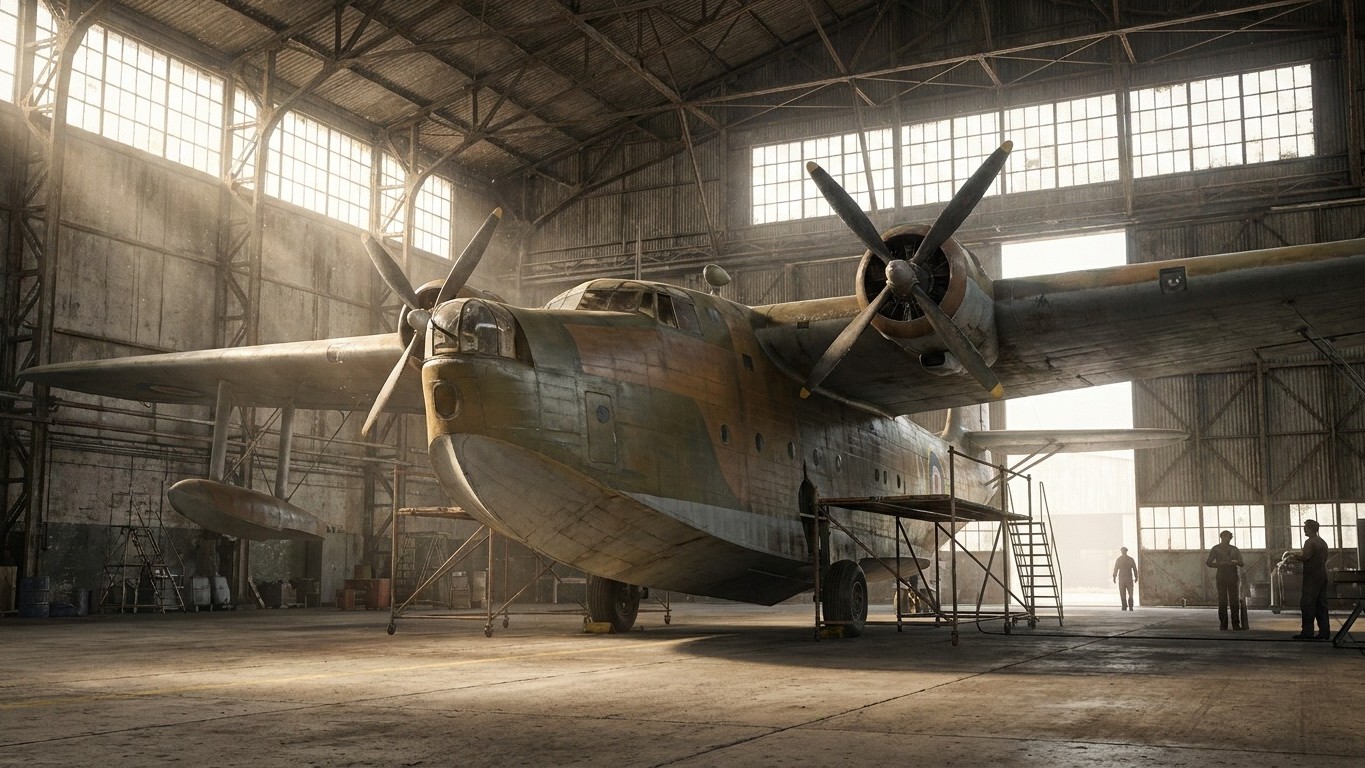
A wingspan of 97.8 meters, built entirely of wood, that flew only once in its entire lifetime and for barely a minute. Then thirty years spent waiting in a climate-controlled hangar, lavishly maintained by its millionaire owner who could have launched it at any moment yet never lifted off. This tale isn’t the stuff of urban legend: it is the story of the Hughes H-4 Hercules, better known by the nickname he loathed, the “Spruce Goose.”
Key takeaways
- A 97.8-meter wingspan aircraft built entirely from plywood: why choose such an unusual material?
- A single minute of flight in 1947: how Hughes silenced his critics
- Thirty years of climate-controlled hangar maintenance, at a cost of about a million dollars annually
A Birch Giant Born from Wartime Shortages
The story begins in the chaos of the early 1940s. The aircraft was conceived as a response to heavy losses among American cargo ships in 1942, battered by German submarines in the North Atlantic. A means to transport troops and materiel without fearing U-boats was needed. The idea took root in the mind of industrialist Henry J. Kaiser, but it was Howard Hughes and his company Hughes Aircraft who shouldered the design and construction of this colossal project.
Even today, the material choice raises eyebrows. With metals rationed for the war effort, the plane was built almost entirely from laminated wood, principally birch, using the Duramold process. There was no spruce involved, despite the mocking nickname: the structure largely consists of birch plywood rather than solid wood. A technical decision that transformed into an engineering feat, given that the wooden components had to bear the enormous loads for an aircraft of this scale.
The project dragged on, consumed public funds, and ignited a heated controversy. In 1947, a Senate wartime-investigation committee summoned Howard Hughes to account for the $27 million invested by the War Department in the project. But the war had already ended. The military need that had justified the behemoth flying boat had dissipated long before the aircraft touched water for the inaugural time.
A One-Minute Flight to Silence the Critics
On November 2, 1947, at the Port of Long Beach in California, Hughes decided to settle the matter once and for all. He took the helm, with David Grant as co-pilot and a crew of test pilots and engineers, for three high-speed taxi tests. On the third run, in gusty crosswinds of about 20 knots that kicked up spray, he pushed the throttles to 2,200 rpm and lifted the aircraft from the water for just over a mile, roughly a minute of flight, briefly reaching 70 feet in altitude at about 95 mph.
Twenty-six seconds. That is the precise duration cited by several accounts for this solitary flight in aviation history. On the third pass, Hughes accelerated unexpectedly, allowing the craft to lift off for 26 seconds over a one‑mile span, at an altitude of 70 feet above the water. No further takeoffs would follow. The context had changed—the government no longer needed this giant seaplane—and yet Hughes refused to abandon what he regarded as his masterpiece.
Thirty Years in a Climate-Controlled Hangar, a Million Dollars a Year
The story then veers into the absurd, and at the same time, the captivating. Rather than dismantling the aircraft or letting it rust, Hughes chose to preserve it in a state of perpetual readiness. He regarded the H-4 as one of his greatest aeronautical accomplishments and, from 1947 until his death in 1976, kept the machine in a climate-controlled hangar at the Port of Long Beach. For three decades, the airplane remained primed to take off, never actually leaving the ground.
The maintenance bill is staggering. Hughes paid $800,000 to acquire the aircraft and had it hermetically sealed within a massive climate-controlled hangar, at an expense of about a million dollars per year, ready to fly at a moment’s notice. To sustain this level of care, a veritable army of technicians rotated through the project. Up to 300 people were employed for upkeep into the early 1960s, later reduced to roughly 50.
What stands out is the sheer stubbornness of the man. Hughes, at the height of his wealth, chose to devote the equivalent of several modern‑day millions of dollars each year to an aircraft that would never fly again. Officially, the craft belonged to the U.S. government, but Hughes bore the cost of its upkeep out of his own pocket, year after year, until his death in 1976.
From Hangar to Museum: The Second Life of the Wooden Giant
After Hughes’s passing, the airplane changed hands several times. It first moved under the guardianship of the Aero Club of Southern California, then was displayed inside a geodesic dome in Long Beach alongside the Queen Mary liner. When Disney took over the site management in the late 1980s, the company no longer had room for such a monument. In 1992, Evergreen Aviation & Space Museum won the bid to house the aircraft, building a new hangar at its McMinnville, Oregon, headquarters.
The journey to its final destination proved nearly as remarkable as the aircraft itself. The H-4 arrived at McMinnville on February 27, 1993, after 138 days and 1,055 miles of travel from Long Beach—by barge, train, and truck. Since then, the Spruce Goose has stood in this Oregon museum, continuing to draw curious visitors who come to behold this flying paradox: the largest aircraft ever built, a machine that spent most of its life grounded.
One detail deserves emphasis: for more than seven decades, nothing matched its wingspan. It wasn’t until 2019, with the advent of the Stratolaunch—featuring a 115-meter wingspan—that the record set in 1947 finally fell. It took nearly eight generations of aviation advancement to surpass a plane that, at heart, never truly took to the skies.
Sources: media24.fr | baonghean.vn
