
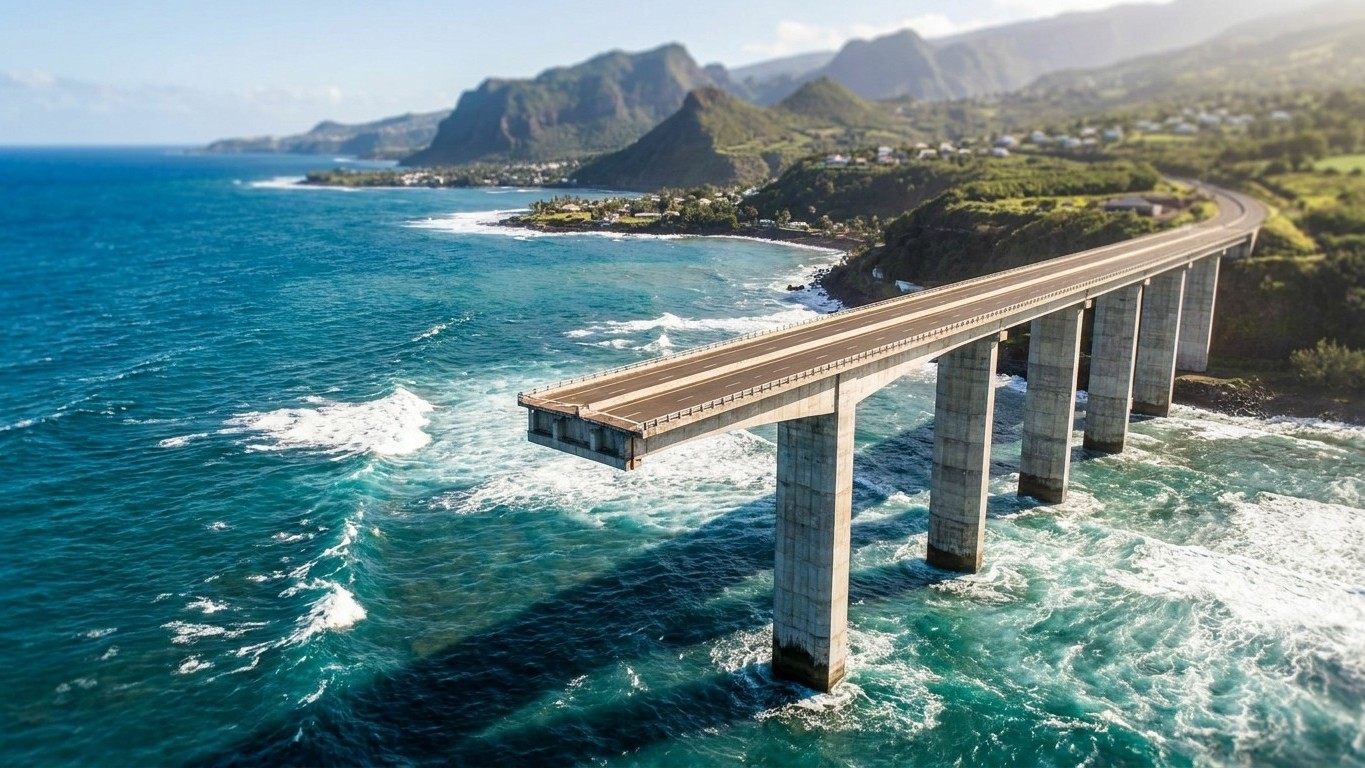
The longest viaduct in France ends above the waves, and you have to squint to realize it isn’t a disaster-movie set. Since 2022, the highway meant to connect Saint-Denis to La Possession on Réunion terminates abruptly in the open sea. Drivers traversing this concrete ribbon laid across the Indian Ocean must at some point descend back onto the old coastal road, the very one the structure was supposed to replace.
Twelve years after the first spadeful of earth, the Nouvelle Route du Littoral project embodies a simple truth: building an extraordinary bridge isn’t enough if there’s no plan for how to finish the rest.
Key takeaways
- A 5.4 km viaduct, the longest in France, stops inexplicably in the sea for three years
- The breakwater intended to complete it was never built due to a lack of approved stones
- A second viaduct costing 846 million euros is now set to finish the project by 2030
An extraordinary viaduct, but half of it is missing
Technically, the structure is impressive. This prestressed concrete work of art spans 5,409 meters, making it the longest bridge in France, and it rests on 48 offshore piles off Saint-Denis, linking Le Barachois to La Grande Chaloupe. Its construction involved staggering amounts of material: about 300,000 cubic meters of concrete and 38,000 tons of steel. The viaduct was completed on April 30, 2019, inaugurated on March 30, 2021, and opened progressively starting August 28, 2022.
Three years between its physical completion and its actual opening already sums up the chronic difficulty of keeping to deadlines on this project.
The project aimed to replace a coastal route that had become a deadly trap. The current coastal road is battered by weather and rockfalls, which have caused 21 fatalities since its opening in 1976. Built away from the cliff, the viaduct provides a level of safety the old road could no longer guarantee, boxed in by surges and landslides during every cyclone season.
The breakwater that never found its rocks
The original plan did not foresee just one project but two: a viaduct on the Saint-Denis side, and a rock-filled breakwater along the rest of the route to La Possession. This breakwater would have swallowed enormous quantities of stone. All of the breakwaters already built required 20 million tons of stone—roughly half for rock armor, the other half for backfill—with imports being marginal, around 50,000 tons sourced from Madagascar. The island simply could not rely on imports alone: it needed local quarries, and quickly.
That’s precisely where the project hit a snag.
In late 2018, the prefecture authorized the Bois-Blanc quarry in Saint-Leu to operate, anticipated to supply most of the missing stones. But the administrative courthouse in Saint-Denis de la Réunion annulled the prefectural exploitation order and suspended the preliminary clearing authorization issued at the end of 2018. Opponents, environmental associations and the Saint-Leu town hall filed appeals, arguing “significant nuisances for the population, grave risks to the environment and biodiversity.” The court did not mince words about the project’s handling, stating that “the Nouvelle Route du Littoral project is characterized by the absence of a real plan for the supply measures to carry out the breakwater portion of the structure.”
The Conseil d’État confirmed the decision, effectively burying the quarry project. Result: the breakwater work halted in 2019 for lack of material available and legally authorized. A Saint-Leu resident had even been consulted by a local referendum on the subject, with 81.1% voting against the quarry project, but only 7,194 of the 25,595 registered voters turned out. The turnout, lacking the requisite participation, made the vote only advisory, yet it solidified local opposition.
The 180-degree turn: goodbye to the breakwater, make way for a second viaduct
Facing an impasse, the Réunion Region ultimately changed course. Rather than endlessly seeking quarry stones, the State and the local authority decided to abandon the breakwater solution in favor of a second viaduct to close the remaining 2.5 kilometers to La Possession. This decision was sealed by the “Matignon III” protocol, signed in March 2022. The project’s price tag is far from trivial: estimated at 846 million euros, with the State confirming support by provisioning 420 million euros, including 139 million from the VAT Compensation Fund, or 50% of the project’s cost.
The regional president expresses clear satisfaction at finally unlocking the file. As she puts it, letting the project stagnate in 2019 was not an option; the chosen path is to complete and finish the Nouvelle Route du Littoral with a fully open road by 2030. The new viaduct will extend directly from the existing structure, and it will be designed to withstand extreme conditions: anchored at up to 20 meters below the sea surface, it is engineered to endure a cyclone swell exceeding 10 meters.
Practically, the work will not restart all at once. The new La Possession interchange, slated for mid-2027, will allow direct connection between RN1, the connecting breakwater, and local roads, before the ends of the breakwaters on either side of the future viaduct must be reconfigured. Construction on the new viaduct will begin in 2027 and run through early 2030, with full operation targeted for mid-2030. A first step is already underway: the La Possession junction segment will open to traffic in the Saint-Denis–West direction in August 2026, then in both directions by December. Ironically, the missing stretch—the part initially considered the simplest of the project (a breakwater rather than a bridge across open sea)—will be completed after the viaduct that it was meant to complement.
What stands out, in the end, is not so much the delay as the complete reversal of the technical logic: what was deemed too complex and expensive at the outset (a second viaduct) became the only viable option in the face of a solution that seemed simpler (the breakwater) but proved politically and legally impossible to implement. In the meantime, Réunion’s drivers will continue, until 2030, to use the 1976 road that claimed 21 lives, waiting for the viaduct to rise above the waves.
Sources: la1ere.franceinfo.fr | france-digues.fr
