
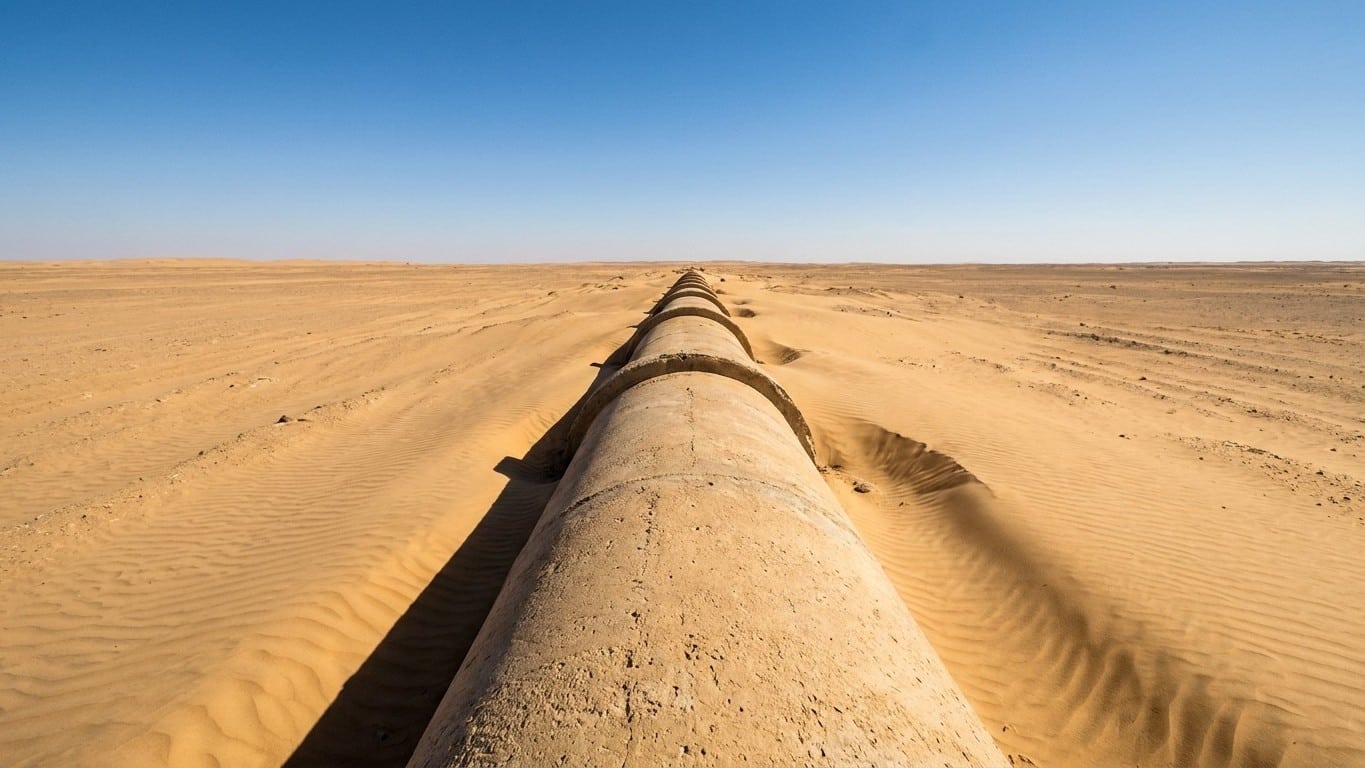
Since 1984, four thousand kilometers of concrete pipes, as wide as a two-story building, traverse the subsurface of the Libyan Sahara. This network carries toward Tripoli and Benghazi water that is tens of thousands of years old, drawn from an aquifer that hardly recharges anymore. The problem isn’t leaks, vandalism, or even the war that damaged the system. The problem is that what comes out of the ground will never return.
Key takeaways
- Why Muammar Gaddafi chose the desert over the Mediterranean Sea to tackle the water crisis
- What is this 100,000-year-old water that flowed when the Sahara was home to hippos
- How a NATO bombing sealed the fate of a project meant to last for generations
An Underground River Financed by Oil
The Great Man-Made River remains one of the largest hydraulic undertakings ever accomplished. On August 28, 1984, Gaddafi laid the cornerstone in the Sarir oil field region, and two years later inaugurated the Marsa El Brega factory for the production of prefabricated cylindrical concrete pipes. The pipelines themselves are staggering: they measure 4 meters in diameter, consist of 7.5-meter-long cylindrical segments, and weigh 80 tons each. In effect, they bury, literally, the equivalent of a highway bridge across thousands of kilometers.
Funding came almost entirely from Libyan oil revenues. This project, planned for 25 years, was the product of Muammar Gaddafi’s will, pursued with the help of technologies imported from South Korea, and absorbed half of Libya’s budget. A number that is dizzying: 25 billion dollars of public funds poured into buried pipes, for a country whose total population today does not exceed seven million. And yet, economically, the operation had a compelling logic. The cost of one cubic meter of water through this system was 35 cents, while obtaining a cubic meter of desalinated water costs 3 dollars. Facing the nearby Mediterranean, Gaddafi chose the desert over desalination.
Water That Fell from the Sky 100,000 Years Ago
That is the crux of the problem. The resource being exploited is the Nubian Sandstone Aquifer System, an aquifer that stretches beneath Egypt, Libya, Sudan, and Chad. It is the largest known fossil-water system in the world, located beneath the eastern edge of the Sahara. Its volume is colossal: it is estimated to contain about 150,000 cubic kilometers of underground water, a reserve whose scale defies human comprehension.
But this water has nothing to do with a river or a conventional aquifer that recharges with the seasonal rains. Carbon-14 dating has shown that much of this groundwater is fossil, and that substantial recharge occurred during the humid wet phases of the Pleistocene to the Holocene. Concretely, this water fell on a green Sahara, at a time when giraffes and hippos roamed a region that is now arid. The majority of the water in the system dates from between 100,000 and 1,000,000 years ago.
The current renewal rate is negligible. A study focusing on the Eastern Desert of Egypt, a comparable region, concluded unequivocally: today, the Nubian aquifer receives only a little water during the flash flood season, and its recharge rate is “zero,” in the words of the quoted researcher. Elsewhere, in the Sinai, scientists have detected some modern local recharge, but it is negligible: barely 13 million cubic meters per year, while the Great Man-Made River alone withdraws an estimated 2.4 cubic kilometers annually, for consumption and agriculture. The ratio of input to output is dizzying: we are drawing from an account that will never be replenished.
A Project Weakened by War
This already resource-depleted system suffered another blow, this time human. In July 2011, during NATO’s military intervention against Gaddafi’s regime, one of the two factories manufacturing the network’s pipes was targeted. NATO aircraft bombed and destroyed one of the two pipe-making facilities of the GRA at Brega, with the Alliance claiming to possess evidence that the plant was being used as military storage by Gaddafi’s forces. The concrete result: no factory can today produce replacements for these giant pipes on Libyan soil.
The fallout did not stop there. Civil war interrupted the work from 2011 onward, leaving the project 70% complete. Without a stable central authority and without an upkeep budget, the network deteriorated year after year. By 2019, many wells had been dismantled, and in 2020 an armed attack interrupted water supplies to more than two million people. This episode is corroborated by other sources: a station controlling water supply to Tripoli and nearby towns was seized on April 10, 2020 by an unknown armed group, cutting water to over two million people, an action condemned by the United Nations for humanitarian reasons.
The paradox is bitter. A project designed to guarantee Libya’s water independence for generations now depends on a network that is cracking, short of parts and technicians, while drawing from a stock that will never be replenished. The resource is shared among four countries, Egypt holding 38% of the aquifer, Libya 34%, Sudan 17%, and Chad 11%, turning every cubic meter pumped on Libyan soil into a silent diplomatic negotiation with its neighbors. It is hard to imagine a more stark symbol of the finiteness of Earth’s resources than a concrete pipe, laid forty years ago, slowly draining a climate memory dating back about 100,000 years.
Sources: leblogfinance.com | egaliteetreconciliation.fr
