
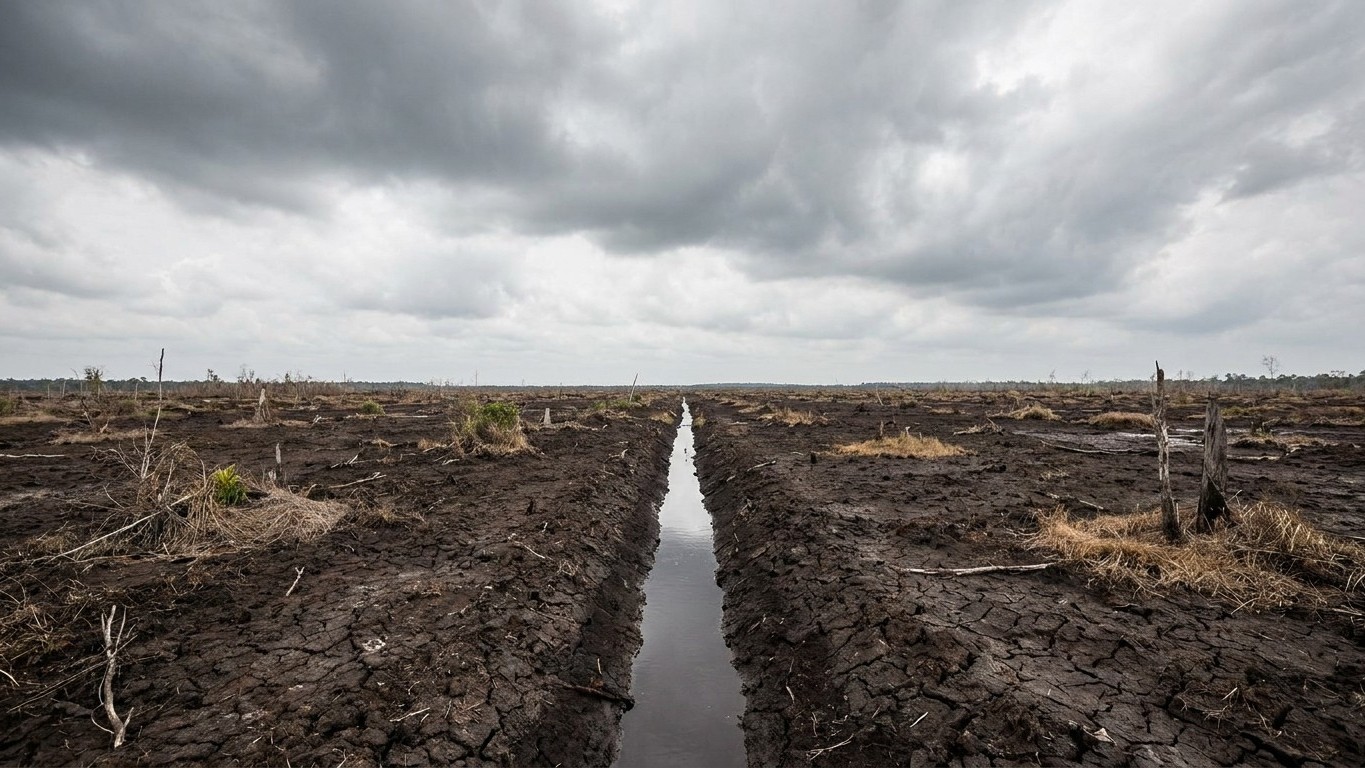
All began with a presidential decree. The project, launched in 1995 under the rule of the formidable leader Suharto, was without precedent in its scale: one million hectares of rice paddies, an area twice the size of the island of Bali, spread across peatlands in Central Kalimantan province, to bolster the country’s food security. The political objective was clear: Java, the economic heart of the archipelago, was losing its rice lands to industrialization, and Suharto sought to offset this retreat by opening up new lands on peripheral islands.
The work started in haste. The construction of canals began abruptly at the end of January 1996. Thousands of bulldozers and tens of thousands of workers were mobilized. They dug roughly 4,600 kilometers of drainage canals to keep the soil sufficiently dry during the rainy season and to irrigate crops in the dry season. Some studies, such as those published within research on the hydrological restoration of the area, cite a slightly different figure: about 4,475 kilometers of canals of varying sizes built between 1996 and 1998. The range varies by source, but the scale remains staggering: enough to connect Paris to Borneo itself, several times over.
A Land That Refused Rice
Yet the soil never followed the plan. The government had not anticipated that peat soils are nutrient-poor and ill-suited to irrigated rice cultivation. The result? An almost total failure. The project proved an unambiguous disaster, with not a single productive grain of rice ever growing. The precise figures, documented by the Center for International Forestry Research (CIFOR), quantify the fiasco: the project, implemented in 1996-1997, covered 1,050,400 hectares and had enabled the construction of 1,145 kilometers of primary drainage canals, but despite its ambitious aims, it managed to establish only 30,000 hectares of rice paddies. Three percent of the targeted area, for zero significant harvest.
Nyoman Suryadiputra, now the executive director of Wetlands International Indonesia, filmed the construction site in 1996 with a Betamax camera. He still recalls the scene: “The monkeys scattered as the excavators advanced. And many of the excavators sank [into the peat] because the soils were too soft while the machines could weigh up to 22 tons.” A nearly burlesque image, except that the consequences were anything but funny.
The regime collapsed before the project could do so itself. In 1999, President Habibie permanently shut down the Mega Rice Project, declaring it a complete failure, just three years after its inception by his predecessor Suharto. What remained was a ravaged landscape: thousands of kilometers of open trenches, a peat forest razed, and no one left to take care of it.
The Climate Time Bomb
The real problem began after the project’s abandonment. A drained peatland is not merely infertile soil: it is fuel waiting for a spark. The drought linked to El Niño in 1997 dried out tropical peatlands, triggering rapid biogeochemical oxidation of the soil and its ignition. The flames did not stay confined to Kalimantan. From late 1997 through 1998, the swampy peat forests of central Kalimantan burned, sending plumes of smoke as far as Sumatra, Singapore, and Malaysia. The scale of the emissions is dizzying: according to some scientific estimates, the amount of carbon dioxide released by the Indonesian fires in late 1997 equaled between 13% and 40% of the world’s annual fossil-fuel carbon emissions.
Eighteen years later, the story repeats itself, and it is worse. In 1997 as in 2015, exceptionally severe fires in the tropical peatland regions of Southeast Asia released between 0.81 and 2.57 gigatons of carbon into the atmosphere, up to 40% of the global total fossil-fuel emissions in those years. The 2015 crisis left tangible marks on the population: the smoke from the fires made half a million Indonesians sick and polluted the air of neighboring countries. The economic cost was equally brutal: the losses to Indonesia’s economy due to the 2015 fires, factoring in the destruction of property, infrastructure, and lost crops, surpassed 16 billion dollars, or 1.8% of the country’s GDP.
In light of this assessment, Jakarta eventually acted. Two decades after the project’s abandonment, parcels of the Mega Rice Project are now targeted by a public peatland restoration program. The agency in charge of this effort, BRG, is betting on blocking canals to raise the water table rather than undertaking new large-scale works. In Pulang Pisau, the district housing the project’s largest canal, a pilot on only a thousand hectares aims to prove that peat can be cultivated without ignition. An initial hectare was tested in a neighboring village; today there are seven hectares of peat developed without fire in the same locality. Seven hectares, versus the one million promised in 1995: the report speaks volumes about the modesty and caution with which Indonesia now seeks to repair one of its greatest environmental mistakes.
Sources: academia.edu | researchgate.net
