
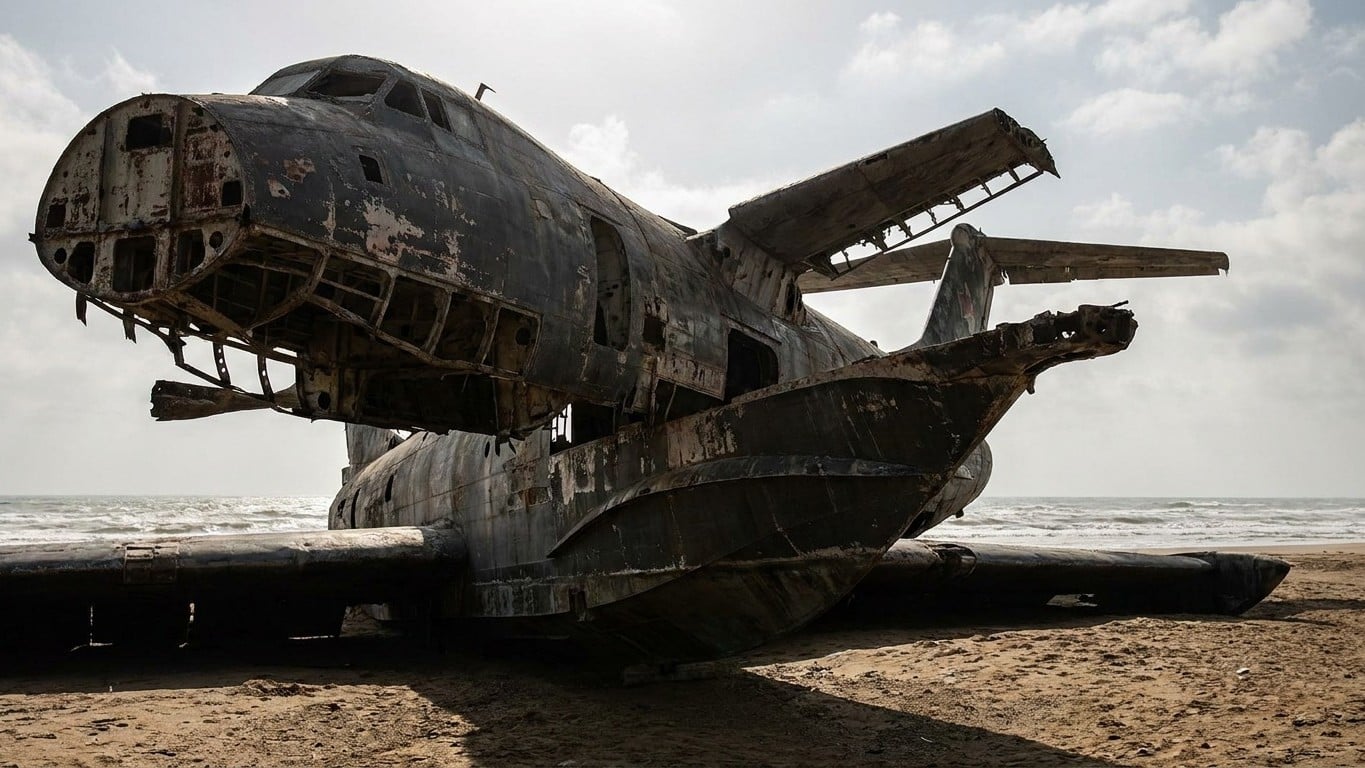
On a secluded beach about twenty kilometers south of Derbent, a 380-tonne hulk has lain buried in the sands of Dagestan for six years. Neither aircraft nor ship, the craft measures 73 meters in length, almost the height of a twenty-storey building lying on its side. It is named MD-160, but everyone knows it by another name: the “Caspian Monster.”
Built at the Krasnoye Sormovo shipyard, on the banks of the Volga, this Lun-class ekranoplane entered service with the Soviet Caspian Fleet in 1987. Its mission: to skim just above the waves, a few metres off the water, to evade enemy radars before unleashing its anti-ship missiles. Six launch tubes for the formidable P-270 Moskit anti-ship missiles adorned its rear, capable of emerging on radars at 500 km/h and firing six missiles at a group of aircraft carriers before anyone noticed. A concept that was fascinating on paper, never truly tested in combat.
The collapse of the Soviet Union abruptly halted this ambition. Only the MD-160 reached completion, while a second airframe intended for rescue missions was abandoned in the early 1990s after the program was cancelled and the Soviet Union collapsed. The MD-160 itself was withdrawn from service at that time. It was sent to the Kaspiysk naval base, where the aircraft would rot in the open air for nearly thirty years, forgotten by everyone except military history enthusiasts who chase its satellite photos on Google Earth.
Key takeaways
- A unique military craft lies abandoned on a beach for six years
- The journey toward its supposed museum turned into an obscure maritime fiasco
- Years of promises never culminated in real protection of the heritage
A Tow That Goes Awry
The summer of 2020 was meant to mark its revival. On July 31, 2020, the Russian Defense Ministry announced that the ekranoplane had arrived in Derbent after a 14-hour journey from the Kaspiysk naval base; a full day was needed to prepare the aircraft, non-operational, before a tug would tow it to its new site. The stated aim: to make it the centerpiece of a future Patriot Park, an open-air military museum celebrating Soviet and Russian power.
The transport quickly turned into a fiasco. The aircraft ran aground in the surf zone, far from the dry beach intended, and remained stuck for months. A report published in August 2020 noted that the hull, exposed to waves in the surf zone, was taking on water, which could have caused further damage during storms. Russian observers, including photographers who tracked the case on Instagram, feared then a total loss of this unique piece. It would take until the end of the year for a rescue operation to finally pull the wreck ashore.
The rescue itself spared nothing for the craft. Towed to the shore at the end of December 2021, the MD-160 sustained damage to wing boxes and the fuselage during transport and the dragging across the beach. The result: a giant already worn by three decades of neglect, now dented by its own “rescue” operation.
A Museum That Still Does Not Exist
Six years after its arrival, the promised Patriot Park never materialized. All this time, the Lun has remained literally stranded, waiting for the museum to be built around it, not officially open to the public even though the beach where it rests could technically be off-limits. No roof, no fence, no proper interpretive signage. Just 380 tonnes of steel laid on the sand, under the sun and the Caspian spray.
This total lack of protection did not stop the site from becoming an attraction. The photogenic appeal of this unique Soviet craft attracted many Russian tourists who, due to Covid travel restrictions, flocked to Dagestan; the Lun even became an Instagram reference. Some visitors, bolder than others, managed to slip inside despite the absence of official permission. A transformed piece of Soviet military heritage, almost inadvertently, serving as a backdrop for selfies.
The Atlas Obscura site confirms the current situation: as early as summer 2021, the Lun stood on the shore, and anyone taking a short taxi ride from Derbent could tour and observe this unique creature. Access remains rudimentary: there is no public transport to reach it, the best option is a taxi from Derbent and to ask the driver to wait during the visit. No ticket booth, no guard, no climate-controlled display case. Just a beach, a rusted giant, and locals who know the address by heart but have never seen it written anywhere.
A Restoration Finally Announced?
At the end of 2024, a beginning of movement appeared from the authorities. Russian sources reported in December 2024 that the MD-160 would be restored, and by autumn 2025 exterior and partially interior works would have begun, the last Cold War sea monster preparing to become a museum piece on the very waters it once patrolled. A cautious hint of hope after years of unfulfilled promises.
Yet the story of this Dagestan Patriot Park alone illustrates a particular Russian relationship with Soviet military heritage: grand in ambition, chaotic in execution. While the local administration proclaims works, the giant continues to welcome, free of charge and without supervision, curious visitors who want to touch a piece of the Cold War stranded on a Caspian beach. How much longer before a real roof protects this unique relic, no official source currently specifies.
