
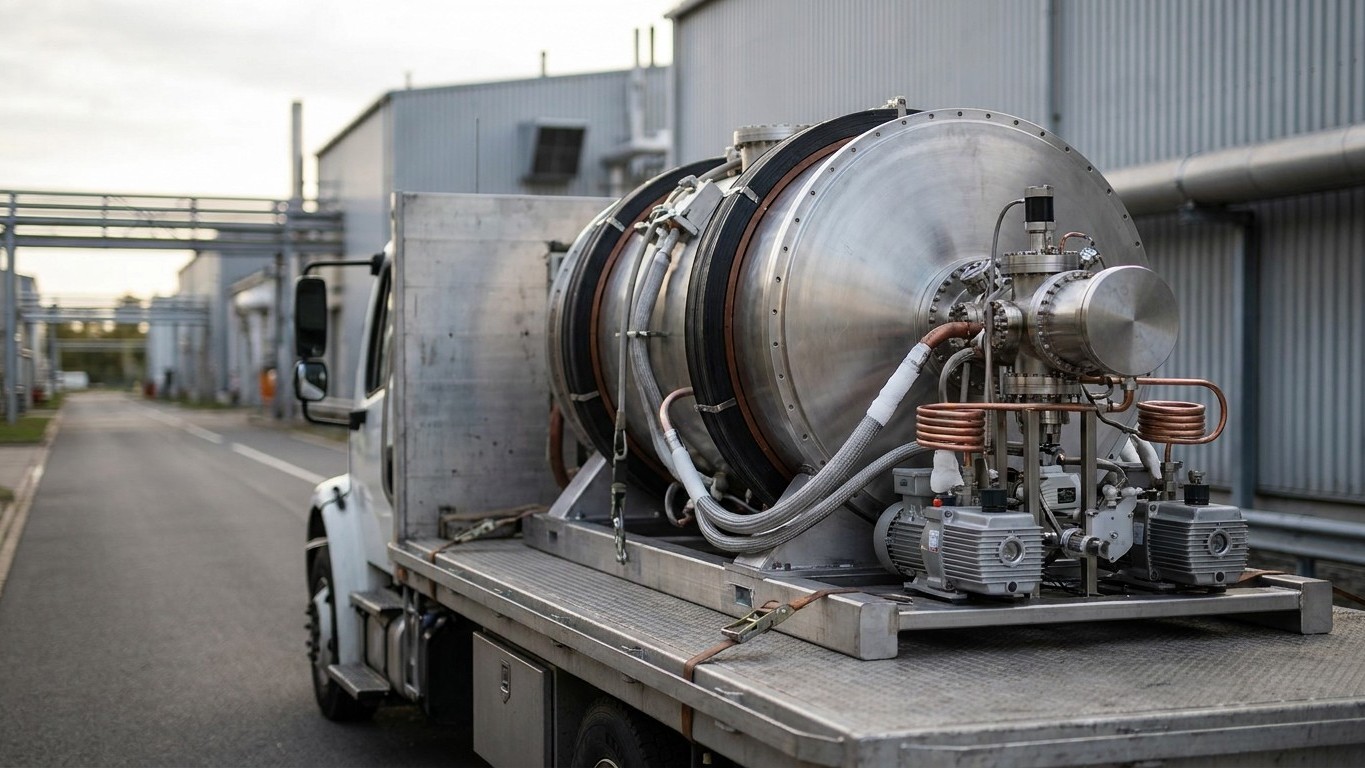
On March 24, 2026, a truck rolled around the CERN site in Meyrin carrying something that does not exist anywhere else on Earth outside of a particle accelerator: 92 antiprotons, the antimatter twins of the proton, extracted for the first time from the ring where they are normally produced and confined. The achievement belongs to the BASE collaboration, which accomplished what physicists describe as the first controlled and reversible transport of antimatter. On March 24, 2026, the BASE collaboration sent 92 antiprotons on a test loop around the Meyrin site of CERN, achieving the first controlled and reversible transport of antimatter.
The voyage itself was far from a dramatic raid. The team successfully transported a trap containing a cloud of 92 antiprotons around the campus for 30 minutes, traveling up to 42 km/h. A pace comparable to mowing the lawn, but with colossal stakes: at the slightest contact with the trap wall, these particles annihilate instantly. Antimatter does not tolerate mistakes.
Key takeaways
- Antimatter particles left their accelerator for the first time: how?
- A one-ton autonomous trap keeps antimatter levitated without main-power supply
- Why risk transporting antimatter when it annihilates at the slightest contact?
A one-ton particle-safe vault powered by batteries
The device enabling this miracle is called BASE-STEP, short for Symmetry Tests in Experiments with Portable Antiprotons. Its principle: trap antiprotons inside an ultrahigh vacuum, at the heart of a superconducting magnet, keeping them in levitation with a combination of electric and magnetic fields. To prevent annihilation, they are sealed in an almost perfect vacuum, suspended in the bore of a superconducting magnet, with an electric field superimposed.
The entire apparatus weighs nearly a ton, yet it fits into a compact footprint. BASE-STEP stands as by far the most compact antiproton trap ever built, measuring just 2 meters long, 1.58 meters high, and 0.87 meters wide. Much of this mass comes from the magnet itself: the bulk of the weight is due to the superconducting magnets, which alone weigh 600 kilograms. To operate without being plugged into the power grid, the system carries everything it needs on board. BASE-STEP is an autonomous system weighing about a tonne, built around a superconducting magnet, a liquid-helium cryogenic system, onboard energy reserves, and an ultra-high vacuum chamber. Practically, the magnet stays superconducting without continuous power thanks to a persistent-current mode, while onboard batteries provide the trapping voltages. During their four-hour transport campaign, the superconducting magnet operated autonomously, powered by batteries, with cryopumping and cooling handled by a liquid-helium reservoir.
The March 24 journey was not an isolated test. It followed a prelude in 2024 with protons, stable cousins of the antiproton, to validate the mechanics without risking the precious antimatter cargo. Thanks to the BASE-STEP Penning-trap system that can transfer trapped particles to another experiment, the team successfully moved a cloud of about 100 trapped protons out of CERN’s antimatter facility and demonstrated lossless particle transport on a truck across the Meyrin campus. This dress rehearsal lasted much longer than the March trip: in 2024, BASE researchers used the device to transport a cloud of roughly 105 trapped protons across the Meyrin campus for four hours.
Why take antimatter out of the accelerator
CERN has produced and studied antiprotons for decades within its Antimatter Factory, powered by the Antiproton Decelerator and the ELENA ring. The problem is that this hall is crowded with stray magnetic fields and vibrations, a noisy environment that limits measurement precision. The magnetic environment of CERN’s antimatter factory now restricts the level of precision that can be reached. It’s hard to track a tiny difference between matter and antimatter when the instrument rattles and the magnetic field fluctuates just a few meters from the decelerators.
The BASE collaboration’s ultimate objective can be summed up in three letters: CPT, for Charge-Parity-Time. A fundamental symmetry of physics that the researchers want to test with unprecedented precision by comparing the magnetic moment of the proton and that of the antiproton. The BASE collaboration aims to measure the properties of antiprotons with extreme precision, in particular their magnetic moment, and compare them with protons. Any potential asymmetry, even minute, could illuminate one of cosmology’s oldest puzzles: why our observable universe is made almost exclusively of matter, while the Big Bang should have produced equal amounts of matter and antimatter?
Removing antiprotons from the noisy environment would drastically push back current measurement limits. The team’s calculations are telling: in a magnetically isolated environment, CPT tests based on the antiproton with a statistical uncertainty on the order of 10^-12 would become possible, representing more than an order of magnitude improvement over the current state of the art. A significant leap in precision for a field already conducted at the highest levels of rigor.
Heading for Düsseldorf, but not yet
The March test was only a closed loop: starting from the Antimatter Factory, the truck returned there with intact antiprotons. The March 24 test demonstrated that BASE-STEP could withstand vibrations and acceleration without losing its cargo. The next step is to transfer the particles to a part of CERN that is less magnetically polluted, before considering a genuine cross-border journey. Further ahead, BASE-HHU at Heinrich Heine University in Düsseldorf is under construction to receive the antiprotons from BASE-STEP and perform precision measurements.
This German leg will pose a different technical challenge: the system will need to operate for a much longer time than the current few-hours battery-and-liquid-helium autonomy. The transfer to Düsseldorf will take about 10 hours, longer than the trap can sustain on its own; a generator mounted on the truck will feed a cryorefrigerator to maintain the magnet’s superconductivity throughout the trip. A crucial technical detail: the magnet must remain below 8.2 kelvins, around -265°C, for the entire journey. In the event of a failure, the catastrophe scenario remains safe for all: “The worst that can happen is that the antiprotons annihilate, and we’ll have to return to the antimatter factory to recharge the trap,” summarizes Christian Smorra, who leads the BASE-STEP project.
One variable changes the game for the program’s future: the trapping lifetime lengthens as the team refines its technique. The first injection of antiprotons, in December 2025, lasted three days; a subsequent test kept them trapped for more than a month, bringing the cumulative experimental lifetime to two and a half months. This bodes well for longer journeys in the future, well beyond those planned for Düsseldorf, to other European laboratories capable of hosting this extraordinary cargo.
Sources: pmc.ncbi.nlm.nih.gov | nature.com
