
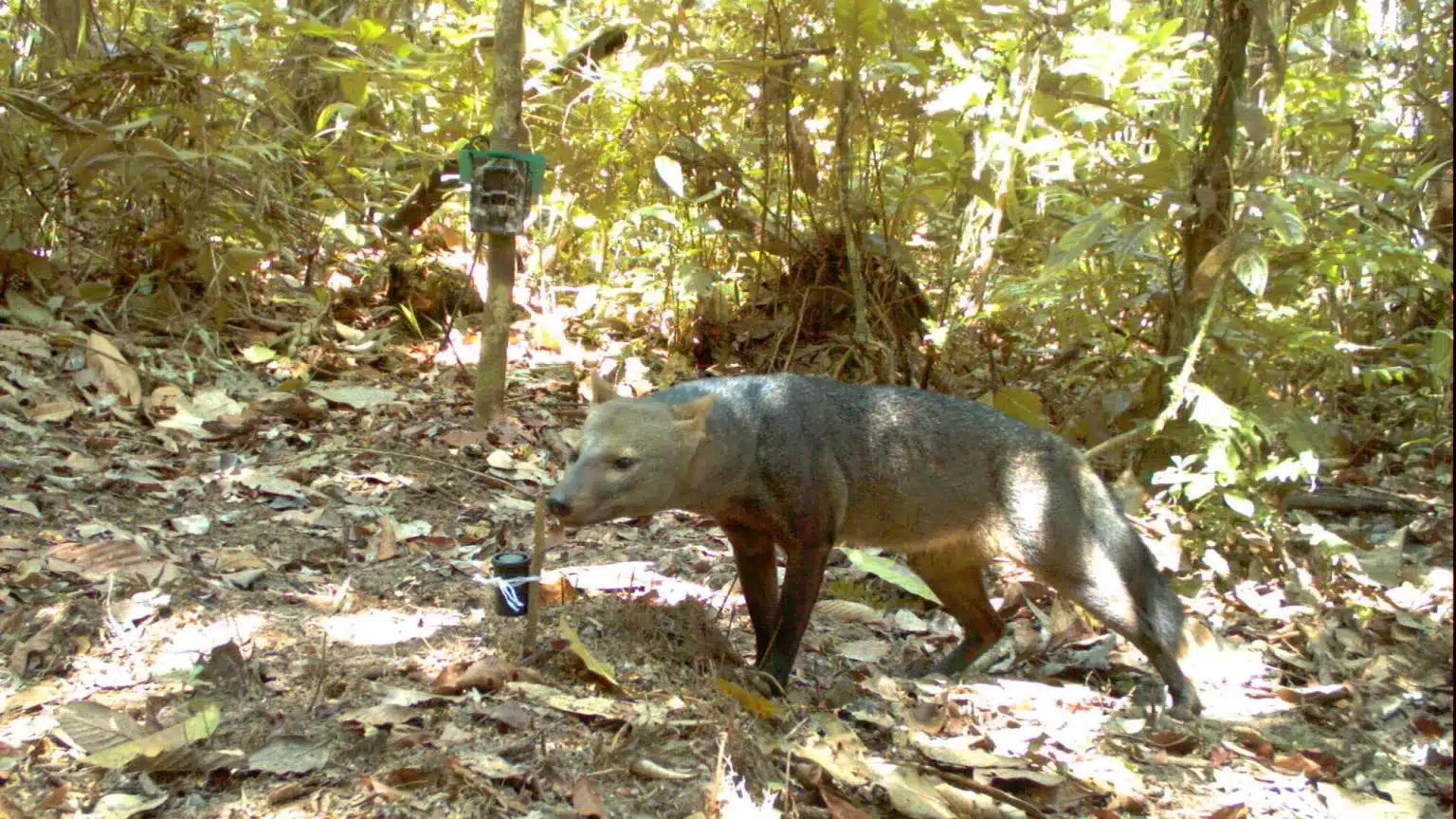
For 25 years, researchers tracked one of the world’s most enigmatic carnivores through the Amazonian forests of Bolivia and Peru. The short-eared dog, nicknamed the “ghost dog,” was so rare that it was thought to be on the brink of extinction. After 594 photographs, the conclusion is unexpected: it is much more widespread than previously believed.
What you will learn
- What makes the short-eared dog so hard to observe—and why its partially webbed paws are an anomaly among canids
- What 34 camera-trap campaigns reveal about its real population density
- Why protected areas and Indigenous territories are crucial for its survival
The most little‑known carnivore of the Amazon
Atelocynus microtis has no universally recognized common name—it’s known as the short-eared dog, or simply the “ghost dog.” It inhabits the dense forests of Bolivia and Peru, keenly avoiding humans thanks to exceptional hearing and sense of smell, and it prefers montane forests far from waterways—places where researchers rarely venture.
Result: in a quarter of a century of research, the available data on this species consisted of a few isolated observations. Its population density, habits, and true conservation status were unknown.
25 years, 34 campaigns, 594 photographs
To fill this gap, a team led by Robert Wallace of the Wildlife Conservation Society conducted 34 intensive camera-trap campaigns over more than 25 years in the Amazon plains. The result: 594 individual photographs of the ghost dog—an unprecedented database for this species.
These images reveal for the first time with precision its appearance: a large head, small round ears, short legs, a long, bushy tail, a coat ranging from reddish-brown to gray-black. And a distinctive anatomical feature among Amazonian canids: partially webbed paws.
More widespread than expected — but not common
The study’s main surprise, published in Neotropical Biology and Conservation, is demographic. By estimating density from trap data, researchers arrived at roughly 15 dogs per 99.6 km². A figure that places the species above the region’s large carnivores like the jaguar in terms of relative abundance, yet below medium-sized carnivores such as the ocelot.
This is not a common species—but it is not the quasi-mythical creature scientists feared would remain almost impossible to study.
A forest specialist, not a river dweller
Its partially webbed feet might suggest a semi-aquatic lifestyle. In fact, the short-eared dog is a strict forest specialist, with a strong preference for areas away from rivers. It is precisely this deep, hard-to-reach habitat that explains its legendary elusiveness.
The species is also more active between 6 a.m. and noon—a new finding that could guide future behavioral studies.
Protection as the key to survival
The study confirms what conservationists had long suspected: ghost dog density is significantly higher in national protected areas and Indigenous territories than in unprotected zones. Understanding the species in order to better protect it is precisely what these 25 years of patient research have made possible.
