
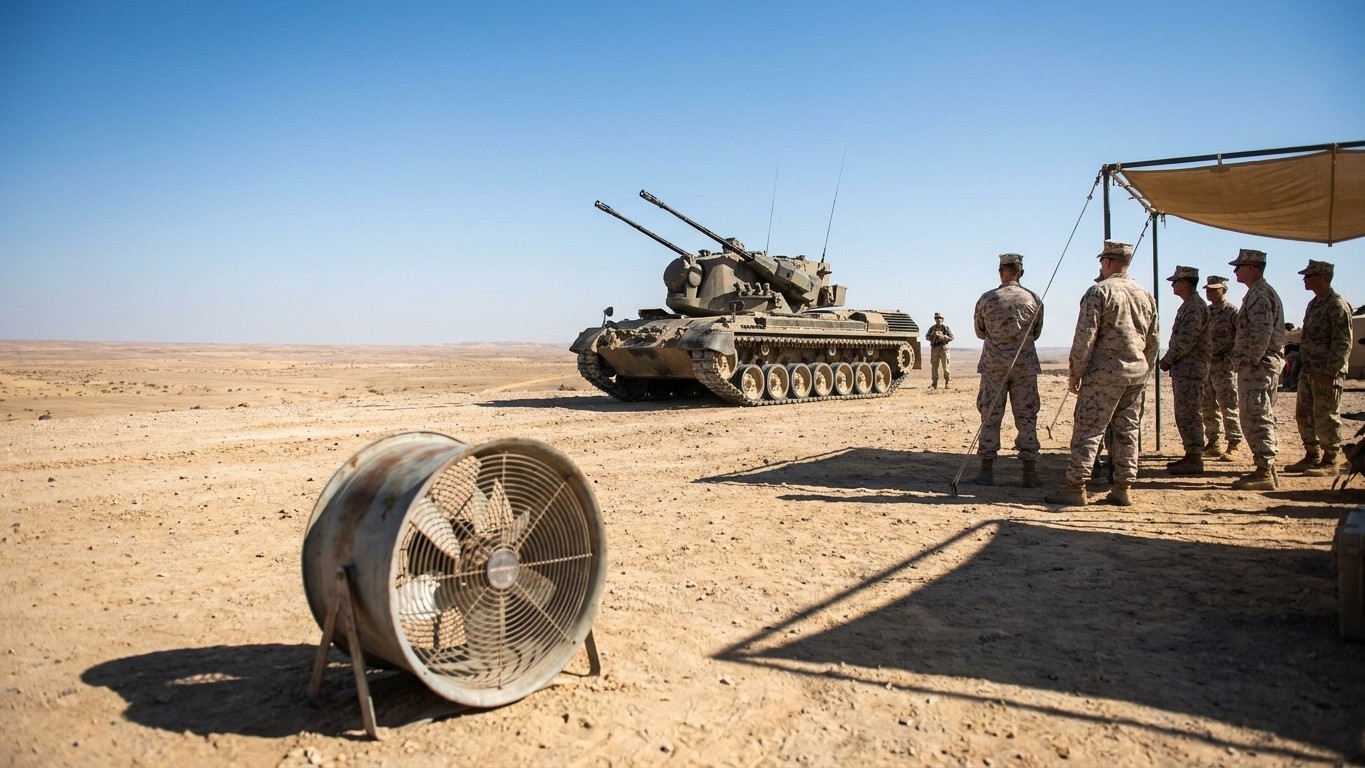
An on-site latrine exhaust fan stood motionless before a sea of generals and lawmakers. It was on this very target that the United States Army’s most sophisticated anti-aircraft gun chose to lock its radar, simply ignoring the fast-moving drone it was supposed to shoot down. The anecdote, as amusing as it is alarming, sums up the failure of the M247 Sergeant York—a program that swallowed nearly $2 billion before being brought to a close by the Pentagon itself.
Key takeaways
- A radar system built for fighter aircraft proves unable to differentiate helicopters from ground objects
- During an official demonstration, the cannon trained on the generals’ stands before firing at the ground
- The iconic moment: locking onto a latrine exhaust fan instead of a high-speed drone in flight
A fighter radar grafted onto a tank chassis
The project began in the late 1970s, amid the Cold War, as the U.S. military sought a system capable of shielding armored columns from Soviet helicopters and low-flying attack aircraft. Ford Aerospace won the competition over General Dynamics and delivered a device built on the chassis of the aging M48 Patton tank, topped with a turret housing two fast-firing 40 mm Bofors cannons. The vehicle combined an M48 Patton chassis with twin 40 mm Bofors guns and a radar system derived from the F-16 fighter.
The idea looked clever on paper: reuse proven components to move quickly and cut costs. In practice, this tech transplant proved disastrous. A radar designed to scan the sky struggled to distinguish low-flying helicopters from ground clutter such as trees, hills, and even latrine exhaust fans. A fighter radar is optimized to detect a aircraft standing out against a clear sky. Placed low to the ground, amidst trees, buildings, and camp equipment, it lost its bearings. The system also appeared unable to distinguish helicopters from trees, and showed a tendency to lock onto other ground objects mistaken for threats.
The demonstration that turns into a fiasco before the generals
February 1982, Fort Bliss, Texas. The Army staged an official demonstration before American and British officers, members of Congress, and various dignitaries. The moment was supposed to reassure everyone about the reliability of the gadget. It failed. In February 1982, the prototype was shown to a group of American and British officers, as well as Congress members and other figures. When the computer was activated, it immediately began aiming the cannons at the stands, causing several minor injuries as spectators ducked for cover. An anti-aircraft gun aiming at its own generals rather than the mock target: hard to imagine a worse scenario for marketing an arms program.
The technicians reset the system. This time, it started firing at the target, but struck the ground 300 meters in front of the tank. Despite several attempts to get it to function correctly, the vehicle never successfully engaged the test targets. A Ford official offered a creative if unconvincing explanation, attributing the mishap to a vehicle wash just before the demonstration that allegedly disrupted the electronics, prompting a journalist to quip about the rainy climate of Central Europe, the theater of the anticipated clash against Soviet armor.
And then came the episode that would stay in memory: during a subsequent test, a M247 intended to shoot down a fast-moving drone utterly ignored its target and instead locked onto a nearby latrine exhaust fan. A M247 assigned to take down a fast-flying drone locked onto a latrine fan, apparently classifying it as a slow-moving target. A specialist journalist, Michael Duffy, even revealed that Ford officials had contacted him in a conference call to urge him to describe the target as a “building fan” rather than a latrine fan. Needless to say, the crisis communications did not fool anyone.
$1.8 billion for 65 unusable guns
With the string of mishaps mounting, Secretary of Defense Caspar Weinberger ordered a set of real-world combat tests conducted by an independent body newly created by Congress. Weinberger approved a combat testing sequence costing $54 million, overseen by the Pentagon’s new Office of Operational Tests and Evaluation, established by Congress in 1983 to act as an independent watchdog. The verdict was unequivocal. The head of the agency stated: “As tested, the Sergeant York was not operationally effective in adequately protecting allied forces during simulated battles.”
The figures sealed the program’s fate. The requirement demanded a 90% operational availability, but tests revealed only 33% availability. A anti-aircraft cannon that was supposed to continuously shield armored columns but failed two-thirds of the time would not hold up against a surprise aerial attack. On August 27, 1985, Weinberger delivered the final word. The decision to cancel the Sergeant York came after $1.8 billion had been spent manufacturing 65 of the cannons. The justification, concise and biting: “The tests show that further improvements to the York cannon remain marginal and do not justify the additional cost; we will not invest further funds in this system.”
The complete program, if carried to completion, would have cost even more. Weinberger estimated the program would have totaled $4.8 billion by the end. Almost all of the units produced wound up with a rather unglorious end: serving as targets on Air Force ranges. The U.S. Army spent years filling the void left by this resounding failure, ultimately relying on Bradleys armed with Stinger missiles rather than a radar-guided gun. It would take nearly four decades, and the advent of recent M-SHORAD systems, to find a comparable solution capable of tracking heavy armor up close on the battlefield.
Sources: todayifoundout.com | russellphillips.uk
