
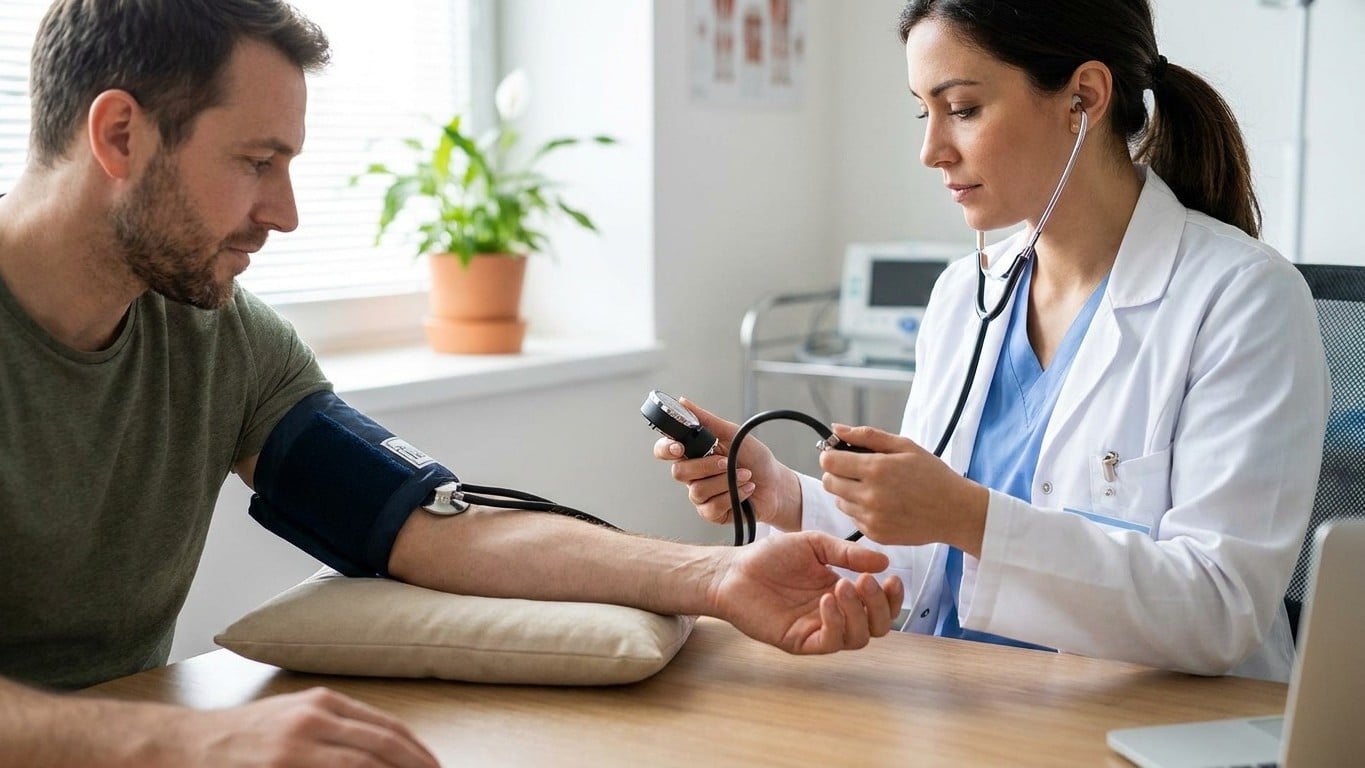
Seven millimeters of mercury. That’s the gap that can tip a perfectly healthy patient into the “hypertensive” category during a routine blood pressure check at the doctor’s office. The cause has nothing to do with the heart: it hinges on the position of the arm at the moment of measurement. A 2024 study published in JAMA Internal Medicine showed that letting the arm hang by the side — a commonplace posture in many clinics — distorts the reading enough to trigger a misdiagnosis.
The ARMS trial, led by a team at Johns Hopkins University in Baltimore, recruited 133 participants with an average age of 57, of whom 53% were women. The protocol, on paper, was straightforward: measure the same person’s blood pressure at short intervals with the arm placed in three different positions. The first position, recommended by clinical guidelines, had the forearm resting on a desk with the cuff at heart level. The second reflected a common clinical scenario: the hand placed on the knee. The third, the most extreme, left the arm hanging unsupported by the side of the body.
Key takeaways
- A posture difference can be enough to push you into the hypertensive category
- Researchers quantified the error: up to 6.5 mmHg overestimation
- Even medical offices regularly ignore this fundamental rule
An Arm That Dangling, a Blood Pressure That Rises
The results leave little room for doubt. The study found that supporting the arm on the knees overestimated systolic blood pressure by 3.9 mm Hg and diastolic pressure by 4.0 mm Hg. An arm not supported on the side overestimated systolic pressure by 6.5 mm Hg and diastolic by 4.4 mm Hg, with consistent results across all analyzed subgroups. Concretely, the most common and neglected position — where one does not even bother to prop a cushion or an armrest under the patient’s arm — produced the most dramatic error.
To put it in practical terms: a difference of 6.5 mmHg is more than enough to push a reading that is perfectly normal into the hypertensive range. The researchers do not miss this point. They warn that this level of error could lead to false diagnoses of hypertension. It is a stark reminder that a hypertension diagnosis frequently leads to long-term treatment decisions.
The ARMS protocol was designed to mirror clinical reality as closely as possible. Before the test, volunteers walked for two minutes to simulate a typical clinical entry before screening. After a five-minute rest, blood pressure was measured with an automated device. A fourth series of measurements, taken with the arm resting on the desk, helped neutralize the natural day-to-day variability in an individual’s blood pressure. In short, nothing was left to chance to isolate the single variable that mattered: the position of the limb.
Why the Heart Dislikes Dangling Arms
The physiology behind this phenomenon is not mysterious. An arm left hanging is below heart level, which alters the hydrostatic pressure in the vessels and artificially inflates the cuff reading. This is why medical guidelines have long stressed a precise principle: the arm should be supported on a desk with the mid-cuff at heart level. It’s a simple rule, yet evidently not consistently followed in daily practice.
The study’s lead author, Dr. Tammy Brady of Johns Hopkins, frames the issue with a blunt statement: “getting the position right makes a big difference.” It might seem obvious, but the numbers backing her team’s findings give it real weight. Moreover, this study is not isolated: another trial, SIMPLE-AOBP, found a similar effect with an overestimation of 7.7/7.2 mmHg when the patient’s arm was not supported. Two studies, two different methodologies, one consistent conclusion.
The problem extends far beyond the clinic. At home, in front of a home blood pressure monitor on the coffee table, how many people actually check that their arm rests flat and at heart level before starting the measurement? The temptation to keep the arm along the body, or to hold the device aloft while the cuff inflates, is real. Yet these small posture deviations, seemingly minor, can turn a reliable self-measurement into a source of unnecessary concern or, conversely, mask true hypertension.
How to Avoid the Error, at Home and in Consultation
The guidance for reliable measurement hinges on a few simple actions, but applying them rigorously makes all the difference. Start with a period of rest before taking the reading: sit and relax for five minutes. Then consider overall posture, not just the arm: sit upright, feet flat on the floor, and place the arm on a table at heart level. Finally, repeat the measurement rather than relying on a single reading, because a lone measurement taken at a doctor’s office is not sufficient to diagnose hypertension. You need multiple converging readings, followed by confirmation with home self-measurements.
It is worth underscoring this last point: even a perfectly executed measurement on one day can never substitute for long-term monitoring. Blood pressure fluctuates with time of day, stress, recent physical activity, and a single number, however well measured, tells only a portion of the story.
One lingering question goes beyond the technical gesture: how many antihypertensive treatments have been prescribed in recent years based on a reading taken with the arm dangling rather than supported on a desk? The study authors also urge clinical guidelines to formally incorporate these results, signaling that real-world practice remains far from theoretical standards.
Sources: eurekaformation.fr | cardio-online.fr
