
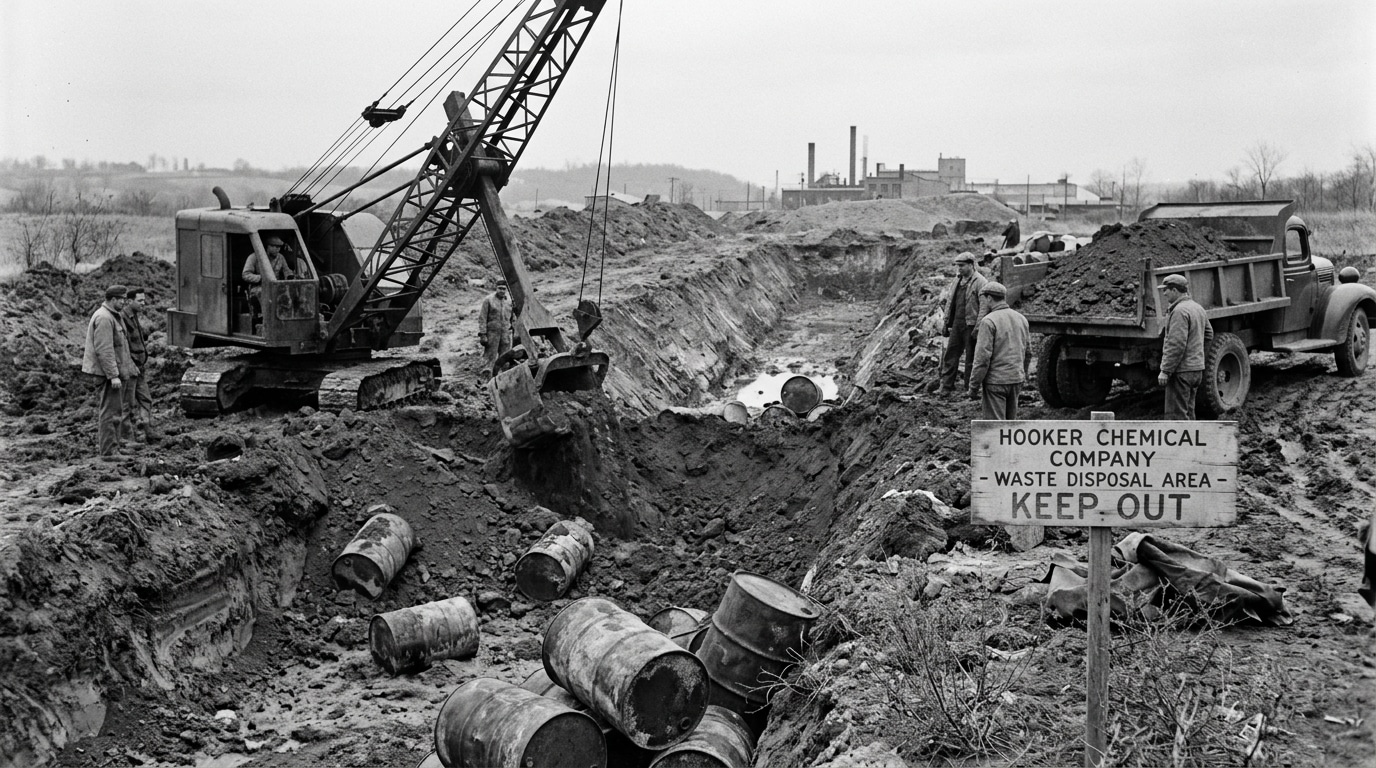
A dollar. That was the price paid by an American school board for land that would become one of the United States’ greatest environmental disasters. Behind this paltry sum lies a vertiginous story: an entire neighborhood built atop a chemical graveyard. In Niagara Falls, New York, the name Love Canal still evokes the moment a community learned, far too late, that the ground beneath their feet was literally spewing poison. What makes the case so chilling is that nothing was truly hidden: the company responsible had spelled out the dangers in black and white in the deed. And yet, children played, grew up, and studied above 21,800 tons of toxic waste. Here is a retelling of a sequence of decisions that reads like a tragedy foretold.
Eleven years of burying poisons in an abandoned canal
Originally, Love Canal was meant to be a grand project: a canal dug to connect two sections of the Niagara River and supply energy to a supposed industrial city. But the dream never reached water. The construction was halted, leaving behind a long, gaping trench that could serve a far less glorious purpose. Beginning in the 1940s, Hooker Chemical Company saw a windfall: a ready-made hole to dump its industrial residues.
For nearly eleven years, the company dumped 21,800 tons of chemical waste there, a dangerous cocktail including benzene, dioxin, and PCBs. Once the canal was saturated, it was covered with a thin layer of clay, as one would seal a can in hopes that no one would ever open it. Beneath that delicate barrier lay some of the most carcinogenic substances known. The problem is that soil does not keep its secrets forever.
A dollar, an exemption clause, and a problem handed to the school
Then came the most troubling moment of the tale. When the landfill was shut down, the parcel was deeded to the Niagara Falls school district for the nominal sum of one dollar. One might imagine it as a generous gesture. In reality, it was a transfer of responsibility carried out with nearly cynical precision. In the deed, Hooker explicitly noted the presence of buried hazardous chemical waste beneath the land, as well as the risks that any construction on this soil would pose.
The clause attached to the sale also released the company from any future liability. In other words: “We warn you, but if something goes wrong, it won’t be our problem anymore.” And despite this written warning, the school board signed. Worse still, it built. Two schools arose, accompanied by a playground and more than 800 homes. Entire families settled on what was nothing more than a time‑bomb of chemicals, hidden under a lawn.
The ground that oozes, the children burning, a city that would not look away
For years, nature did its job. Rain, seepage, and time gradually eroded the clay cover, and the chemicals began their slow ascent to the surface. Pungent puddles appeared in gardens, substances oozed from basements, and strange odors hung in the air. Children sometimes returned from the playground with unexplained skin irritations.
These signals, though blatant, were long minimized. It was only gradually that the neighborhood understood it lived above an invisible danger. Residents noticed an abnormally high rate of miscarriages and babies born with congenital malformations. The link between these tragedies and the contaminated soil would take time to be officially established, but the worry grew from house to house.
What a local journalist unearthed before the authorities
The real turning point came not from a lab but from a newsroom. A series of investigations by the Niagara Falls Gazette brought to light the scale of the disaster, pushing officials to act. New York State analyses confirmed the worst, and the site was declared an emergency by the state, before receiving federal health emergency status a few days later. The health commissioner ordered the closing of the 99th Street School and the evacuation of nearby residents. President Jimmy Carter himself would issue two emergency declarations.
Broad containment measures were then undertaken: a drainage and leachate-collection system, a new clay cap, a dedicated treatment plant, and a fence encircling the area. New York State filed a colossal $635 million lawsuit against Occidental Petroleum and its subsidiaries, including Hooker. Cleanup was completed by the late 1990s, but the site remained a Superfund site until 2004, emblematic of a wound that takes decades to heal.
Today, some parcels are reserved for commercial or industrial use, while others remain off-limits to housing. Surprisingly, homes near the canal were sold in the early 2020s, and residents remain divided on the true safety of the area. Environmental authorities continue close monitoring, with regular tests to ensure that the past stays buried. Love Canal leaves us with a question that remains as relevant today as ever: how many other plots of land, somewhere beneath our feet, still hide truths that no one wants to dig up?
