
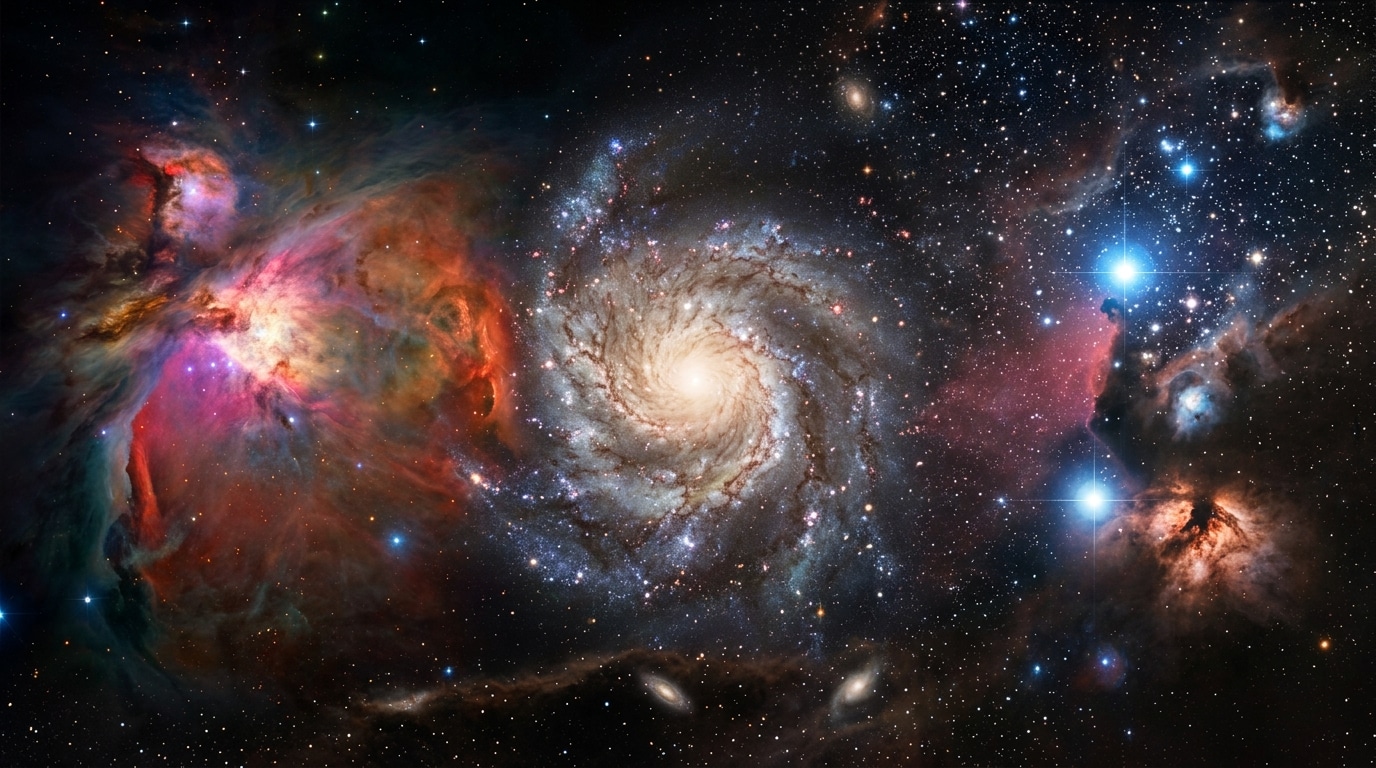
We often imagine space as a frozen, sterile desert, a void where nothing resembles the living world that surrounds us. Yet this view deserves to be seriously nuanced. Far from empty expanses, the vast regions where stars are born teem with an astonishingly rich chemistry. And among the molecules hidden there, one is intimately familiar to us: water. Long before a star lights up, in the total darkness of interstellar gas clouds, this essential ingredient for life is already present. A discovery that upends the way we tell the story of the birth of celestial bodies and, perhaps, of our own.
In the absolute cold of molecular clouds, an unsuspected cradle of stars
To understand where it all begins, one must first visit the galaxy’s harshest corners: the molecular clouds. These immense reservoirs of gas and dust stretch across tens of light-years, plunged into a vertiginous chill, barely a few degrees above absolute zero, around -260 °C. In other words, conditions that are anything but warm.
Yet at the heart of these icy darknesses unfolds one of the universe’s most fundamental spectacles. Under the weight of their own gravity, certain regions of these clouds slowly contract, like dough being kneaded on itself. Matter accumulates, density rises, and gradually an embryonic star takes shape. This process, silent and slow, occurs out of sight, hidden behind thick curtains of dust. One might think these cocoons sterile. In reality, they harbor a bustling chemistry, where complex molecules form long before the first stellar spark.
Herschel and the radio telescopes, these giant ears that track the signature of water
How to detect water in such a distant and dark place, hundreds of light-years away from us? The answer lies in a fascinating property of matter: each molecule emits or absorbs light at specific wavelengths, like a true fingerprint. Read these signals correctly and you can identify what lies hidden in the dark.
That is precisely the role of the Herschel space telescope, an observatory designed to peer into the universe in the far infrared, a range of light invisible to the naked eye and particularly suited to tracing cold water. From space, shielded from the disturbances of our atmosphere, it could capture what ground-based instruments struggle to see. In parallel, the large radio telescopes deployed on Earth act as enormous ears aimed at the cosmos. Together, these instruments detect what astronomers call emission lines: tiny variations in light that betray the presence of water vapor. Thanks to them, the invisible becomes measurable.
When water hides where no star has yet shone
The most surprising aspect remains the location of this discovery. One might have expected to find water around already formed stars, warming their surroundings. But observations revealed its presence well upstream, within the very molecular clouds that precede any stellar birth. In other words, water was already there before the faintest glimmer of light appeared.
In these icy environments, water exists mostly in the form of ice, coating dust grains like a delicate frost. But it is also detected as vapor, released by subtle chemical processes. This dual presence fascinates astronomers, because it shows that the raw material for future oceans is crafted long before planets form, in the icy setting that surrounds gestating stars. Water would thus not be a late consequence of the evolution of stellar systems, but a starting ingredient, present from the very first lines of the cosmic recipe.
From cosmic vapor to oceans: what these discoveries mean for us
If water forms so early, it radically changes our understanding of its journey. The vapor and ice detected in star nurseries could indeed be direct ancestors of the water that fills today’s oceans. When a star is born, it is surrounded by a disk of gas and dust where planets form. And the water present from the outset is integrated, transported, and preserved through the ages.
This dizzying continuity directly links the cosmos’ cold clouds to the drop that falls from a faucet. It also suggests that water, so precious to life, could be a widespread phenomenon in the universe, present wherever stars are born. This gives rise to hope that other distant worlds, circling other suns, might also possess this fundamental ingredient.
By scrutinizing the absolute cold of interstellar clouds, astronomers have thus uncovered a poetic truth: the water that makes up our bodies and our oceans likely began its existence in the icy darkness, long before the light of stars. A reminder that we are, literally, children of the cosmos. And could the next step be to trace this familiar ingredient around a planet that could also harbor life?
