
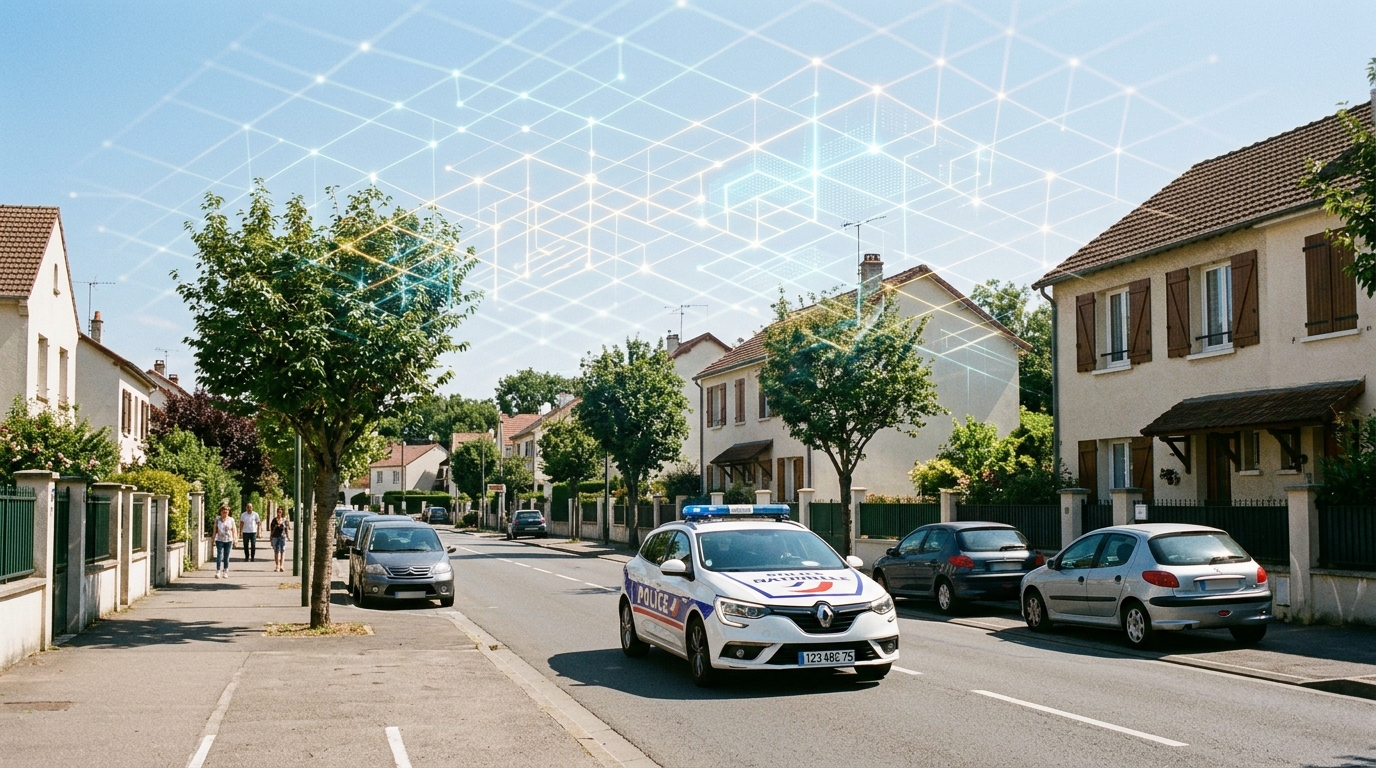
In some large cities, software analyzes thousands of data points every day to tell the police where the next crime is likely to occur. The idea seemed appealing: entrust cold, rational machines with guiding patrols, away from intuitions sometimes tinted by prejudice. Yet a recent analysis has cooled this technological optimism. Far from making safety more equitable, these tools reproduce and amplify the inequalities they were meant to erase. The heart of the problem? An invisible yet fearsomely effective phenomenon that drives law enforcement back to the same streets again and again. How can technology designed to objectify the fight against crime end up spinning in circles? Let us dive into the workings of this perplexing mechanism.
When the Algorithm Thinks It Is Predicting but It Is Merely Repeating Itself
The principle of predictive policing rests on a simple promise: by analyzing past crimes, an algorithm identifies risk zones and directs patrols accordingly. On paper, this resembles a weather forecast for crime, capable of signaling the zones of turbulence before trouble erupts. But that is precisely where the problem lies.
Imagine for a moment that you search for your keys only under a streetlight because it is the only lit spot. You will never find them elsewhere simply because you are not looking anywhere else. That is exactly what happens with these systems. The study documents a feedback loop: predictions steer patrols toward sectors already monitored. More police presence on the ground naturally yields more observations, thus more data recorded for that neighborhood. The algorithm, fed by this new information, concludes that the area is even more dangerous and sends even more patrols there. The loop bites its own tail.
Past Data That Dooms Neighborhoods to the Present
The Achilles’ heel of these tools rests on a single word: historical data. An algorithm doesn’t invent anything; it learns from what it is given. Yet crime statistics from yesterday do not reflect the objective reality of crime, but rather where the police chose to concentrate their efforts in the past.
In other words, if certain neighborhoods have historically been more surveilled, often for social or economic reasons, they will appear more crime-prone in the numbers. The machine inherits the human biases of the past and engraves them into the system, all while cloaking them in a veneer of scientific neutrality. The danger is subtle: no one consciously decides to target a neighborhood; the system appears to designate it “objectively.” A crime committed in an under-patrolled area will slip under the radar, while the same act in a police-saturated zone will weigh further on the statistics. Crime itself does not move, but the spotlight stays fixed on the same place.
The Numbers Speak: What the Study Really Reveals
What stands out the most is the amplification effect. A slight overrepresentation of a neighborhood in the initial data does not remain stable; it grows with each cycle. It is akin to a snowball effect, where a minor initial imbalance ends up crushing everything in its path.
The central finding is unequivocal: these systems do not so much predict crimes as they predict places where policing will occur. They confuse the map with the territory. In practice, this means that a stigmatized neighborhood sees its reputation reinforced by a computer tool, with real consequences for its residents: repeated checks, a sense of distrust, and a deteriorating bond between the people and the police. The promise of algorithmic justice thus turns against the most vulnerable.
Breaking the Spiral: Paths Toward Truly Fair Predictive Policing
Should we, for all that, discard the technology altogether? Not necessarily. Several avenues have started to emerge to break this vicious circle. The first is to diversify the data sources, not relying solely on police reports, which are inevitably biased by the presence of patrols. Incorporating direct citizen reports could help build a more faithful picture of reality.
Another approach aims to correct the algorithm deliberately, forcing it to explore areas it would tend to ignore—much like nudging a child to try new foods rather than always demanding the same. Finally, transparency becomes an imperative: making these systems auditable and understandable to external observers, so they do not become black boxes whose workings nobody understands. Human oversight remains indispensable to prevent the machine from entrenching itself in its own certainties.
Behind the fascination with artificial intelligence lies a lesson in humility: a tool is never more neutral than the data that feeds it. By reproducing our past missteps under the guise of objective calculation, these algorithms hold up a troubling mirror. The real question may not be whether we can predict crime, but whether we are prepared to examine the biases we unknowingly entrust to our machines. And if technology, rather than replacing us, invites us to think more deeply?
