
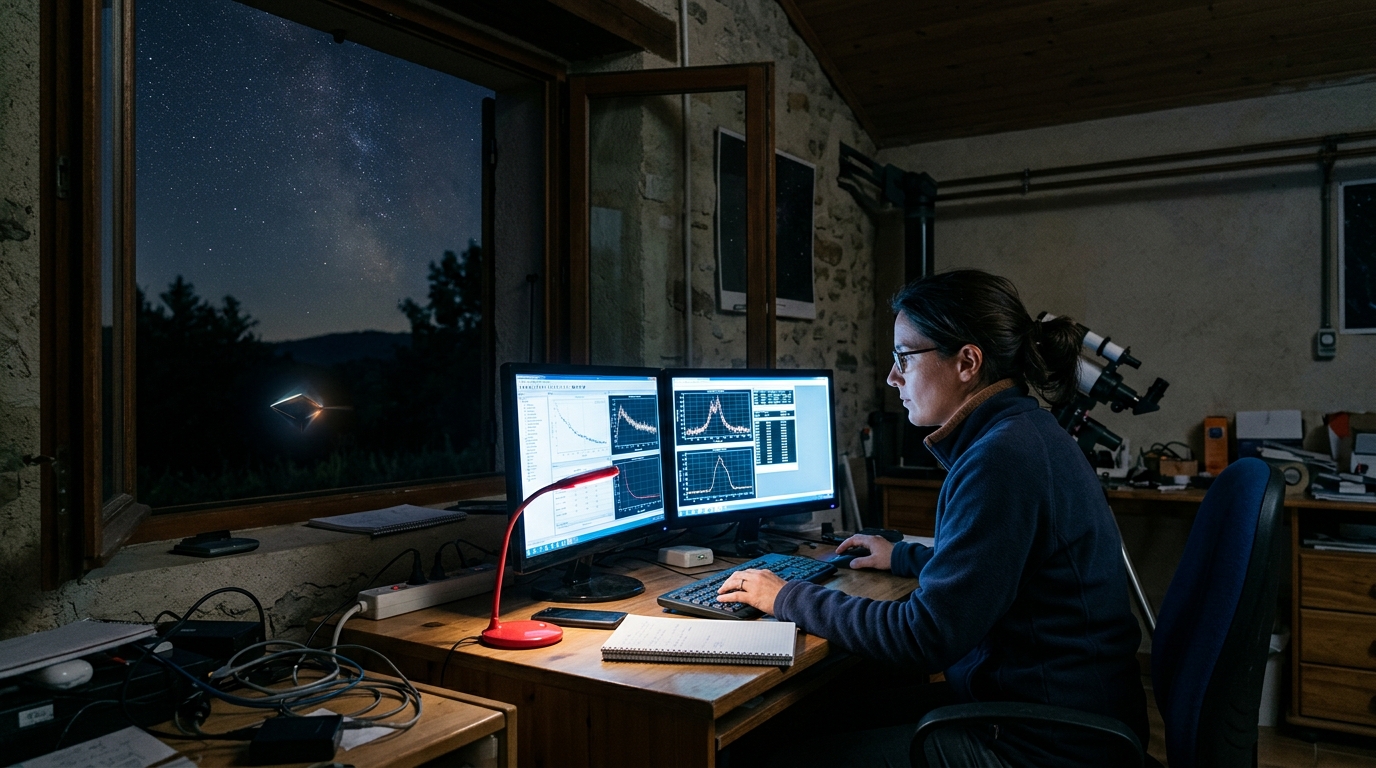
Ever since humanity first lifted its eyes to the stars, one question has haunted us: are we truly alone? This inquiry, long confined to science fiction novels and summer evenings under a clear sky, has become a genuine field of scientific investigation. Today, ultra-powerful telescopes scrutinize the far reaches of the cosmos in search of technosignatures, traces that a technologically advanced civilization might have left in the universe. Yet there is a dizzying paradox: perhaps our greatest obstacle isn’t distance or technology, but our own brain. Even before catching the slightest signal from elsewhere, our biases sketch in the gaps of what we seek. Let us explore why this quest could already stumble at the source, due to our blind spots.
These technological fingerprints we hunt at the edge of the universe
The term may seem abstract, so let’s clarify. A technosignature is the cosmic equivalent of an industrial fingerprint. Where a biosignature betrays the presence of life (organic molecules, abundant oxygen), a technosignature reveals, instead, the existence of technology. Imagine a hiker discovering a soda can in the middle of a pristine forest: the object is not natural, it signals a human passage. That is exactly what astronomers hope to spot on a galactic scale.
These clues can take many forms: radio waves oddly regular, flashes of light too intense to be produced by a star, or chemical compounds in a distant atmosphere that could not exist without industrial activity. In short, we search for the deliberate gesture of an intelligence rather than merely the faint tremor of life. A subtle but decisive distinction to steer the entire approach.
Radio, lasers and pollution: the cosmic detection toolkit
Concretely, how do we track these footprints? The method rests on the search for artificial non-natural signals through the analysis of radio, optical emissions and atmospheric pollution in telescope data. Three major avenues, therefore, that researchers explore in parallel.
The first, historical, is to survey radio waves. An emission concentrated at a very specific frequency, with no known natural echo, would stand as a suspect signal, like a held note amid a din. The second relies on light pulses: a laser of immense power projected toward the sky could serve as a beacon or a means of communication. Finally, the third track, more recent, focuses on atmospheric pollution. By analyzing the light filtered through the atmosphere of an exoplanet, we could detect industrial gases that have no natural reason to exist. In short, we would be looking for the signature of factory smoke across light-years. Fascinating, but far from infallible.
The invisible trap: when our brain decides for us what “intelligence” is
Here lies the heart of the problem. All these methods share one insidious flaw: they assume that an extraterrestrial civilization would communicate like us, with tools derived from our own. This is called anthropocentrism, the tendency to measure everything against human standards. We search for radios because we make them, lasers because we master them, pollution because we produce it.
Yet nothing guarantees that a radically different intelligence would use these means. A civilization that has surpassed the industrial age for millennia might have no pollution to betray. Our biases act as blinders: we point our telescopes where we expect to find something, even if it means ignoring an anomalous signal that would not fit any of our categories. The risk? Missing the essential simply because it does not resemble our reflection.
Broadening the view: avenues to outsmart our blind spots and restart the hunt
So, how can we escape this distorted mirror? The first path is to multiply the hypotheses rather than rely on a single scenario. By broadening the very definition of what could count as a clue, we automatically increase the chances of spotting the unexpected. It’s no longer about finding a needle in a haystack; it’s about accepting that the needle might not look like a needle.
Algorithms play a valuable role here: instead of asking them to recognize a known pattern, we can train them to spot any anomaly, anything that stands out in the data, without preconceived ideas. This approach, more humble, amounts to acknowledging our ignorance as a starting point. Finally, cross-disciplinary collaboration — physics, biology, cognitive science — helps to deconstruct our automated thinking. Because recognizing our own biases is already the first step toward overcoming them.
The search for technosignatures is not merely a technological venture: it is also an exercise in collective introspection. In seeking intelligence elsewhere, we perhaps learn more about the limits of our own. And if the greatest step toward discovery lies, above all, in learning to look differently? The next major announcement may come less from a more powerful telescope and more from a mind finally capable of imagining the unimaginable.
