
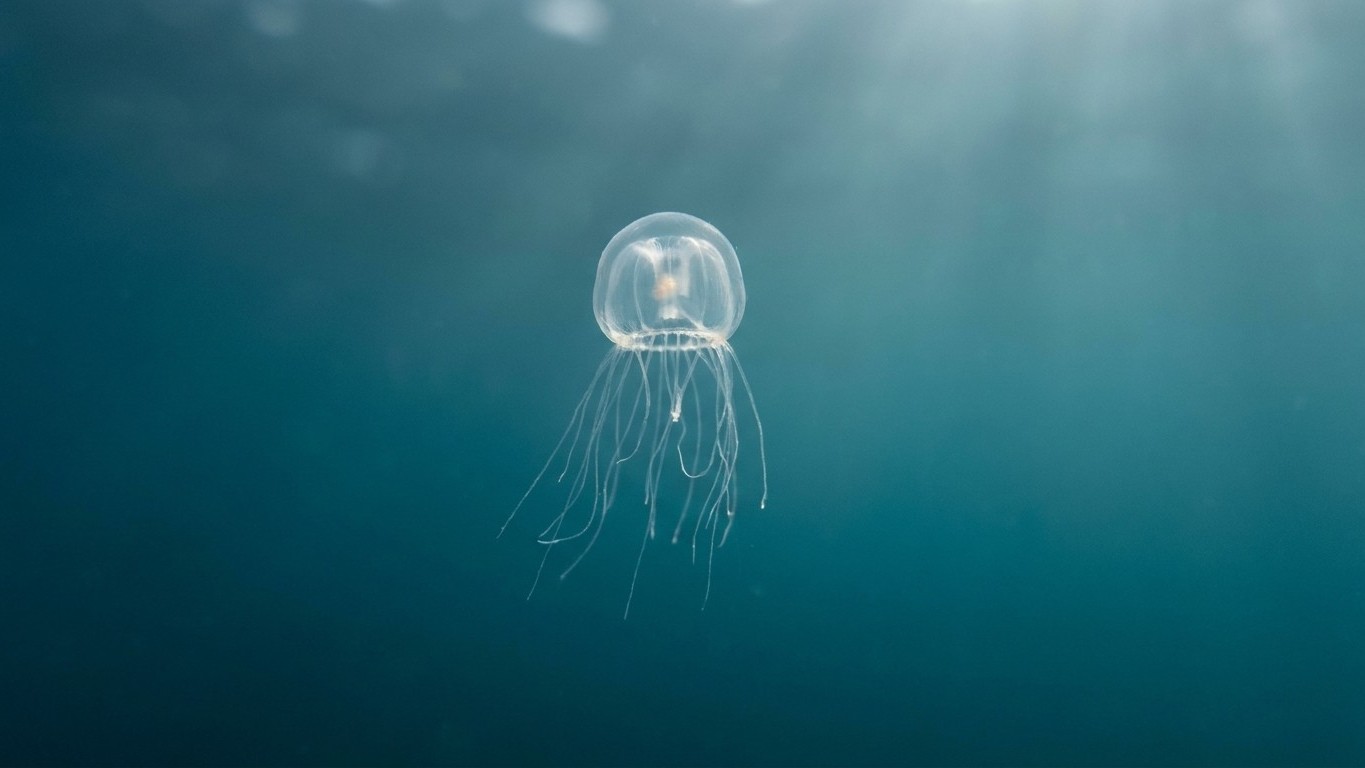
A 4.5-millimeter-wide jellyfish, barely larger than a grain of rice, challenges everything biology thought it knew about aging. When faced with stress, injury, or famine, Turritopsis dohrnii does not die: it rewinds its own development, reverts to a juvenile polyp, and starts over from scratch. According to the Natural History Museum in London, this hydrozoan measures about 4.5 millimeters in width and height, making it one of the planet’s most unobtrusive and studied marine animals.
Takeaways
- A tiny marine animal manages to erase years of aging in barely a few hours
- Specialized cells completely forget their original function and transform into entirely different cell types
- This phenomenon has never been observed in nature, only in laboratories for the last forty years
A life cycle that runs backward
For most jellyfish, the story is simple and irreversible. The curator at the London museum, Miranda Lowe, sums up this classic path: “They have eggs and sperm that are released to be fertilized, and from that you get a free-swimming larval form. The larva will drift with the current until it finds a hard surface to settle on. It will then begin to mature and grow.” The larvae become polyps, which bud to produce juvenile jellyfish. An adult is a jellyfish. End of story, in theory.
But Turritopsis dohrnii refuses this script. If it is exposed to environmental stress, a physical assault, or if it is sick or old, it can revert to the polyp stage, forming a new colony of polyps, thanks to the process of cellular transdifferentiation, which alters the differentiated state of cells and transforms them into new cell types. Concretely, specialized cells, those of the bell or the circulatory system, forget their original function and reprogram to become something else. It’s a bit like an adult human heart deciding, under pressure, to revert to embryonic tissue.
The discovery of this mechanism owes much to chance. In the 1980s, two Italian students, Christian Sommer and Giorgio Bavestrello, were raising tiny hydrozoans in jars. They expected to see millimeter jellyfish breed and then die like any other species; instead they watched the adults collapse into motionless cysts, produce stolons and polyps, and then bud genetically identical new jellyfish. A resurrection without eggs, without sperm, without a larval stage. Repeated trials confirmed the anomaly: even when starved, injured, or cooled, the animals showed the same result, revealing a cellular resetting mechanism now called transdifferentiation.
Twenty-four hours to start over
The process is not slow. Once the distress signal is sent, the metamorphosis unfolds at a brisk pace. Studies published on the species’ transcriptome describe a crucial intermediate stage, the cyst, a transitional phase between a regressing jellyfish and a healthy polyp, during which cellular transdifferentiation and tissue reorganization occur. This cyst does not lag along the way: other research places the complete transformation into stolons and polyps within a window of 24 to 36 hours barely. Three days, sometimes less, to erase an entire life and restart as juvenile.
What makes this even more troubling is the near-total absence of a role for classical stem cells in the process. Researchers note that although a proliferation of certain cells occurs during the reversal, it does not appear to play a central role in the rejuvenation, since portions of jellyfish lacking these cells still manage to revert completely to the polyp stage, which necessarily implies a substitution of cell types and a shift toward new lineages. A genomic study published in 2022 in the journal PNAS, led by Pascual-Torner and his team, compared the genome of T. dohrnii to that of its cousin Turritopsis rubra, incapable of the same feat. The result: expanded families of genes related to DNA repair, telomere maintenance, and stem cell pluripotency, which would probably underpin this aging-reversal trick.
Immortal, yes, but not invincible
The word “immortal” deserves nuance, and that is where public myth diverges somewhat from scientific reality. Biologists speak of biological immortality, meaning that the animal need not die of aging, not that it cannot die by any means. In the ocean, dangers are abundant. The Natural History Museum notes that these immortal jellyfish become prey for other animals such as fish and turtles, while polyp colonies anchored to the seabed are almost defenseless against sea slugs and crustaceans. Nature, even if it offers a reset button, has not given it a shell.
Another striking detail: no one has ever observed this phenomenon directly in the sea. The process has not been observed in its natural habitat, partly because it is fairly rapid and field observations at the right moment are unlikely. All that is known about this biological reset comes from laboratory jars, patiently monitored for decades.
The interest does not stop at curiosity. The DNA repair and cellular reprogramming mechanisms at work in this tiny creature directly inform research into human aging and degenerative diseases. A researcher not involved in the 2022 study, cited by Smithsonian, sums up the stakes plainly: “This is one of those papers that, I think, will open the door to a new line of research worth pursuing.” One question still dividing biologists remains: when the jellyfish reverts to polyp and then buds back into a jellyfish, is it really the same individual continuing its existence, or a clone simply taking its place? The debate, itself, has not stopped turning in circles.
Sources: nhm.ac.uk | ncbi.nlm.nih.gov
