
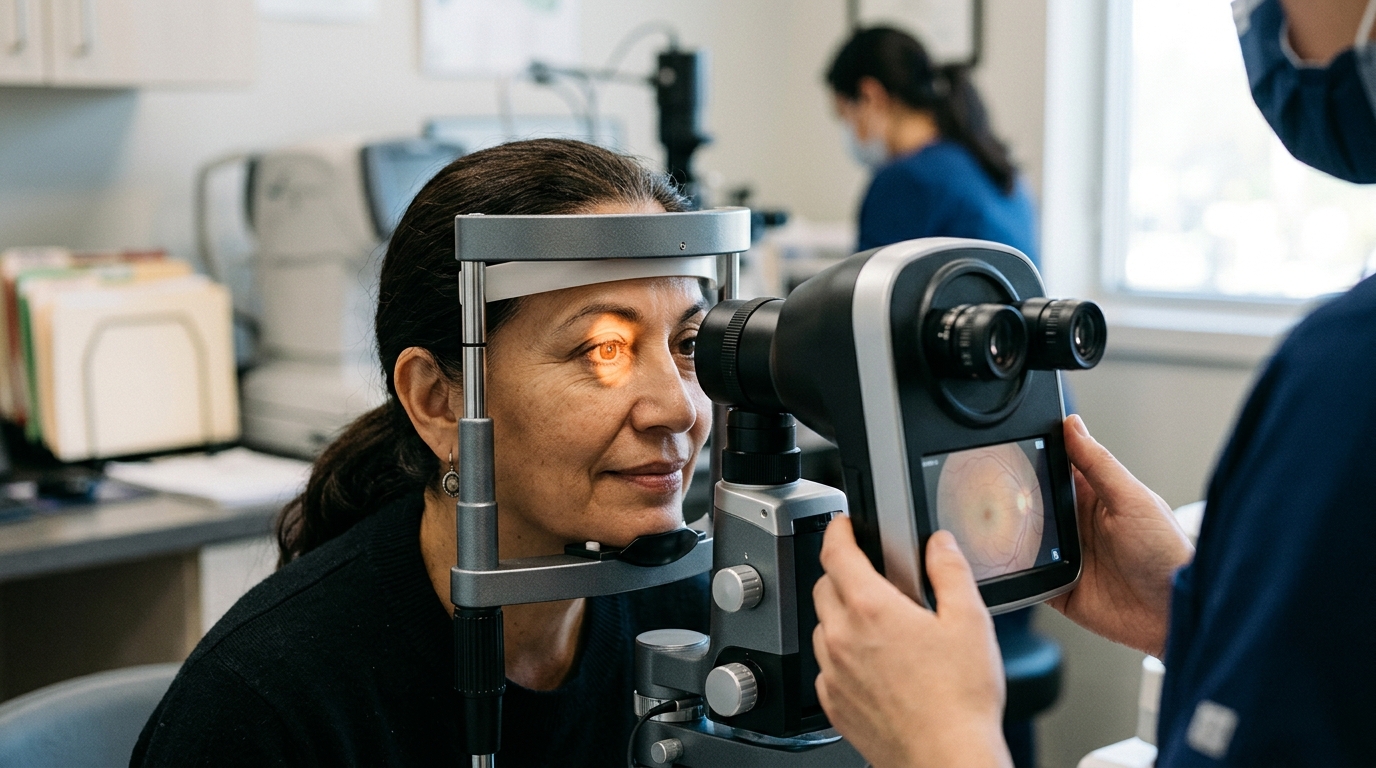
What if your eye knew more about your health than you do? In the secret of our retinas, a network of tiny blood vessels tells, almost without us realizing, a part of our medical history. These invisible filaments to the naked eye carry traces of our habits, of our fragilities, sometimes even diseases that have not yet shown the slightest symptom. Today, an artificial intelligence claims to know how to decipher them. Its promise is as simple as it is dizzying: to detect a diabetes still invisible from a simple image of the fundus. A feat that could well redefine the way we screen for certain silent diseases.
Quand vos yeux parlent avant vos symptômes
Type 2 diabetes is a stealthy disease. It often settles in quietly, for years, without triggering any alert. Many people live with a misregulated blood sugar without suspecting it, until the day when complications finally begin to appear. It is precisely this invisibility that makes it such a formidable enemy.
And yet, the retina offers an exceptional vantage point. It is the only place in the body where one can directly observe blood vessels, without any incision, simply thanks to a photograph. When blood glucose stays high for too long, it gradually damages these tiny channels. They thicken, deform, sometimes leak tiny droplets. All these cues that a doctor’s human eye might take time to spot, but a machine, it can track with unparalleled precision.
Google Health et l’algorithme qui déchiffre la rétine
This is where a team of researchers working for Google Health enters the scene. Their idea: train an artificial intelligence to read our retinas as if reading an open book. The principle is deep learning. Tens of thousands of fundus images are shown to the algorithm, with each instance indicating which patient was diabetic and which was not. Gradually, the machine learns to recognize patterns invisible to us.
Where a human naturally focuses on large anomalies, the computer analyzes every pixel. It spots minute variations in colour, caliber, or arrangement of the vessels. Imagine a detective able to reconstruct an entire medical profile from clues no one else would notice. That is exactly what this retinal algorithm does: it turns a plain photograph into a true biological signature.
88 % de précision : ce que dit vraiment l’étude de Nature Medicine
The results, published in the journal Nature Medicine, are impressive. The algorithm manages to detect type 2 diabetes with 88% accuracy from solely fundus images. In other words, in a large majority of cases, the machine correctly identifies the individuals involved, without blood tests, without fasting, without finger-prick tests.
This figure is far from being trivial. It means that a non-invasive technology could, in the long run, serve as a first filter to identify people at risk. A simple pass in front of a specialized camera would trigger an alert, inviting then to more thorough examinations. For a disease that plays hide-and-seek so well, having a tool that can flush it out early represents a significant advance.
Entre espoir médical et prudence : ce qu’il faut retenir
Should we, for all that, discard our trusty blood tests? Certainly not. An accuracy of 88% remains remarkable, but it also leaves a margin of error that would be imprudent to ignore. A retinal image does not replace a full medical diagnosis: it accompanies it, guides it, sometimes even anticipates it. The nuance is essential.
The true value of this technology lies in its accessibility. In regions where medical infrastructure is lacking, or to reach populations who rarely consult, a quick and painless screening could make a huge difference. We can already imagine these cameras installed in pharmacies, optician’s offices, or local health centers, offering everyone a first assessment in a matter of seconds.
Yet this quiet revolution raises fascinating questions. If our retinas can betray a diabetes, what will they reveal tomorrow? Some research is already exploring the possibility of detecting cardiovascular risks or other pathologies from the same images. Our eyes, long considered mere windows to the world, could become true mirrors of our health. And you, would you be willing to let a machine read in your gaze what your body still prefers to keep silent?
