
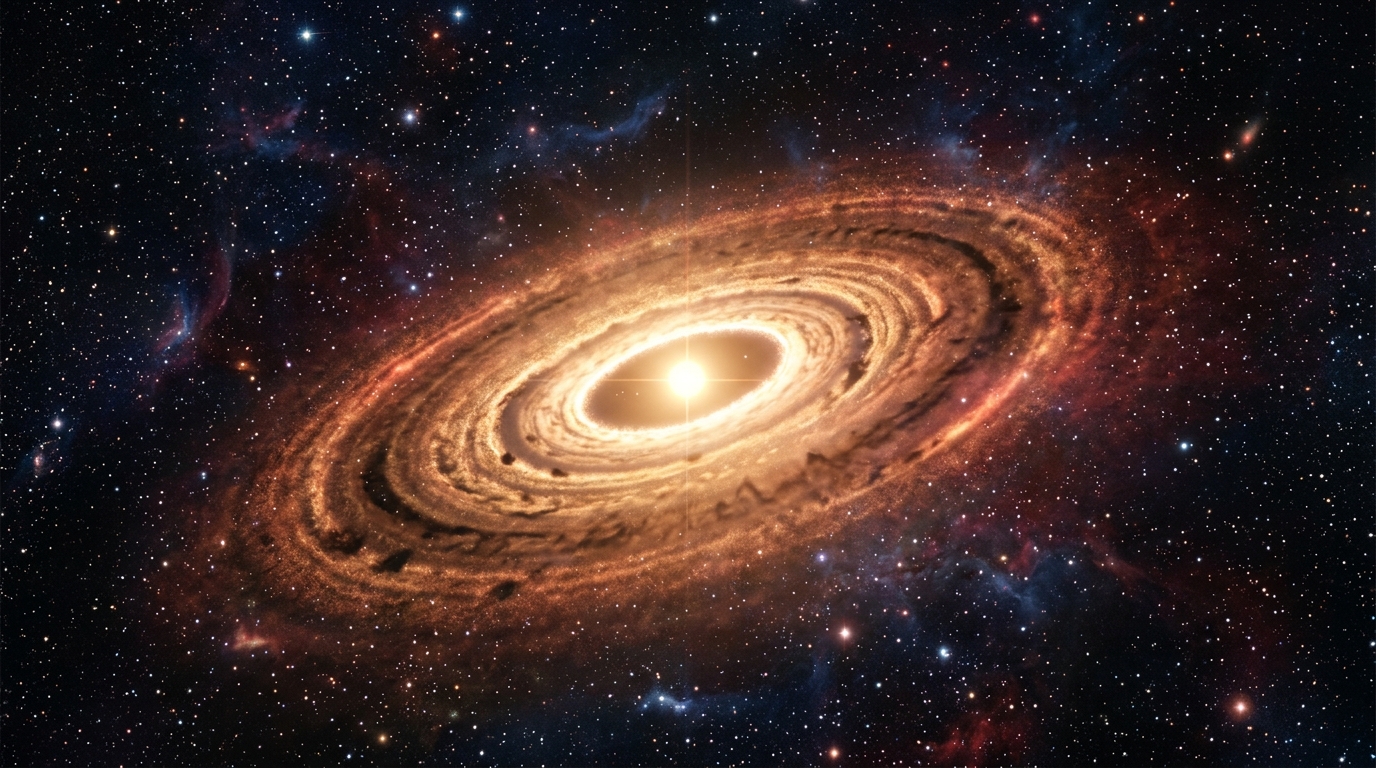
A scarf of frozen dust, twisted as if an invisible hand had pinched it. Around a distant star, this deformation tells a story: a massive world roams there, never directly observed, but indeed hunted. By decoding the asymmetries of the surrounding matter, astronomers have reconstructed its orbit. An unprecedented way to hunt planets.
――――――――――――――――――――――――――――――――――――――――――――――――――――
What you will learn:
- How a debris disk betrays the presence of a planet no one sees
- By which methods astronomers reconstruct the orbit of a hidden world
- Why this approach upends the hunt for distant exoplanets
――――――――――――――――――――――――――――――――――――――――――――――――――――
These Dust Scars That Reveal a Hidden Giant
Around many stars, debris disks—vast rings of dust and rocky fragments, remnants of planet formation—grace their surroundings. They were once imagined as smooth, orderly structures. Recent observations tell a far different tale.
These disks exhibit multiple-ring belts, wide halos, surprisingly sharp edges, arcs, surprising clumps, and regions brighter than others. All of these irregularities look like scars. And a scar, by definition, preserves the trace of what caused it.
All of these patterns point to the same explanation: a gravitational sculpting. Something massive, lurking in the shadows, tugs at the surrounding material and shapes it. Dust has no will of its own: if it accumulates on one side and becomes rarer on the other, it’s because an invisible force governs it.
When Gravity Traces the Orbit of a World We Cannot See
The problem is that these planets are almost invisible. Classic techniques, radial velocity and transits, work well for worlds close to their star. But a giant orbiting far out, in the chilly outer regions of a system, almost escapes these methods.
Hence the idea of turning the problem on its head. Instead of searching for the planet, we study the footprint it leaves behind. By mapping the disk’s brightness variations, astronomers deduce where gravitational perturbations concentrate the dust. The deformation becomes an indirect tracer.
One image sums up the case nicely: it’s a bit like shining a flashlight on an object and studying its shadow projected on the wall. You don’t see the object itself, but its silhouette is enough to infer its shape, size, and position. Here, the shadow is made of dust.
The Instruments That Turn a Shadow into a Planetary Signature
To read these clues, you need razor-sharp images. The disk around the star HD 181327 was examined with the STIS spectrograph on the Hubble Space Telescope. The result: an optical depth peaking at 84.2 astronomical units, and, once the image is deprojected, a pronounced asymmetry manifesting as a 90-degree arc richer in dust.
Another textbook case: HD 106906. This system has the rare feature of hosting a planet already directly imaged, a behemoth of 11 Jupiter masses orbiting at 735 astronomical units, far out, beyond the disk. Here too, the disk appears perturbed, with a moderate brightness asymmetry visible in scattered light.
These perturbations sometimes carve true cavities. When a rocky fragment brushes against a deeply embedded giant planet, it becomes dynamically stirred and ejected, leaving behind a cleared region dubbed the chaotic zone. The width of this void, as predicted by theory, helps backtrack the characteristics of the perturber.
From a few measurements, a model can sketch the robot portrait of the intruder: a semi-major axis between 80 and 130 astronomical units, an eccentricity of 0.17 to 0.28, and a mass greater than 0.2 Jupiter masses. An identiy reconstructed without ever having seen the suspect.
A New Compass for Exploring Distant Stellar Systems
Being able to resolve these structures at distances comparable to the orbits of Saturn, Uranus, and Neptune marks a major advance. We now access regions of the sky that were nearly silent, where the large icy giants hide best.
Yet one must distinguish causes. Not every asymmetry betrays a planet: some arise from a giant impact between rocky bodies, others from interactions with the interstellar medium. Depending on the viewing angle, these collisions sketch characteristic patterns, in a “fork,” in a “needle,” or in a “double wing.” These shapes serve as a reading grid for disks such as HD 111520, HD 106906, or Beta Pictoris.
These asymmetric structures seem ultimately routine in cold disks. And even if the culpable planets remain most often out of reach of instruments, their hidden presence offers the most coherent explanation for these recurring deformations.
By learning to read dust as one reads a fingerprint, astronomers are arming themselves with a new compass. The lesson is elegant: sometimes, to find a world, it helps to look at everything that surrounds it. The next major planet to be discovered may do so without ever having been seen. And what if the universe is mostly made of what we can infer?
