
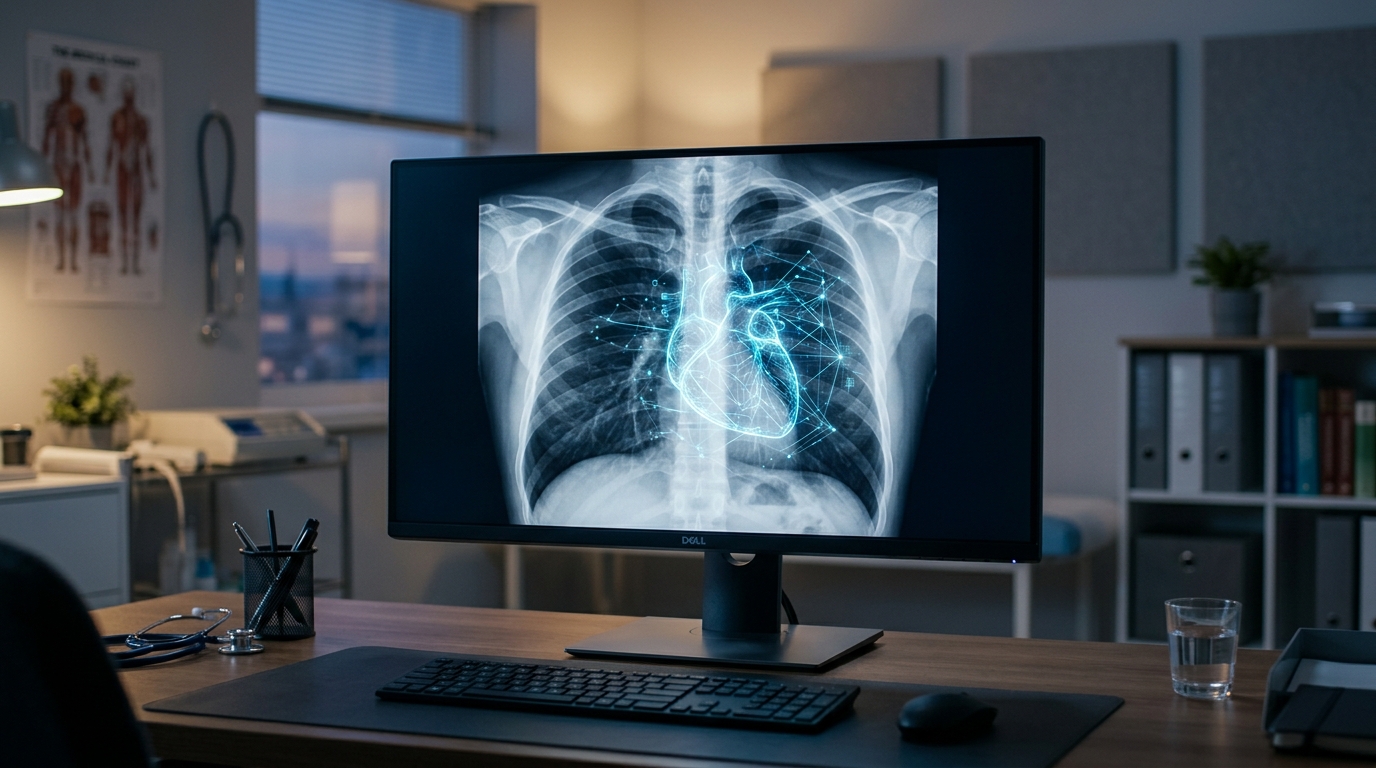
Imagine for a moment: you undergo a simple chest X-ray for a routine check, a persistent cough, or a standard assessment. A black-and-white snapshot, like millions of others taken every year. And if this seemingly ordinary image could whisper to doctors a far more intimate secret, the health of your heart? That is precisely the promise of an artificial intelligence that is shaking up the codes of preventive medicine. By analyzing the shadows and highlights of a thoracic radiograph, this technology could foresee your heart-related troubles years before they arise. A feat that seems straight out of a science fiction novel, yet now rests on real data.
When a chest X-ray reveals the secrets of your heart
The thoracic radiography is one of the most common examinations worldwide. It is used to inspect the lungs, detect pneumonia, a rib fracture, or a respiratory anomaly. Until now, nobody would have imagined looking for clues of a future cardiac event there. Yet this simple image holds far more information than the human eye, even the most seasoned, can discern.
That’s where a new generation of digital tools comes into play. By sifting through every gray shade and every subtle contour, artificial intelligence detects invisible signals for us. Much like a seasoned sommelier who can guess the grape variety and the terroir of a wine where the layperson only perceives a glass of red. The human body leaves traces, and once decoded, these traces draw a striking portrait of our future health state.
Behind the scenes of CXR-CVD, the algorithm that deciphers the invisible
This artificial intelligence has a name: CXR-CVD. Developed by Massachusetts General Hospital in the United States, this algorithm is designed to translate a radiographic image into a genuine estimate of cardiovascular risk. Its operation rests on machine learning: the machine was trained to observe countless X-ray images, gradually learning to associate certain visual features with the later onset of heart problems.
Where a physician typically relies on well-known factors such as age, smoking, cholesterol level, or blood pressure, the algorithm adopts a radically different approach. It requires no blood tests, no prior numerical data. It only needs one image. From this single photograph of your chest, it assesses the probability that you will develop heart or vascular disease in the ten years to come. A sleek way to leverage tests that millions of patients already undergo, with no extra effort or cost.
78 % accuracy: what this technological feat truly promises
The figure is impressive. According to a study published in the journal The Lancet Digital Health, the CXR-CVD algorithm predicts ten-year cardiovascular risk with an accuracy of 78 %. In other words, in nearly eight cases out of ten, the machine correctly identifies the people most exposed to danger. A remarkable score for a tool that relies solely on a simple radiograph.
The major advantage of this approach lies in its accessibility. No need for expensive equipment or additional tests: the AI works on existing images. One can imagine large-scale screening capable of spotting at-risk patients who, otherwise, would slip through the cracks. Detecting danger before it strikes offers the possibility to act early, to change one’s lifestyle, or to begin a more intensive follow-up. In preventive medicine, every year gained can make all the difference.
Between medical hope and caution: what to remember before crying miracle
As exciting as it is, this advance should be met with a note of caution. An accuracy of 78 %, while excellent, also means that about two predictions out of ten can be wrong. The algorithm is therefore not intended to replace a clinician’s judgement, but rather to serve as a valuable ally, an additional alarm signal in the arsenal of screening.
Moreover, technology developed in a specific hospital context must still prove its reliability across diverse populations, with different equipment and distinct lifestyles. The journey from a promising demonstration to widespread use in medical offices remains long, paved with validations and ethical safeguards. The question of who controls these predictions and how they are communicated to patients remains unresolved.
That said, the idea remains fascinating: turning a banal examination into a window onto our cardiac future. This AI vividly illustrates the silent revolution sweeping through medicine, where artificial intelligence learns to read between the lines of our medical images. And if tomorrow, a single image could save lives by anticipating the unseen? Technology is paving the path, but it will be up to humans to use it wisely.
