
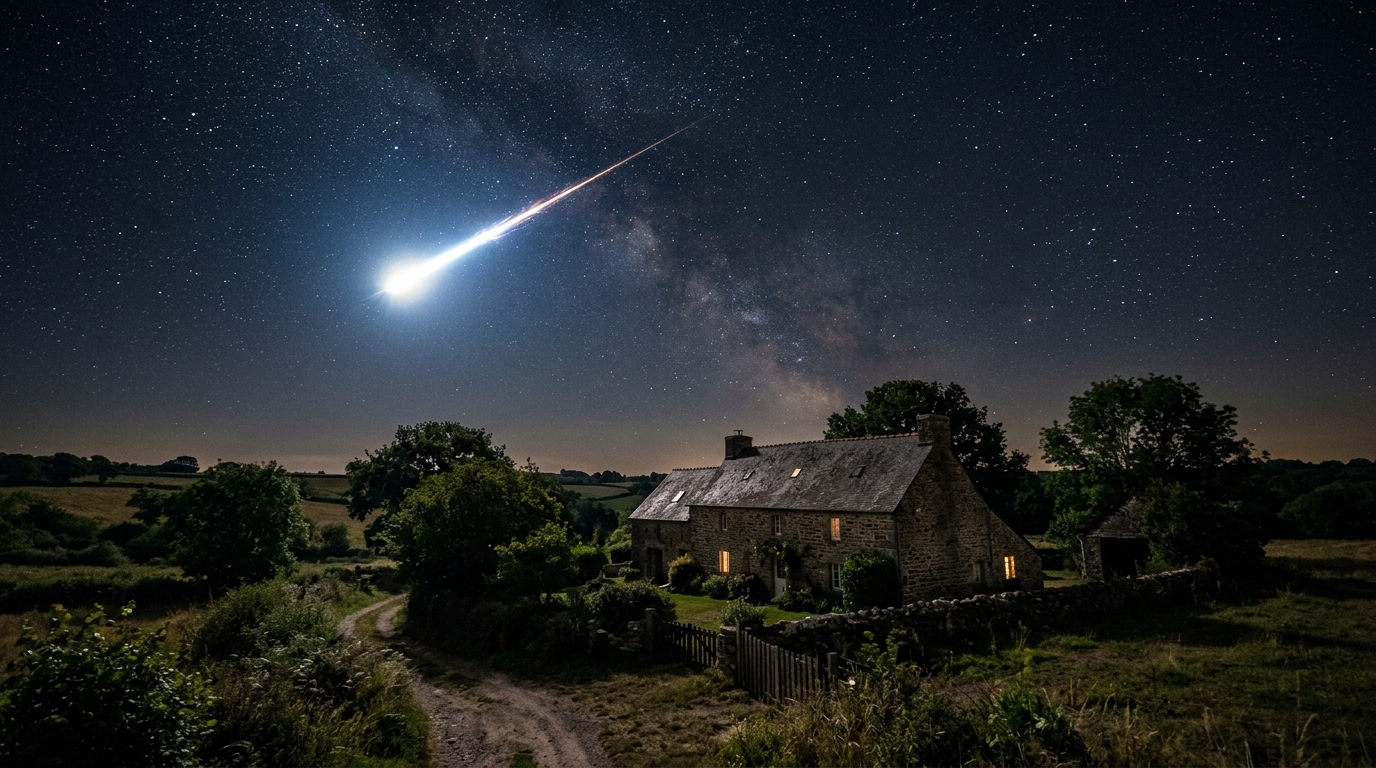
There are nights when the sky reminds us that it is never truly empty. In the night from Monday, June 22 to Tuesday, June 23, 2026, at precisely 23:11, a gigantic fireball ripped through the darkness above northwest France. Visible from Paris to Brest, via Rennes, this bolide left behind a luminous trail and a multitude of questions. Where did it come from? Where did it go? And above all, can we recover what remains of it somewhere on our good old cow pasture? The answer, fascinating, rests in a single word that scientists wield with precision: triangulation. Follow along; we’ll trace together back to the impact site.
The night the sky lit up over the northwest
The spectacle was as brief as it was unforgettable. In the middle of the night, while much of France was already asleep, an intense flash crossed the firmament over northwest France. The phenomenon was quickly confirmed by the Vigie-Ciel network, a scientific program run by the National Museum of Natural History. No fewer than 24 witnesses reported what they had seen to the program, while a video, shared on the social network X via the account Xplora, offered a striking visual testimony of the event.
This kind of display isn’t as rare as one might think. The previous notable event observed by the network dated June 14, with two meteors spotted. In other words, our sky is much more active than it appears. Simply, you must be lucky to look up at the right moment, and above all, have the right tools to understand what is happening up there.
Fireball, meteor, shooting star: sorting truth from fiction
Let’s start by putting a bit of order in the vocabulary, because the words used matter. This famous bolide is actually a meteor, that is to say the result of the entry into our atmosphere of a meteoroid: a fragment of a comet or an asteroid. When this celestial rock speeds through the air and rubs against it, it heats up and begins to shine intensely, producing this famous fireball. These phenomena are visible all year round.
And the popular expression “shooting star”? Vigie-Ciel is explicit: these luminous trails have absolutely nothing to do with stars. The term is poetic; it evokes dreams, but it misleads. We observe not the death of a distant star, but the brief and brilliant combustion of a small debris from our own solar system. A nuance that changes everything when trying to understand the phenomenon.
FRIPON and its cameras: the eyes that never blink
To track these fireballs, France has a remarkable setup. Vigie-Ciel relies on the FRIPON network, launched on May 31, 2016. In its early days, it counted 100 cameras spread across the country, inaugurating 360-degree sky surveillance, day and night. Today, there are about 250 automated cameras that watch, never blinking, ready to seize the slightest suspicious flash in the vault of the sky.
The secret of this network lies in a simple geometric principle: triangulation. As soon as the same bolide is filmed by at least three cameras from different angles, its trajectory can be reconstructed in three dimensions. The data are then automatically centralized and analyzed by a computer at the Université Paris-Saclay, which determines the trajectory, origin and probable fall zone. Better yet: FRIPON also uses the military radar GRAVES of the Air Force, initially designed to detect satellites, to refine the speed calculation using radio data. Human witnesses, too, are not left out: their observations help improve the precision of the calculations.
From trajectory to the fall point: the meteorite hunt
Once all these data are cross-checked, the result is stunning. The system can calculate the possible impact point of a fragment with an accuracy of a few hundred meters. For an object from space pulverized at tens of kilometers altitude, it’s a dizzying feat. Optical observations provide the apparent trajectory, radio data deliver the speed: the two complement each other like the two legs of the same compass.
When FRIPON succeeds in locating a fall zone, the baton is passed to Vigie-Ciel, which then organizes ground search campaigns. This system has proven its worth: on January 1, 2020, a meteorite that fell in Italy was detected by the cameras of the Italian PRISMA network, itself integrated into the global e-FRIPON network. For this mesh does not stop at our borders: it extends across Western Europe and into small sections of Canada, with 150 cameras and 25 radio receivers.
This northwest fireball is by no means an isolated case: a large-scale phenomenon, marked by a strong blue flash, had already lit up several regions on a Sunday evening in March, visible from Paris, Rouen and Brittany. Each passage of a fireball is an invitation to lift one’s eyes and, why not, to become oneself a link in this chain of observers. And if the next shooting star you cross hides, somewhere in a French field, a small piece of the universe to pick up?
