
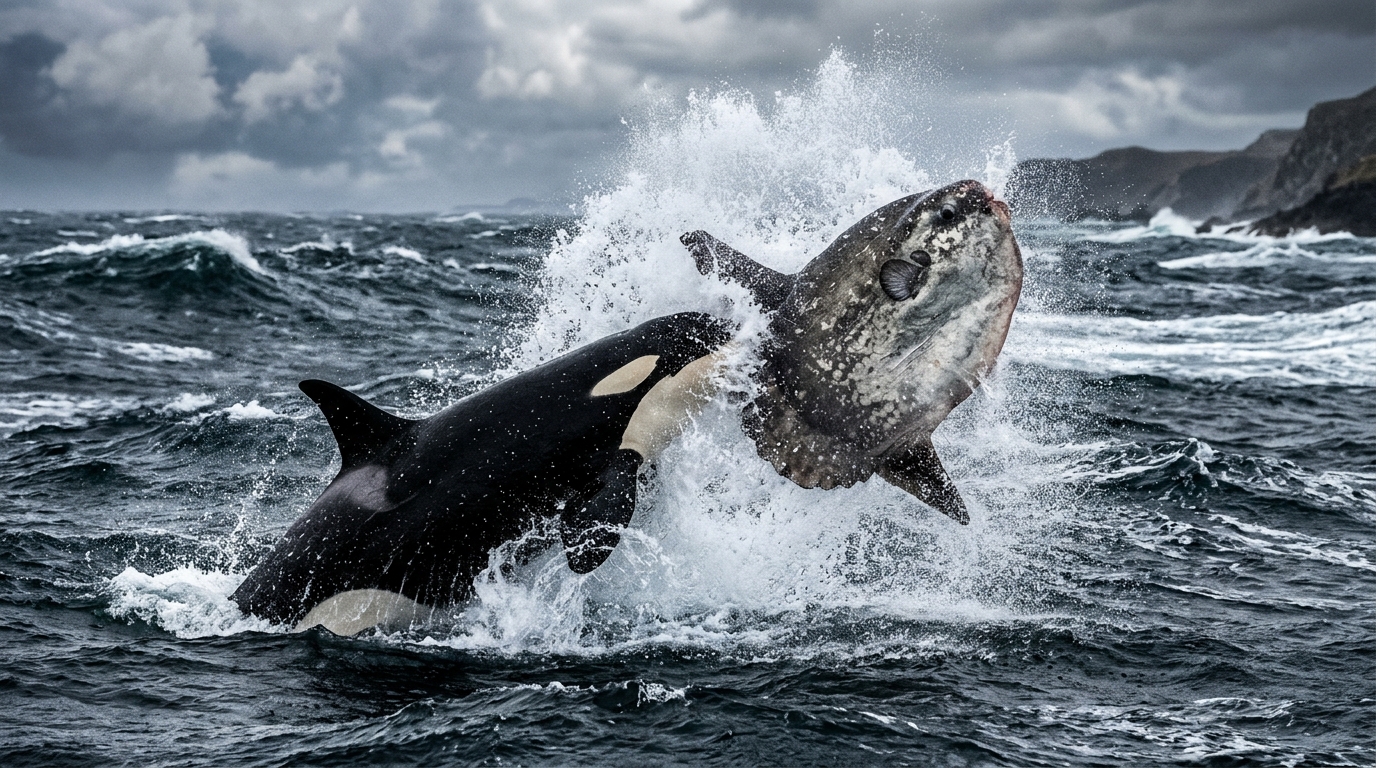
The sunfish is one of the strangest creatures in our oceans: a massive, almost truncated silhouette that gives the impression of a marine giant missing half its body. Some species reach dizzying sizes, surpassing two tons. One would easily picture such a behemoth kept safe from trouble. And yet, in the warm waters of the Gulf of California, scientists witnessed a scene of astonishing brutality: an orca hurling its skull against one of these giant carcasses at full speed, until it shattered into a cloud of flesh fragments. The scene was filmed twice. And the most surprising discovery isn’t the violence of the act, but its intent. For these predators were not aiming to kill. They were trying to découper leur repas en bouchées destinées aux plus jeunes.
The Ram That Pulverizes a Two-Ton Carcass
Imagine the scene: a sunfish with a pointed tail, a species that can weigh up to 2,000 kilograms, floats inert near a submarine mound off the southern coast of Baja California, Mexico. It is already dead, and even partially eviscerated. An adult orca dives forward and strikes it head-on, belly up, with enough force to send flesh scattering through the water. Observers present described a spectacle they had never seen before.
What stands out here is the contrast between the scale of the gesture and its quiet objective. This isn’t about a killing, nor about a confrontation. The fish is already a carcass. The strike has but one aim: to fragment it into smaller pieces. It’s as if the orca were using its head as a gigantic living knife, turning a bulky block of flesh into morsels easier to grasp.
A Two-Person Choreography: One Holds Still, the Other Strikes
The most fascinating aspect remains the coordination. This technique, dubbed « ram-to-fragment », literally “strike to fragment,” relies on genuine teamwork. A first orca grabs the sunfish by the tail, that distinctive part specialists call the clavus, and holds it firmly in place. The second then closes in at high speed and delivers the impact, scattering fragments in all directions.
At the first encounter, an adult female held the prey while a male ensured the impact. Some may think that impact behavior already exists in the orcas’ repertoire; what makes this observation remarkable is precisely this “hold then release” mechanism, the micrometer-precision collaboration between two individuals. The maneuver also evokes the coordinated attacks already spotted in the Gulf of California against whale sharks, where several orcas act in concert to subdue an extraordinary prey.
Portions Calibrated for the Littlest Stomachs
Why all this effort to cut up a meal that’s already served? The answer lies in one word: the young. After the strike, the smallest members of the group benefit from the fragments dispersed in the water. In the first scene, a young orca hurriedly swallowed the small floating pieces, while the adults dealt with the main carcass. In the second encounter, filmed by a diver, we again see a calf calmly taking tissues.
Everything unfolds as if the adults were preparing a kind of meal within reach for beginners. An entire sunfish remains far too bulky and tough for a young, still inexperienced animal. By breaking it into bites, the adults make the food accessible, much like a parent who trims the meat on a child’s plate. This reading, that of a food-handling approach that eases access to nourishment, sheds new light on a scene that, from a distance, looked like a pure outburst of force.
What These Strikes Reveal About a Culture That Is Passed Down
Beyond the spectacular anecdote, this behavior raises a fascinating question: the transmission of knowledge. Among orcas, it is known that hunting and feeding techniques are not mere instincts but practices shared and learned within the group. Watching a youngster directly enjoy the pieces prepared by the adults may be witnessing the first step of learning: tomorrow, that same individual might reproduce the gesture in turn.
These observations remind us that orcas are not only formidable predators, but also animals endowed with their own culture, made up of local traditions and know-how passed from generation to generation.
That head-thrust that blows apart a two-ton fish is therefore not a display of gratuitous violence, but a deliberate, cooperative, and, in a sense, educational gesture. One open question remains: how many other equally ingenious behaviors are still unfolding, far from our cameras, in the depths we only glimpse from the margins?
