
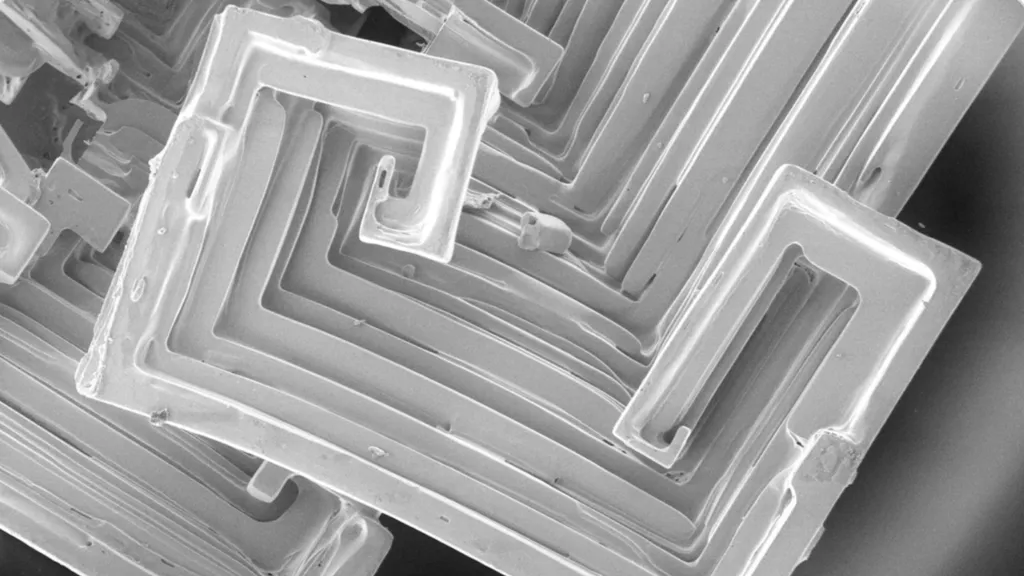
A crystal coiled upon itself, like a parchment unfurling in mid-deployment. On Earth, this object would have collapsed under its own weight in a matter of seconds. Aboard the ISS, it grew in layered, hollow tiers, almost too perfect to be real. This simple potassium chloride salt hides a fascinating secret about what governs matter when gravity fades away.
———————————————
What you will learn:
- Why this potassium chloride crystal adopts a shape that would be impossible to obtain on Earth.
- What truly governs matter when gravity is almost entirely absent.
- How these “perfect” crystals could transform the manufacturing of our technologies.
———————————————
An image that terrestrial chemistry simply deems impossible
NASA astronaut Don Pettit shared an image that is enough to leave one perplexed. It shows a potassium chloride crystal grown aboard the International Space Station. Its shape evokes a futuristic sculpture far more than a natural object pulled from a container.
The assembly takes the form of a pyramid bending in on itself, in layers arranged like a staircase. The whole thing seems almost too orderly, too regular to belong to the real world. And yet, according to scientists, this is precisely what happens when gravity stops ruling.
On Earth, such a crystal would have no chance. As it grows, it would sag, break, or settle to the bottom of the container. Gravity imposes its law and interrupts any vertical momentum. In orbit, this constraint nearly disappears, and matter then follows different rules.
Microgravity, or when other forces take charge
First misunderstanding to clear up: microgravity is not the total absence of gravity. On the ISS, astronauts experience gravitational pull about a million times weaker than at Earth’s surface. It’s not nothing, but it is subtle enough to change everything.
When this force becomes so faint, other forces come into play. Molecular attraction and polarity, usually crushed by weight on Earth, suddenly become dominant. It is these forces that then steer the behavior of liquids and crystals.
The result is spectacular. Where gravity constantly disrupted the formation of structures, microgravity provides a much calmer environment. For crystallization of inorganic molecules, that translates into growth with fewer disturbances, yielding larger and better-formed structures.
The secret of hopper growth: why edges win the race
Here lies the key to this strange shape. Potassium chloride naturally forms cubic crystals. But in microgravity, it does not grow uniformly. It is mainly the edges and corners that grow, leaving the center hollow and giving rise to these peculiar pyramid-like structures.
This phenomenon has a name: hopper growth. Edges and corners develop faster than the flat faces, producing that distinctive stepped appearance. As new corners emerge, the crystal can even entirely change its direction, explaining this rolled pattern worthy of a parchment scroll.
The most surprising part? This mechanism is not exotic. Ordinary table salt, the stuff in our salt shakers, forms exactly in the same way. The difference is that in orbit, free from the weight that would cause it to collapse, it finally reveals the full geometry hidden behind a simple grain of salt.
From kitchen salt to semiconductors: what this crystal teaches us
Behind this visual curiosity lies a very concrete stake. Materials grown without gravity often exhibit fewer defects. They thus offer a glimpse of what an “ideal” structure would look like, free from the imperfections gravity usually imposes.
This perfection directly interests industry. A better understanding of these mechanisms could enable refining manufacturing processes for semiconductors and other advanced materials produced on Earth. A perfect crystal is, at times, the promise of a more reliable component.
The pharmaceutical field is not left out either. On Earth, analyzing protein structures remains difficult because gravity hampers optimal growth. In microgravity, high-quality crystals are obtained, suitable for identifying drug targets. Crystallization experiments even traveled to the ISS aboard the SpaceX CRS-34 resupply mission, to understand how this phenomenon affects the crystals present in tablets and capsules.
So, this rolled crystal is not merely a pretty image shared from orbit. It perfectly illustrates a simple yet dizzying idea: by removing gravity from the equation, we reveal what matter would make if nothing constrained it. An open question remains: what if tomorrow’s ideal factory were, in fact, a few hundred kilometers above our heads?
