
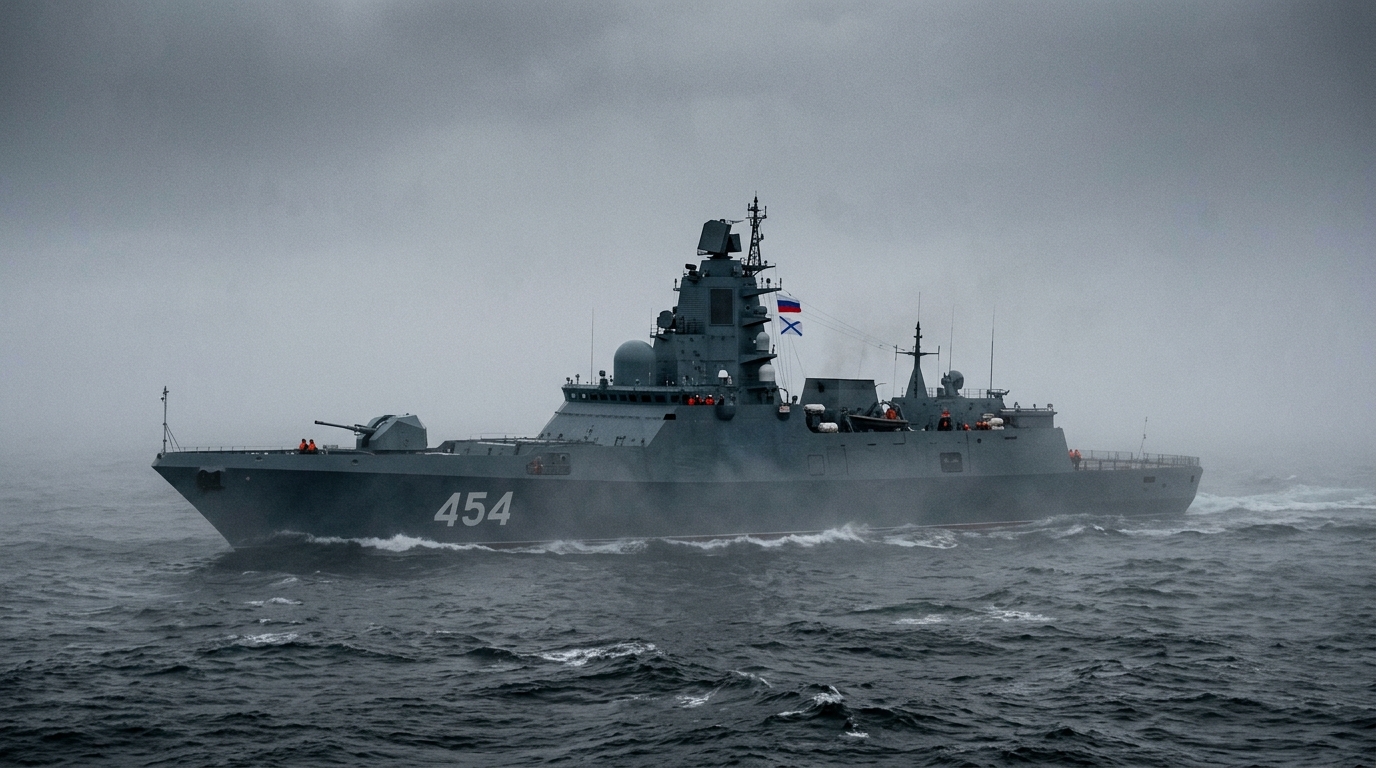
A glimmer of gunfire on the horizon, just 75 kilometers from the English coast. A Russian frigate opened fire for thirty minutes off Plymouth, after first warning the British patrol vessel HMS Tyne to steer clear. The Royal Navy watched, without intervening. A message sent just hours after the change of leadership at Downing Street.
What you will learn:
- Why the Royal Navy allowed a real Russian firing exercise to take place 75 km from its shores, deeming it not a violation
- How this firing fits into a string of Russian incidents in the Channel since June
- How the arrival of Andy Burnham immediately hardened the tone between London and the Kremlin
Thirty minutes of firing at 75 km off the English coast
The event is striking. According to the British Ministry of Defence, a warship from Moscow’s fleet carried out a live-fire exercise in the Channel, about 40 nautical miles south of Plymouth, roughly 75 kilometers from the southwest coast of England. The operation lasted around thirty minutes, a duration long enough to turn a routine exercise into a visibly forceful display.
The most striking detail lies in how events unfolded. The Russian vessel first warned the British patrol boat HMS Tyne, present in the area, of its intention to carry out these shots, asking it to reposition to a safer distance. A proper, almost ceremonial warning. The Royal Navy, for its part, chose to monitor the exercise without intervening, while continuing to closely track the ship’s activity and staying ready to safeguard the United Kingdom’s national security.
Why this apparent passivity? Because the area in question lies outside British territorial waters. The latter are limited to 12 nautical miles, about 22 kilometers. At 75 kilometers from the coast, the Russian vessel was therefore in international waters, where such maneuvers, however provocative, do not constitute a legal violation. Hence the choice of observation rather than confrontation.
The Neustrashimy Frigate, a 1988 ship still armed to strike
According to several British outlets, the vessel involved would be the frigate Neustrashimy. Commissioned in 1988, she is already aging but still built for combat. At 130 meters long and attached to the Baltic Fleet, she is equipped with anti-ship cruise missiles, a 100 mm gun, and an anti-submarine rocket launcher. In short, an older ship but far from harmless.
Its current role sheds light on the rest. Neustrashimy is notably tasked with escorting ships of the ghost fleet, this parallel armada meant to circumvent Western sanctions, especially in the oil sector. It becomes clearer, then, that its presence in the Channel is not by chance: it embodies a strategy of evasion and demonstration at once.
Warnings, ghost tanker: the Channel becomes a friction zone
This episode is not isolated. Since June, the Channel has become a genuine friction zone. In mid-June, British forces intercepted a tanker belonging to the ghost fleet. Two days later, a UK-registered sailing vessel reported having received warning shots fired by a Russian warship as it sailed south of the Isle of Wight, again outside British territorial waters.
Versions differ on this incident. The then-Prime Minister, Keir Starmer, had condemned an imprudent action, while the Russian Defense Ministry claimed instead that the sailing vessel was approaching dangerously close to the Russian frigate. Facing this escalation, the British government had, a few months earlier in the spring, announced that its armed forces would be authorized to board ships suspected of belonging to the parallel Russian fleet. A gradual hardening that, incident by incident, draws a maritime front off the coasts of Europe.
Burnham at Downing Street, the Kremlin already closing the door: what to take away
The timing of this firing exercise is not incidental. It coincided with the appointment of Andy Burnham to the post of Prime Minister of the United Kingdom, replacing Keir Starmer at the helm of the Labour Party. Such a sequence, separated by only a few hours, strongly resembles a signal sent to London at the moment a new face settled into 10 Downing Street.
The Kremlin’s response did not delay either. Moscow stated it had no hope for improving relations with London after Burnham’s ascent to power, denouncing the new prime minister’s unwavering support for Ukraine. The diplomatic door, if it had been left ajar, now seems to have closed again.
One fundamental question remains. As long as these maneuvers take place in international waters, they escape any designation of violation, leaving the Royal Navy in an observer’s posture. But how far can this logic of calculated gestures, skirting the rules, be pursued before an incident tips into irreparable? This may be where, quietly, the delicate balance of the Channel is being played out.
