
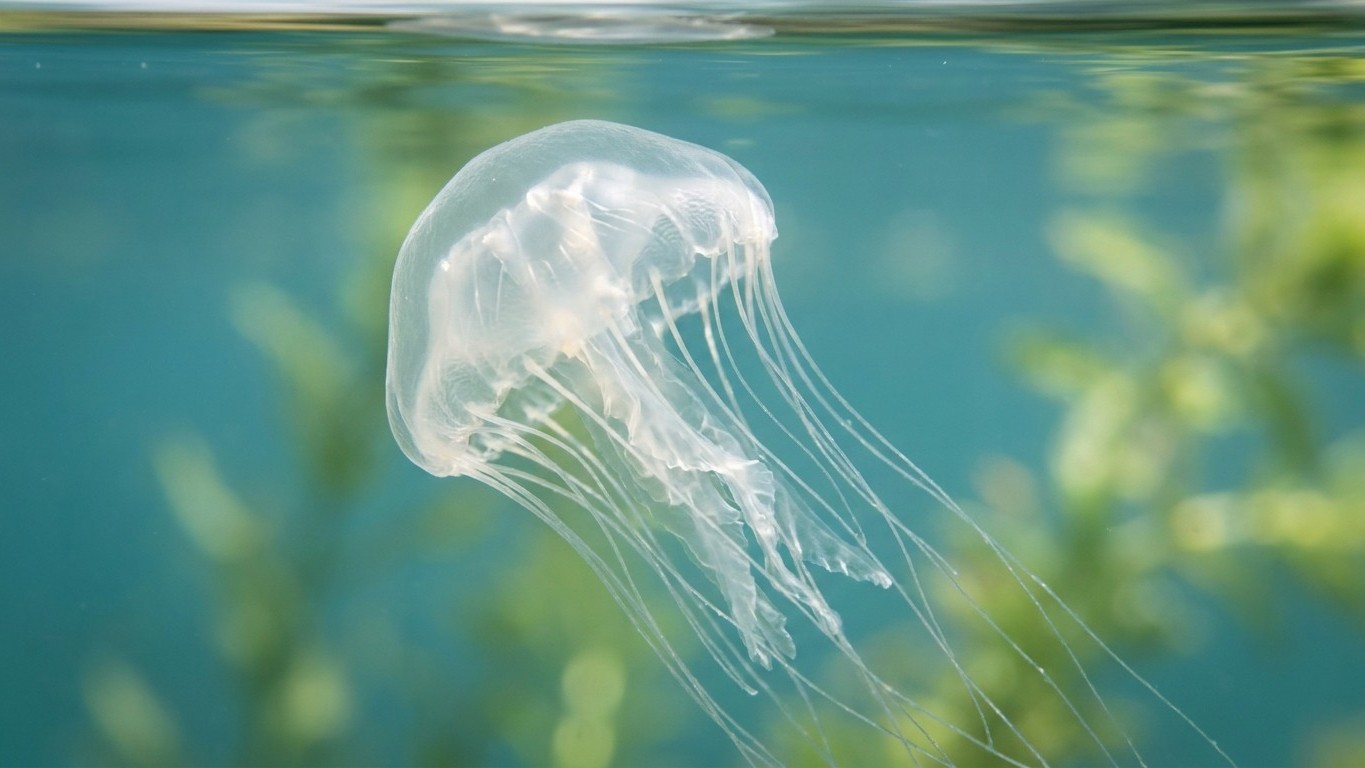
Dozens of swimmers at Lac d’Orient, in the Aube, were surprised this summer to come across small translucent creatures shaped like parachutes, drifting calmly between two layers of water. Nothing alarming: they are jellyfish, but not the ones people typically imagine. Freshwater jellyfish have appeared in the lake’s waters for several days, enough to surprise and raise concerns among bathers. The scene seems unlikely, as jellyfish are usually associated with the sea, with Breton or Mediterranean beaches. Yet these animals do exist in freshwater, and their presence in the lakes of the Forêt d’Orient is by no means an isolated occurrence.
À retenir
- Living jellyfish observed in a freshwater lake: an appearance that unsettles certainties
- Craspedacusta sowerbii, a discreet traveler that has colonized Europe since London in 1880
- They surface suddenly when the water reaches around 25°C, as if the lake were revealing a buried secret
A well-identified species, far from being a novelty
The episode that drew attention in Lusigny-sur-Barse illustrates the phenomenon well. Freshwater jellyfish were spotted on a July Monday in Lusigny-sur-Barse, in the Aube, by swimmers who stumbled upon a bank of jellyfish during a training session, with at least a hundred specimens according to one of the swimmers. That was enough to make anyone who had never heard of these freshwater critters break out in a cold sweat. But there is no need to panic: if you encounter them as well, don’t worry; these jellyfish, whose scientific name is Craspedacusta sowerbii, are completely harmless to humans.
Moreover, this is not the first time such a sighting has occurred in the region. A nature guide from the Aube has previously observed these specimens in the lake, notably in 2021 near Mesnil-Saint-Père, and explains that they can develop when the lake waters are warm. This translucent ballet is not an accident of nature but an almost seasonal rendezvous, conditioned by the weather. When summer is hot and the water temperature rises, the jellyfish reappear, like a floating biological thermometer at the surface of the Aube’s lakes.
Craspedacusta sowerbii, the only freshwater jellyfish in Europe
Its name sounds like a chemistry formula, but it carries the story of a transcontinental journey. Craspedacusta sowerbii is the only known freshwater jellyfish species in Europe and has a cosmopolitan distribution. A biological exception in a world where the vast majority of jellyfish live in the sea. The species was described for the first time far from any French lake: the jellyfish Craspedacusta sowerbii was first observed and described by William Sowerby in 1880 in the basins of the Royal Botanic Garden in London. It then moved to France, where it was first observed in 1891 by Mr. Chiffot in the basins of the Parc de la Tête d’Or in Lyon.
Since then, the species has continued to colonize the territory. Beginning in the early 20th century, the number of scientific publications reporting observations of C. sowerbii in France increased, and its geographic range expanded considerably. Lake Annecy, Lake Geneva (Lac Léman), gravel pits in Nouvelle-Aquitaine, ponds in Mayenne: the list of water bodies visited by this discreet traveler keeps growing year after year. It is found in all clear freshwater environments, from slow-moving rivers to lakes and ponds, but also in artificial reservoirs in gravel pits or quarries.
Its size remains modest, similar to a coin rather than an umbrella. The jellyfish shape is hemispherical with a maximum diameter of 25 mm, with a large number of tentacles along the edge of the bell and a whitish body that is translucent enough to allow the gonads to be seen. A near-ghostly appearance that explains why many bathers take several seconds to realize what they have just brushed against.
Why these jellyfish surge suddenly, and do they sting
The mystery of their sudden appearance is explained by a life cycle that is rather unexpected for an aquatic animal. The visible jellyfish is only the emerged part, so to speak, of a much more discreet cycle. The jellyfish originate from the budding of polyps that live attached to the lake bottom, and water temperatures around 25 °C are required for the medusa form to develop and appear periodically and abruptly, from July to October with a peak at the end of August and early September. These tiny polyps can wait for years without giving rise to a single visible jellyfish. Asexual reproduction can occur for several years without jellyfish appearing if the water temperature remains too low. One particularly hot summer, and suddenly hundreds of individuals emerge almost simultaneously, as if the lake had waited for the right signal to reveal its hidden population.
In terms of diet, nothing spectacular either. Craspedacusta sowerbii feeds on zooplankton, notably rotifers of the genus Asplanchna and daphnids of the genus Ceriodaphnia. It thus hunts microscopic prey, far from the predator profile sometimes attributed to marine jellyfish.
Where the question preoccupying bathers remains: does it sting or not? The answer is nuanced, and that is where the topic becomes truly interesting. Contrary to a stubborn common belief, these jellyfish do possess a stinging apparatus. Like all jellyfish, they have nematocysts located in their tentacles to harpoon their prey. In the vast majority of cases, this venom is too weak to penetrate human skin and causes no sensation. But there is an exception: researchers documented the first case of envenomation by Craspedacusta sowerbii in a freshwater lake in France, proof that prolonged contact or sensitive skin can, very rarely, trigger a mild skin reaction. This serves to temper the sometimes overly reassuring messages circulating on social media: harmless for the vast majority of bathers, yes, not entirely inert. If you encounter these small translucent umbrellas this summer in the Aube or elsewhere, observe them rather than touching them: it’s the best way to enjoy the spectacle without unpleasant surprises.
Sources: researchgate.net | sciencedirect.com
