
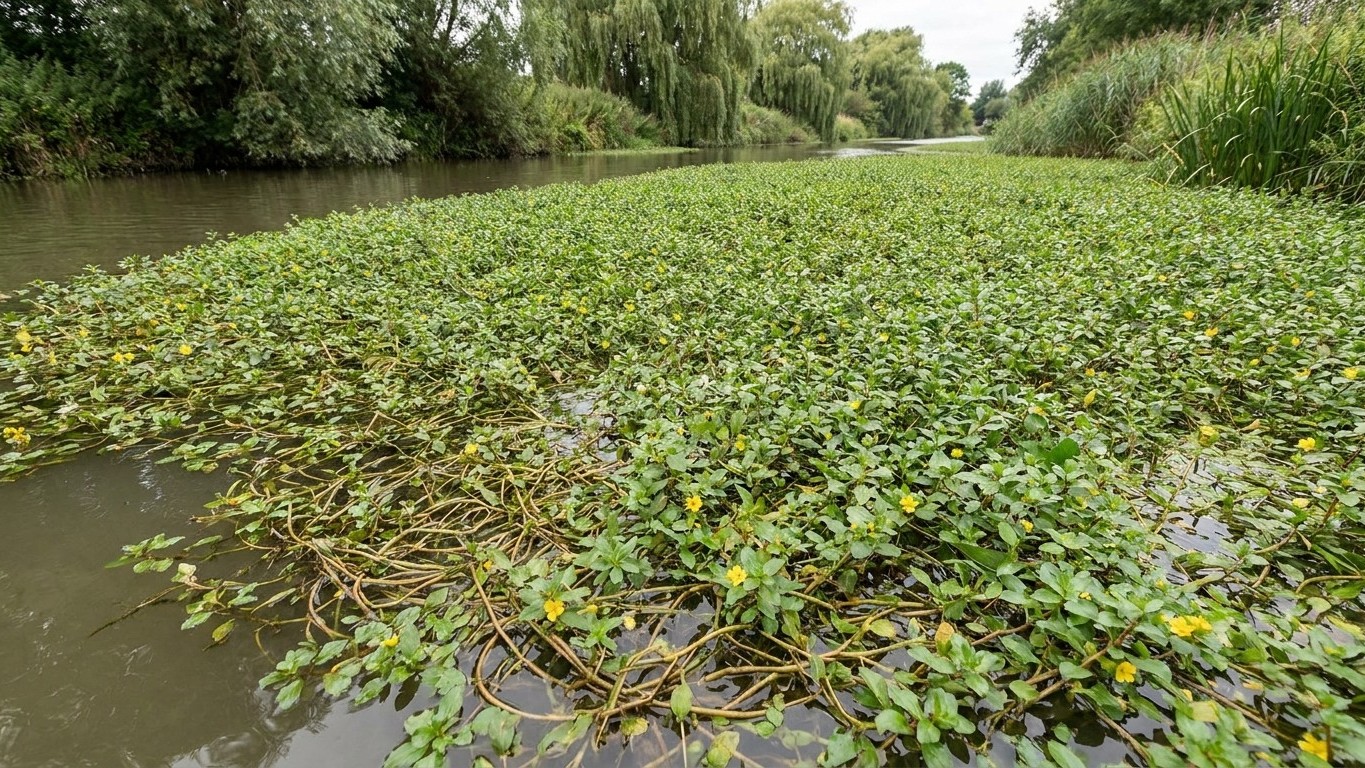
A single yellow flower floating on the surface of a canal. That is how it all began, around 1820, when gardeners conceived the idea of importing this South American plant to brighten ornamental basins and botanical gardens. Two centuries later, the creeping jussie covers hundreds of kilometers of French waterways, and no one has yet found a durable way to stop it. The creeping jussie is an invasive aquatic plant native to South America, introduced in France around 1820 to adorn ponds. An aesthetic choice that turned against its own inventors.
The exact story of its arrival varies by source, but all converge on the same region: the south of France. Native to South America, jussies are aquatic plants accidentally introduced in the south of France around 1830 and later used for decoration. Some works even place the founding moment with precision: it was introduced around 1820 on the banks of the Lez in Montpellier. From this Occitan starting point, the plant spread relentlessly toward the west and north of the country, becoming a familiar sight in Brittany’s canals, Charente marshlands, and the Loire’s boires.
Key takeaways
- An aesthetic decision of the 19th century that unleashed an uncontrollable biological invasion
- How a simple stem fragment can recreate a plant and turn a canal into a vegetal jungle
- Why two centuries of efforts have failed to halt this invader, and what experts have finally understood
A stem fragment, and everything starts over
What thrilled 19th‑century gardeners is precisely what makes the plant so stubborn to combat today. Its vitality is extraordinary: it can double its mass every two weeks under favorable conditions, forming dense, inextricable mats that squeeze out other plants. Some scientific records even mention growth of up to 2 cm per day. At that pace, a single rooted stem can turn a ditch into a green carpet within just a few weeks.
But the real problem, the one that makes human intervention so risky, lies in its mode of multiplication. Each stem fragment bearing a node can root and quickly develop a new individual. Coaxing jussie out by hand without care often multiplies it rather than eliminates it. A simple stem fragment is capable of rooting and forming a new plant, because jussie reproduces primarily vegetatively. It’s a bit like cutting a branch from a tree and watching an entire tree grow where it falls.
The plant doesn’t merely occupy space; it suffocates everything around it. Its dense mats deprive other aquatic plants of light, causing them to disappear and taking with them entire biodiversity. And when these vegetation masses decompose at the end of the season, they consume the dissolved oxygen in the water, weakening fish, amphibians, and invertebrates. A self-reinforcing cycle, season after season.
The Loire, theatre of a battle never won
The Loire basin alone illustrates the scale of the phenomenon. At Savennières in Anjou, volunteer work sites were organized for years to pull out the jussie invading the boires, the river’s characteristic dead arms. The verdict is clear: after a prefectural order in 2018 forbidding manual cleaning due to cyanobacteria, the situation only worsened. Since then, the jussie has again colonized the two boires of the Petit and Grand Canal, and the Pays de la Loire Natural Areas Conservatory has concluded that eradicating jussie is no longer a feasible objective, because whatever methods are used, the plant returns. A confession of powerlessness that speaks volumes about the invader’s resilience.
Further south, in Loire-Atlantique, the mobilization remains constant. In early July 2026, the Department again organized a removal operation at Petit Vioreau in Joué-sur-Erdre to limit its spread and protect wetlands. This is a typical scene: despite regular campaigns, the plant reappears. Every summer, teams of volunteers and officials plunge back into the canals with nets and barges, knowing full well that they will only postpone the deadline, not solve the root of the problem (to use a little pun).
Illegal to sell, but still there
Facing this continuous expansion, the government eventually acted, albeit late, some would say. Since May 2007, a decree from the Ministry of Agriculture and Fisheries forbids across metropolitan France the peddling, sale, purchase, and introduction of jussie into natural habitats. A regulation enacted nearly two centuries after the plant’s initial introduction, and of course it has no retroactive effect on populations already established in nature.
Today, river-management doctrine has shifted in tone. A Breton river syndicate summarizes the new approach well: the coordinated jussie management program does not aim for eradication — considered impossible at present — but for controlling the density of its stands across the entire basin. There is no longer talk of victory, but rather of long-term management, as one would manage a chronic disease rather than a curable infection.
A detail worth noting, as it complicates the picture: jussie is not alone in this role of ornamental invader that spirals out of control. Another horticultural plant introduced in the 19th century to a château upstream of the small canal’s shore fills the boires of Savennières as well: Amorpha fructicosa. The scenario repeats itself: a species imported for its charm, escaped from gardens, become unmanageable in the wild. The Loire may still pay the price of 19th‑century horticultural fashion.
Sources: ec.europa.eu | parc-naturel-perche.fr
