
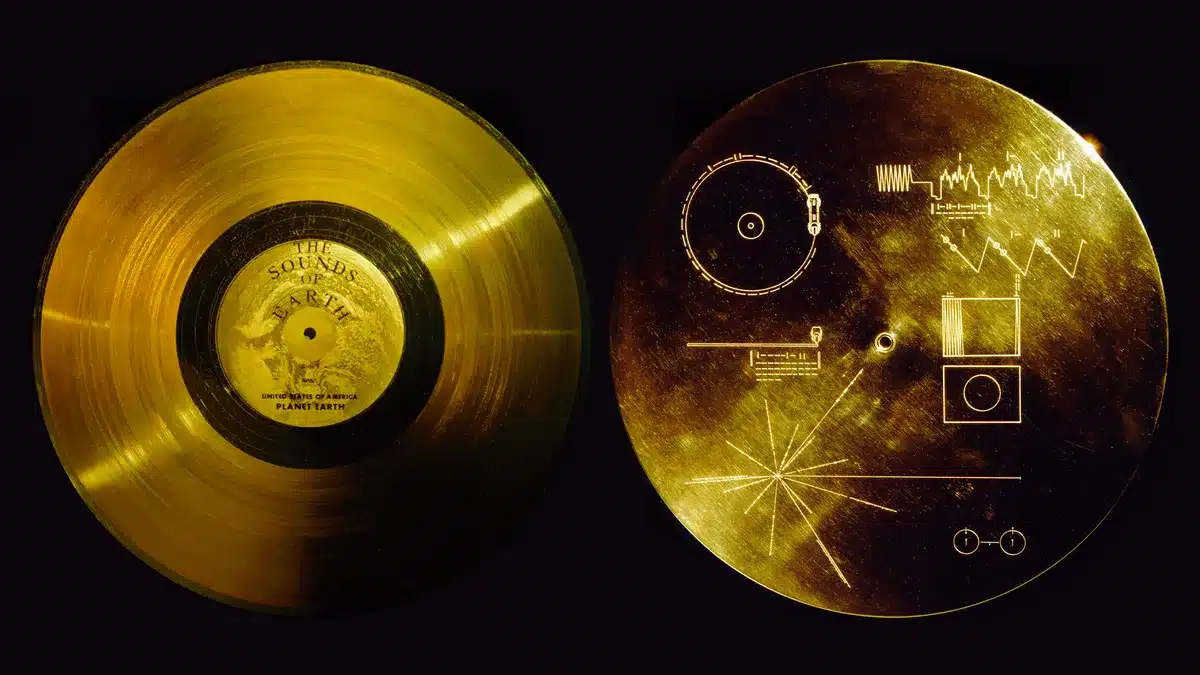
Since 1977, two space probes named Voyager 1 and Voyager 2 sail through the void of interstellar space, billions of kilometers away from Earth. Their main mission was to explore the giant planets of our solar system, yet they also carry a singular treasure: a golden record designed to convey a message from Earth to potential extraterrestrial civilizations. More than a mere time capsule, this record is a true sonic and visual portrait of our planet, an invitation to discover what it means to be human. But what exactly does it contain? What does it say about us? And above all, why send this message into the vastness of the cosmos?
Voyager: more than a journey, a declaration of humanity
When NASA launched Voyager 1 and 2, science was the heart of the project. Yet the designers were also aware that they were sending these probes into unknown territory, perhaps inhabited by other forms of intelligent life. For this reason, they included the Golden Record — a copper disk plated with gold, containing sounds, images, and messages from Earth.
This disk comes with a sleeve indicating the position of our Sun relative to pulsars, as well as the instructions needed to read this message. A genuine scientific challenge, but also a gesture of hope and curiosity. Even if the probability that this disk will ever be recovered is infinitesimal, it remains a unique testament to our era and to our desire to communicate beyond the stars.
A symphony of Earth: the sounds captured on the Golden Record
The richness of the record lies in the diversity of the sounds it contains. It is not merely noises, but a carefully chosen mix intended to represent life on Earth in all its complexity. It includes natural sounds, such as the chirping of crickets, frog croaks, the gallop of a horse, or the clatter of a cart. These simple noises convey a fundamental part of daily life and the natural environment.
But the disc also holds human sounds, witnesses to our social and emotional life: laughter, a kiss, a mother speaking to her child, as well as a very particular recording — the brainwaves of Ann Druyan, translated into sounds. Druyan, who helped conceive the disk and later married Carl Sagan, explains that these waves symbolize a moment of love and intense emotion.
Below are footsteps and heartbeats:
Below is a dog barking:
Below: birds, hyenas, or elephants:
A universal playlist: music that crosses cultures
The Golden Record isn’t limited to sounds and voices; it also carries about 90 minutes of music representing an exceptional range of styles and origins. Among the selected pieces are Australian Aboriginal chants, Mexican mariachi, the gospel blues of Blind Willie Johnson, and classical works, notably Bach’s Brandenburg Concertos.
A particularly famous inclusion is Chuck Berry’s “Johnny B. Goode,” a rock’n’roll piece that sparked debates among the selection committee. Some felt this style was too “juvenile,” but Carl Sagan defended the choice by recalling that youth is a universal living force. This musical diversity is a true postcard of our planet, illustrating humanity’s rich cultural fabric.
Greetings from around the world: breaking the language barrier
To complete this sonic and musical portrait, the record includes 55 greeting messages in various languages. This choice reflects the world’s linguistic diversity, with messages ranging from a simple “Hello everyone” in French to longer and more poetic salutations in Swedish, Mandarin, Arabic, or even African languages.
These messages aim to tell any listening intelligence: “We are here, this is who we are, and we extend a hand to you.” Among them, the English greeting is spoken by Nick Sagan, son of Carl Sagan, adding a personal and human touch to this outreach into the unknown.
Below are Morse code, or even ship noises:
Why send a golden record into space?
Sending the golden record reflects a distinctly human impulse: to leave a trace, to say “we exist” and to share our story, our culture, and our life with others, even if they are perhaps far away. It is a gesture that is scientific, cultural, and philosophical, charged with hope and poetry.
It also bears witness to our curiosity and our need for dialogue. Even if Voyager 1 and 2 will travel for hundreds of thousands of years before meeting another star, the golden record embodies a dream: that somewhere in the universe other beings might one day listen to these sounds and view these images, discovering what it means to be alive on Earth.
