
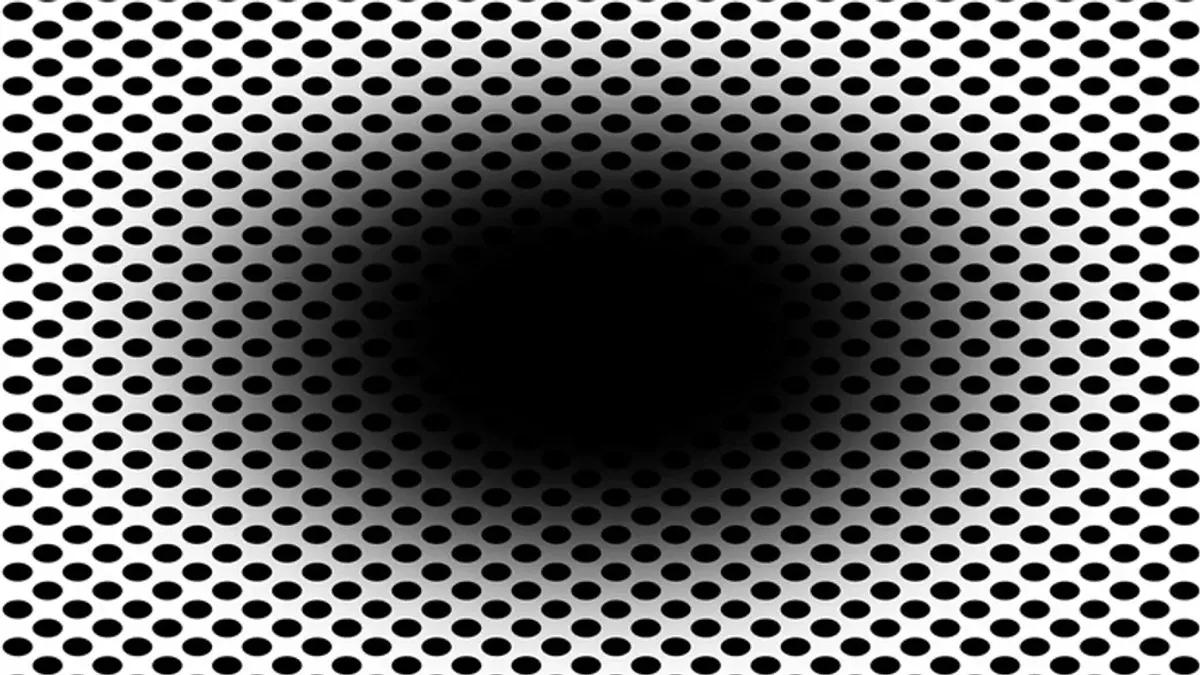
In the laboratories of the University of Oslo, an image that seems ordinary has sparked a sensation among neuroscience researchers. A simple white background speckled with black dots, with a blurred black hole at the center, has just unveiled one of the most puzzling mysteries of our visual perception. This optical illusion is not only capable of fooling our conscious brain; it can even trick our most automatic reflexes. Yet here’s the strangest part: one in five people remains completely insensitive to it, and scientists have been unable to explain why this immunity exists.
An illusion that defies biological logic
The illusion of the “expanding hole” represents more than a simple visual curiosity. When you fixate carefully on the central black spot, your brain spontaneously interprets what you see as forward movement, as if you were heading toward the entrance of a dark tunnel.
This illusory motion perception triggers a cascade of fascinating physiological responses. Your pupils automatically dilate to let in more light, anticipating the darkness to come. This pupillary reflex, normally triggered only by real changes in light, reveals just how deeply our visual system can be influenced by purely imaginary perceptions.
Dr. Bruno Laeng, who leads this groundbreaking research, explains that this involuntary reaction demonstrates the extraordinary power of this particular illusion. Unlike other optical illusions that affect only our conscious perception, this one manages to infiltrate the automatic mechanisms of our nervous system.
The enigma of non-receivers
The most intriguing aspect of this discovery lies in the variability of human responses. Of the 50 participants tested, about 14% reported no effect with the black hole, and this percentage rises to 20% when the hole is colored. These individuals observe the same image as others, but their brains stubbornly refuse to create the illusion of movement.
Even more troubling, these “non-receivers” show no pupillary reaction. Their eyes remain perfectly steady, as if they were looking at a ordinary static image. This total absence of a physiological response raises fundamental questions about the mechanisms of individual perception.
The Norwegian researchers also found a direct correlation between the strength of the perceived illusion and the magnitude of the pupillary response. The more participants report seeing the hole enlarge dramatically, the more their pupils dilate. This relationship suggests that the physiological response faithfully mirrors the subjective perceptual experience.
When imagination governs biology
This research upends our traditional understanding of visual reflexes. Until now, scientists regarded pupillary dilation as a purely automatic mechanism, functioning like “a photosensitive cell opening a door,” in the words of Laeng.
The results instead show that our pupils react not only to real light, but also to the light we perceive or even imagine. This discovery challenges the supposed boundary between objective perception and subjective interpretation of our environment.
The inverse experiment confirms this hypothesis: when researchers present a colored hole instead of the black hole, participants’ pupils constrict, as if their eyes are adapting to a brighter light source. This opposite reaction proves that the brain actively treats illusory visual information as if it were a real environmental change.
Implications beyond mere curiosity
These findings, published in the journal Frontiers in Human Neuroscience, open fascinating avenues for understanding perceptual disorders and the processing of visual information. They suggest that our visual system works more like a creative interpreter than a simple passive receiver.
The observed individual variability could also illuminate certain aspects of neurological differences among people. Understanding why some individuals resist this particular illusion could reveal fundamental mechanisms of visual processing and open new therapeutic avenues.
This research reminds us that despite our advanced knowledge of the human brain, perception remains one of the last mysteries of modern neuroscience.
