
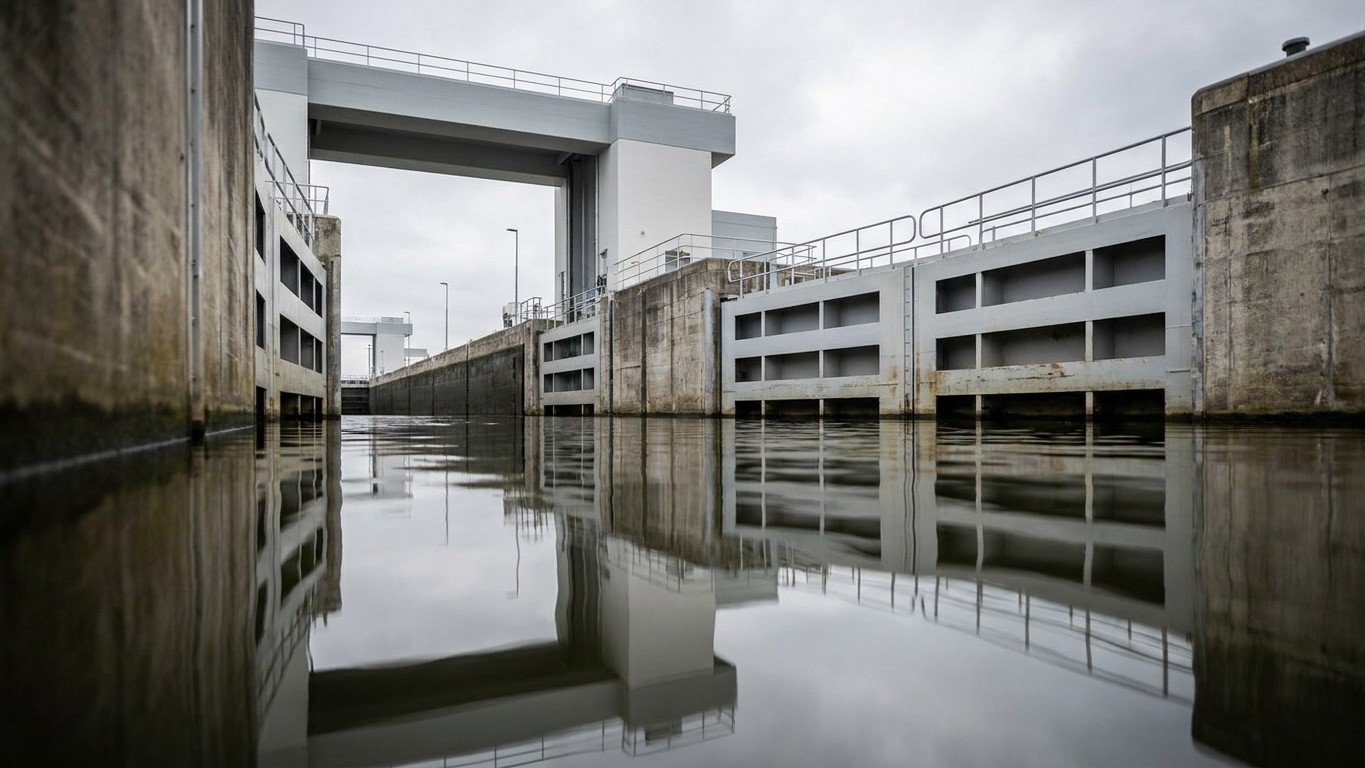
A brand-new, state-of-the-art lock capable of swallowing convoys of 4,500 tons, which has been useless for nearly thirty years: that is the paradox of the Rhine–Rhône Canal in its Alsatian stretch. Between Niffer, on the Rhine, and Mulhouse, France did indeed construct a section with a European large gauge. But this segment leads nowhere, trapped between an international river and a network still operating at the Freycinet gauge of the 19th century. Since the project was abandoned in 1997, barges able to use this route simply have no itinerary to go any further.
Key takeaways
- A world-class lock built for nothing: it has functioned perfectly since 1995, yet no one can use it
- 15 billion francs spent on a geopolitical dream: creating a river highway rivalling the Rhine–Main–Danube on the German side
- The 1997 halt: how the Jospin government abruptly buried a colossal project in mid-construction
A canal designed to link the North Sea to the Mediterranean
The dream dates back to the 1950s, but it was not until 1978 that the project obtained its declaration of public utility. The ambition was colossal: to create a continuous inland-waterway highway between the Rhine basin and the Rhône corridor, capable of rivaling the Rhine–Main–Danube canal inaugurated on the German side. Once in operation, the large-gauge waterway would have allowed self-propelled ships of 2,000 tonnes and pushed convoys of 4,400 tonnes to reach in four days from Niffer, on the Grand Canal d’Alsace, to Port-Saint-Louis at the mouth of the Rhône delta. The project ownership was entrusted to a dedicated structure, SORELIF, created in parity between EDF and the Compagnie nationale du Rhône. Article 36 of the law of February 4, 1995 provides that the financing of the works would be principally ensured by EDF, through the use of energy produced by the Rhône hydroelectric installations, a setup that avoids laying a direct burden on the State budget.
The planned route traversed the Doubs valley for dozens of kilometers, with consequences difficult to ignore. The connection would have had a major environmental and quality-of-life impact as it would run through the Doubs valley, pass through the Mulhouse, Montbéliard, Besançon, and Dole metropolitan areas, and come within proximity of 33 listed or registered sites, 36 historic monuments and 196 archaeological sites. Concretely, it would have required dredging dozens of kilometers of meanders, constructing nearly thirty locks, and rebuilding dozens of road and rail bridges. A titanic project, on the scale of an entire region.
15 billion francs later, the abrupt halt of 1997
The government of Lionel Jospin brought the project to an end in the middle of 1997, under the impulse of Dominique Voynet, then Minister of Regional Planning and the Environment. The decision was formalized without ambiguity. It was juridically confirmed by Decree of October 30, 1997 repealing the declaration of public utility relating to the works for the Saône–Rhine linking plan. The financial argument weighed heavily: between 1995 and 1996, a re-evaluation of the total cost had pushed the bill from 17 billion to nearly 49 billion francs, including interest and VAT.
The Senate, in its 1998 report devoted to major transport infrastructures, gave a merciless assessment of this fiasco. The total cost of the works carried out over the 283 kilometers of navigable routes amounted to around 15 billion francs, equivalent to about 2.3 billion euros today, just for the works already completed. The senators did not mince words about the consequences of this halt. During the December 1997 budget debates, a rapporteur publicly questioned the coherence of the decision, recalling that France risked remaining out of a European network linking Rotterdam to the Black Sea. The report also highlighted an embarrassing paradox: at the same time, the European Commission anticipated further development of inland water transport across the continent.
Niffer-Mulhouse, the brand-new lock that leads nowhere
The Niffer–Mulhouse stretch had, however, been completed just before the halt. The first phase of the Niffer–Mulhouse section was carried out from 1991 to 1995, with the Niffer lock and its connecting reach, the recalibration of the canal to a depth of 5.70 meters, and the widening at Hombourg. This lock, commissioned in 1995, meets the European Vb class standards: 190 meters long, 12 meters wide, capable of accommodating pushed convoys of 4,500 tonnes. A jewel of inland waterway engineering, but an orphaned jewel. In the absence of follow-up toward Montbéliard and then Dijon, this large-gauge section ends at a dead end facing the historic Freycinet network, unable to accommodate the same gauge of boats.
This situation sums up, on its own, the chronic malaise of the French river network. The country builds up modernized segments that connect to nothing, lacking a long-term vision maintained over time. It is as if one were to construct a six-lane highway spur that opens onto a dirt road.
What remains today of the grand project?
The Duron report of 2013 definitively buried the possibility of a short-term revival, postponing any prospects of resuming the large gauge beyond 2050. Since then, attention has shifted to the existing network rather than its extension. Work is indeed underway on the Alsatian network, notably between Artzenheim and Friesenheim, but these concern the automation of Freycinet-gauge locks and the enhancement of tourism, not the resumption of large gauge. The Rhine–Rhône canal now largely lives on pleasure boating and inland tourism, with very limited freight traffic on its southern branch.
One remains with almost a philosophical question: what should be done with infrastructures designed for a use that will never exist? The Niffer lock continues to operate, maintained, functional, ready to welcome convoys that will never come from Dijon or Lyon along this route. A uniquely French symbol of a grand territorial development project halted abruptly, of which a perfectly functional fragment remains entirely isolated, like a terminus station on a line that was never laid.
Sources: geoconfluences.ens-lyon.fr | senat.fr
