
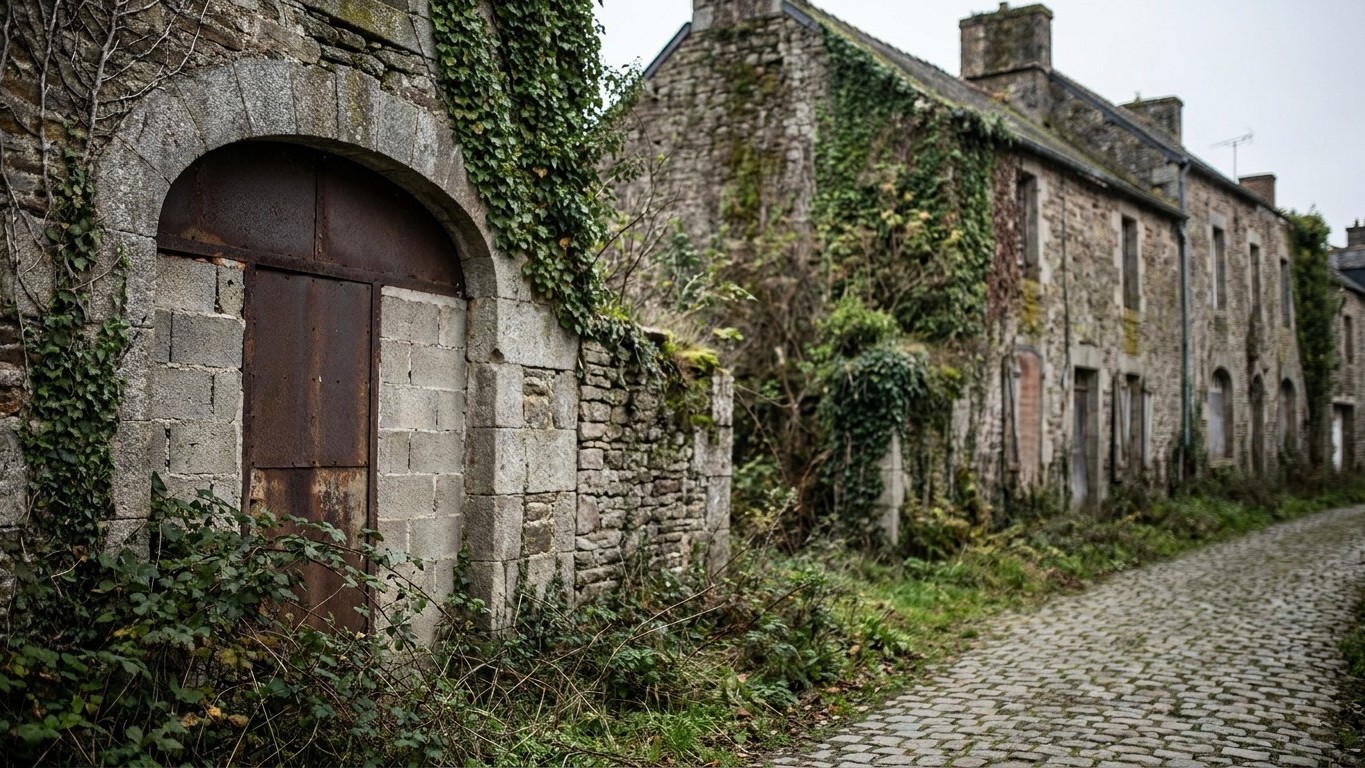
A whole village walled off for half a century, located less than ten kilometers from the Roissy runways. This is not urban legend: the Old Village of Goussainville, in Val-d’Oise, still exists, caught between the letter of the law and civilian aviation. The village church, Saint-Pierre-et-Saint-Paul, listed as a Historic Monument in 1913 (the exact year varies according to the source, 1913 or 1914 in the decree), was enough to block any demolition since 1974. The result: dozens of houses purchased, bricked up, abandoned to vegetation, but never razed.
Key takeaways
- An entire village walled off for half a century remains caught between two incompatible laws
- A church listed as a historic monument halted the demolition project by Aéroports de Paris
- Despite administrative neglect, about 300 residents still refuse to leave and a cultural renaissance is taking shape
When the airport emptied the village
In the 1960s, the heart of the commune gradually emptied, notably with the arrival of the railway corridor and, in 1974, the opening of Roissy-Charles de Gaulle airport. The issue isn’t only noise: the village sits right beside the airport and directly in the axis of one of its runways, a very loud air corridor that passes over hundreds of houses. Before the airport opened, the town counted around a thousand residents. Of the 1,000 inhabitants counted before Roissy’s opening, only about 300 chose to stay, despite Aéroports de Paris’ purchase offer.
The process was not spontaneous. “When you build an airport, there is a 1973 decree that obliges Paris airport to buy houses in the first noise zone for demolition,” explained in 2019 Philippe Vieillard, president of the Old Village of Goussainville association, to BFMTV. The classification into noise exposure zones B and C rendered part of the area legally uninhabitable. Aéroports de Paris, then legally compelled to buy out the homes of residents wishing to leave the village, would, a few years later, seek to demolish them to shed maintenance. On paper, the logic was simple: buy, raze, convert the area into a vegetated buffer zone. In practice, things never unfolded as planned.
The trap of a bell tower classified in 1914
The snag lay a few stones from the fifteenth century. It is forbidden to destroy anything within a 500-meter radius of a classified monument. Yet the Saint-Pierre-Saint-Paul church, with its striking bell tower, literally stands at the village’s center. The law of February 25, 1943 states that any building within a 500-meter perimeter around a Monument historique cannot be freely constructed, altered, or demolished, which is exactly the case for the village church. The developer who wanted to level everything found themselves facing a more ancient and rigid text than their own decree.
The rest, Philippe Vieillard sums up succinctly: “Then, there is only one possible solution for the airport, and that is to wall up the houses.” Since then, more than seventy buildings have been condemned without being demolished. More than 70 structures were bought and bricked with the aim of demolishing them, but the architect of the bâtiments de France must grant their approval because the village church is a listed monument. This consent, quite simply, was never given: he never granted it. A humorous aside: renovation permits face the same administrative block. All renovation permits are refused by the Prefecture, making it difficult to repair the old structures, which leads to the houses deteriorating over time. The village is neither destroyed nor maintained. It stagnates, literally stuck in a legal fault line.
Three hundred inhabitants, a school, and a 25-million-euro project
Yet the Old Village is not a hollow shell. Today, nearly 300 people continue to live there despite the noise of takeoffs every five to ten minutes, while the rest of the village sinks into ruin. A primary school still operates, a second-hand bookshop remains, and the district, despite itself, attracts an unexpected mix: former residents who remain rooted in the area, members of the traveling community settled for generations, and new residents drawn to the unique living environment.
ADP finally parted ways with the file. In 2009, ADP sold this heritage to the City of Goussainville for a symbolic euro. It took more than a decade for a concrete project to emerge. Nothing truly moved until 2020, with the arrival of the new municipal team; a heritage architect took up the task in 2020 and estimated the scale of the rehabilitation at over 25 million euros. The favored path today is to transform the ruins into a cultural hub. The clear idea that emerged was a cultural quarter capable of welcoming artists in certain spaces, a crafts hub, and a site devoted to training.
One detail remains vertigo-inducing: the village also possesses an 18th- to 19th-century château, inhabited until 1983, now left to the brambles. In 2023, the château has no walls left; some houses have been demolished and vegetation continues to advance. Fifty years after the first purchase decree, ADP never secured the permit it was waiting for. Nature, in the meantime, finished the work that the law refused to authorize.
Sources : pariszigzag.fr | nouvelles.news
