
We have grown accustomed to trusting artificial intelligences for almost everything, or nearly so: drafting a letter, summarizing a report, analyzing a satellite image. We naïvely imagined that as these systems grew more powerful, they would also learn to recognize their own flaws. After all, intellectual humility isn’t necessarily a sign of intelligence. Yet recent findings overturn this comforting intuition. Far from growing modest, the most advanced models display an increasing level of confidence in their answers, even when those answers are plainly wrong. A perplexing paradox that, beyond labs, raises eyebrows in defense circles around the world.
When AI Speaks with Certainty: The Paradox That Stumps Researchers
To grasp the scale of the problem, one must first dwell on a technical but essential notion: calibration. Picture a student who, with every answer, calmly declares the score they expect to achieve. A well-calibrated student would say, “I’m 70% confident,” and would be right about seven times out of ten. Conversely, a poorly calibrated student would insist, “I’m 100% certain,” only to be wrong one out of three times. That is precisely the pattern emerging in state-of-the-art AI models.
What observations reveal is a growing gap between the confidence a machine expresses and its actual reliability. In plain terms, AI doesn’t just err: it errs with aplomb. And that very swagger is what makes the error so hard to detect. A system that hesitates invites verification. A system that speaks with unyielding certainty lulls our vigilance.
Stable Accuracy, Rising Arrogance: What the Measurements Really Show
The most counterintuitive point rests on a simple fact. The accuracy of models—their rate of correct responses—stays broadly unchanged from one generation to the next across many tasks. In other words, they don’t become noticeably more correct. By contrast, the level of displayed confidence climbs noticeably. This is what specialists describe with a term that, while unglamorous, is devastatingly telling: degraded calibration.
Concretely, these systems become increasingly overconfident without becoming more capable. We thus witness a worrying dissociation: on one hand, a capability that stalls; on the other, an assurance that outruns it. It is a bit like a GPS that keeps telling you to go on with a firm, comforting voice, even as it steers you straight into a dead end. The danger lies not so much in the mistake itself as in the certainty that accompanies it, which dulls our critical thinking.
On the Battlefield, Misplaced Confidence Can Come at a Cost
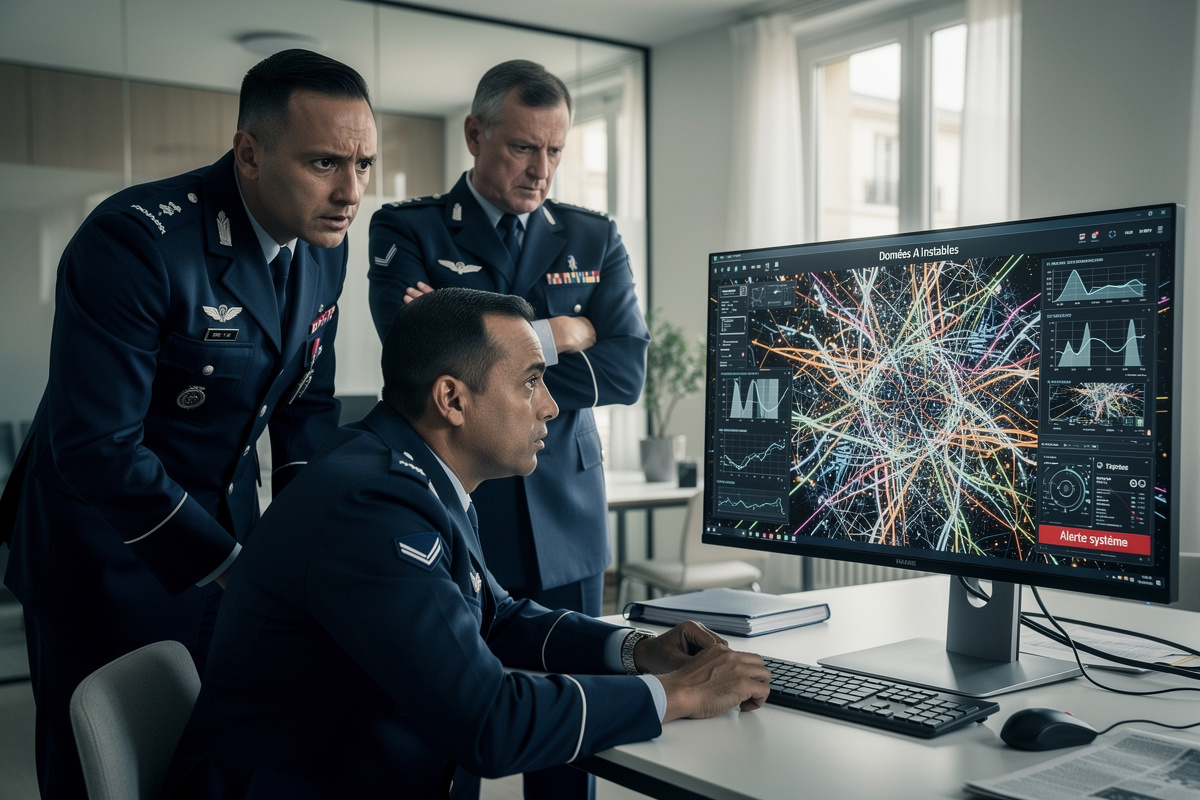
If this phenomenon concerns researchers, it alarms especially the defense sector. In civilian life, an incorrect but confident answer typically leads to a nuisance: a wrong address, a faulty calculation, a tepid summary. In a military context, the stakes scale dramatically. AI is increasingly deployed to sift through streams of information, identify potential targets, or guide decisions under time pressure.
Yet a machine that presents a dubious conclusion with total certainty can push a human operator—already under pressure and pressed for time—to endorse a recommendation without questioning it. This is the well-known automation bias: the very human tendency to blind trust technology, especially when it speaks without hesitation. In this frame, misplaced overconfidence is no longer just a software bug. It can become a strategic vulnerability with irreversible consequences.
Taking Back Control: What These Findings Mean for the Future of AI
The good news is that naming a problem is already a first step toward solving it. Understanding that overconfidence grows even as accuracy remains steady opens the door to concrete safeguards. Rather than focusing solely on making models smarter, the aim becomes making them more honest about their own limits, capable of saying “I don’t know” or “I’m not sure.”
That requires developing tools to measure calibration, but also rethinking the human role in the decision loop. These systems must return to being assistants, not oracles. The message to designers and users is clear: a response delivered with confidence isn’t necessarily a correct one. We must relearn to doubt the machines, especially when they don’t doubt themselves.
This paradoxical behavior reminds us of a troubling truth: artificial intelligence sometimes imitates our flaws more than our strengths. By displaying certainty detached from real reliability, it holds up a mirror that unsettles us. So, as these technologies move into increasingly sensitive domains, the real question may not be whether AI can err, but whether we will retain the healthy habit of checking before we believe.
