
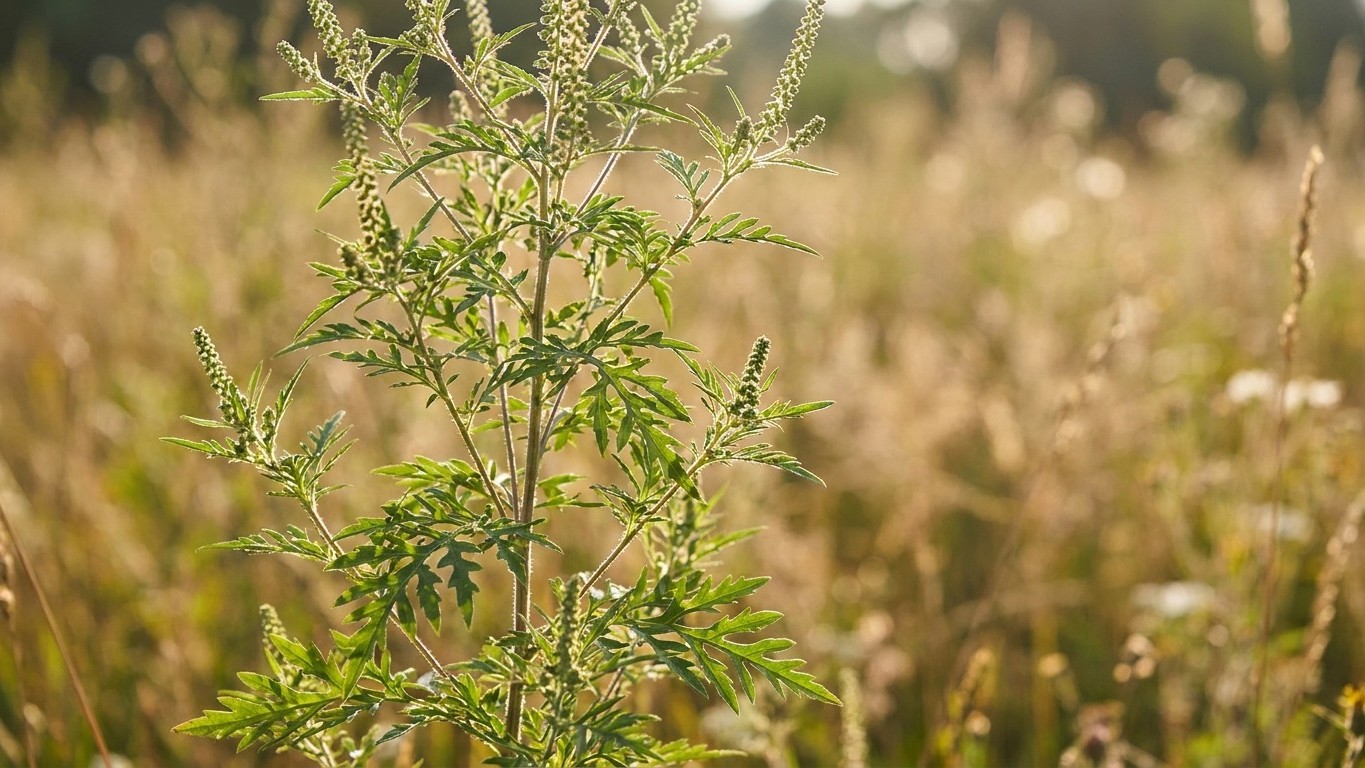
A green stalk, cut leaves, an ordinary-looking weed or roadside scrub. At first glance, ragweed has nothing to distinguish it from an ordinary weed. Yet this North American native plant generates every year between 59 and 186 million euros in health-care spending in France, according to an ANSES expert report published in 2020. Its pollen, one of the most allergenic there is, reaches its peak between mid-August and mid-September, turning the end of summer into a respiratory ordeal for several millions of people.
Key takeaways
- A seemingly ordinary plant conceals the most allergenic pollen there is, with as few as five grains per cubic meter of air sufficient to trigger symptoms
- Its quiet arrival after World War II transformed entire regions into areas of high allergy prevalence, notably in Auvergne-Rhône-Alpes
- Real costs far exceed medical care alone when health, lost productivity and diminished quality of life are taken into account
An invasive species arrived by accident, now a public health issue
The story begins during World War II. Ragweed, Ambrosia artemisiifolia, was introduced to France through the transit of goods and people, before eventually colonizing the Rhône Valley in the 1950s. Since then, its advance has never stopped. The most heavily infested areas are today in the Rhône, Isère, Drôme, Nièvre and Cher, while departments like Charente, Côte-d’Or or Gard act as “front zones,” along the borders of already colonized territories. Brittany, for its part, remains relatively spared for now.
The dispersion mechanism is almost diabolically simple. Each ragweed plant produces several thousand viable seeds over ten to thirty years, and its pollen, very light, travels easily over long distances, sometimes more than 100 kilometers. Public works sites, poorly cleaned agricultural machinery, and the simple transport of contaminated soil are enough to spread the species to new territories. This also explains some surprising patterns: in Corrèze, the plant’s presence essentially follows the route of the A89 highway, proof that humans remain the main vector of its spread.
A pollen classified at the highest level of allergenicity
On a scale from 1 to 5 used to measure the allergenic potential of pollen, ragweed scores the maximum. Only a few grains per cubic meter of air—sometimes as few as five—are enough to trigger symptoms in someone who is sensitized. Sneezing fits, a blocked nose, conjunctivitis, swollen eyelids, and sometimes hives or eczema: the clinical picture resembles that of other pollens, but its intensity and duration make it particularly disabling. A national survey of health professionals conducted for ANSES in 2020 confirmed that ragweed allergy appears more disabling than other pollen allergies.
The peak of pollination occurs precisely from mid-August to mid-September, a window that coincides with the return to work and school for millions of French people just back from vacation. The first grains typically appear at the end of July in readings from the National Aerobiological Surveillance Network, before concentrations rise sharply in early August. According to ANSES, between 1.1 and 3.5 million people would be allergic to this pollen in metropolitan France and Corsica, up to 6% of the population according to some estimates. In Auvergne-Rhône-Alpes, a historically hard-hit region, this rate rises to 10–15% of the population, reaching as high as 21% in the most exposed areas.
What is striking is the allergy’s potential to evolve. About half of people allergic to ragweed pollen develop asthma if their allergy is not properly managed. Sunflower, botanically close to ragweed, further complicates control: it is impossible to eradicate one chemically without risking harm to the other, which helps explain why this invasive species resists control attempts in areas of large-scale cultivation.
A bill that far exceeds medical care alone
The figure of 186 million euros is only the tip of the iceberg. ANSES adds between 10 and 30 million euros in productivity losses due to work stoppages, and above all between 346 and 438 million euros in terms of the loss of quality of life for allergic individuals, including fatigue, breathing difficulties, and reduced academic or professional performance. In total, the annual bill for this “weed” far surpasses half a billion euros when all components are added. And the health agency is clear on the trend: these costs will continue to rise, due to the planned expansion of infested areas and the increase in ambient pollen levels, especially under climate change.
At the European level, the phenomenon is of similar magnitude. In Hungary, where the plant has massively taken root, more than one in five people would be allergic to its pollen. Some projections even envisage a fourfold increase in ragweed pollen across Europe by 2050, a scenario that alarms health authorities as well as farmers facing competition from this invasive species on crops such as sunflowers, corn, or soybeans.
What can we do about this plant?
The fight against ragweed has been part of the public health code since 2017, with prefectural decrees mandating the systematic destruction of plants before flowering. Practically, everyone can act: uproot a single plant in one’s garden before it flowers, or report its presence on the national platform signalement-ambroisie.fr, which triggers local interventions to destroy detected foci. ANSES also recommends involving the building and public works sectors more, notably through the systematic cleaning of construction equipment, to curb a spread that remains largely linked to human activity.
An even more unexpected lead has emerged recently: the ragweed leaf beetle, a North American beetle first spotted near Lyon in 2023, which specifically defoliates this plant and reduces its pollen and seed production. Accidentally introduced in Italy in 2013, this insect could become an unlikely ally in a battle France has waged for more than seventy years without ever truly winning.
Sources: lejdd.fr | anses.fr
